Toulouse Pink City: Why La Ville Rose Glows
Toulouse earned the nickname La Ville Rose from the pink brick that colors its facades, courtyards and monuments. This guide covers where to see the color at its best, how the light changes it, and what to build a visit around.
Short answer
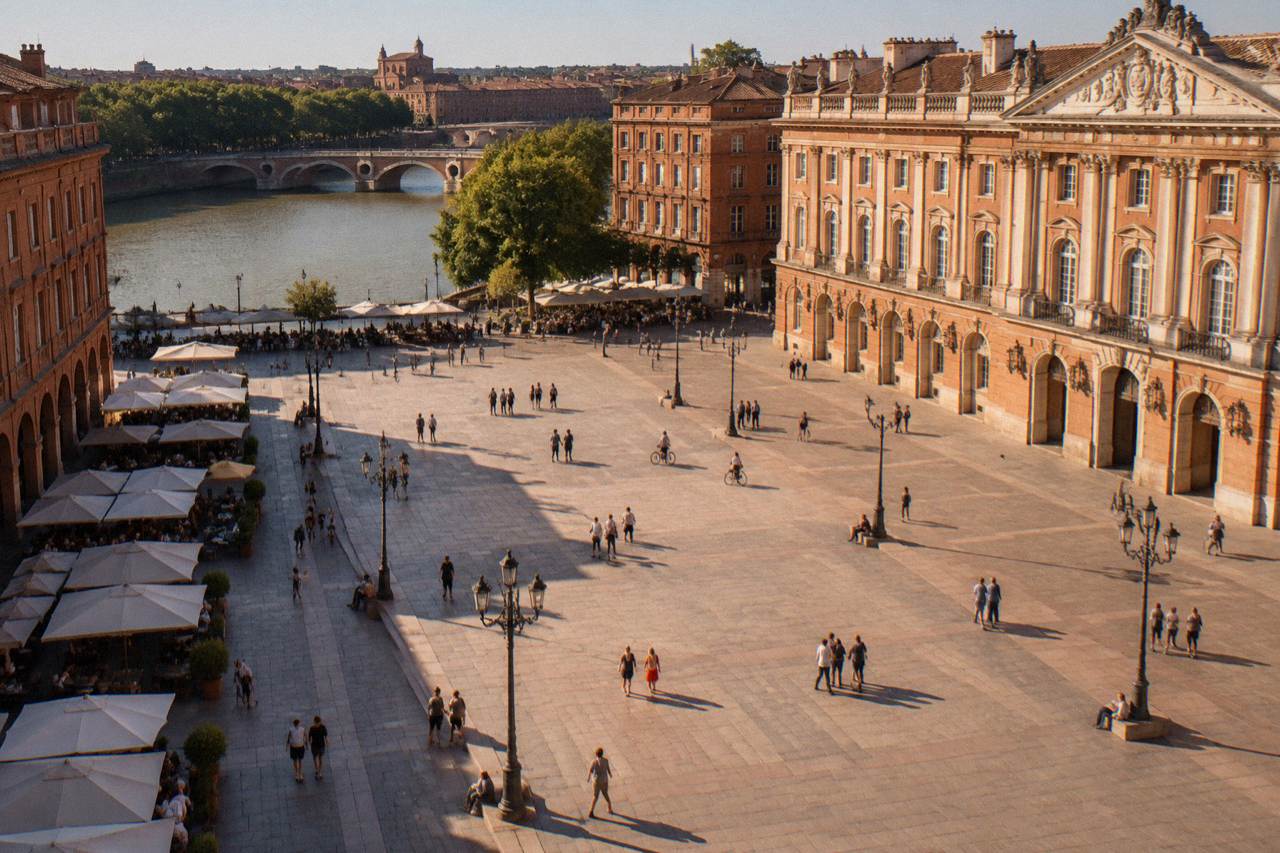
Toulouse is called La Ville Rose, the pink city, because its historic buildings are made of a pale pink brick that glows at sunrise and sunset. The color shows best in the streets around the Capitole and the Couvent des Jacobins, along the Garonne, and in the early morning or late afternoon light.
Toulouse, in the Occitanie region of southwestern France, carries one of the most evocative city nicknames in Europe: La Ville Rose, the pink city. The name comes from the pale pink brick that built the historic center, a material that shifts in tone with the light, blushing deep at sunset and turning almost white at noon. The Garonne river runs through it, the Canal du Midi begins here, and the color of the streets is the single detail visitors remember longest. This guide explains where the pink shows at its best, how the seasons change it, and how to build a visit around it, with the practical numbers that matter for planning.
Why Is Toulouse Called The Pink City?
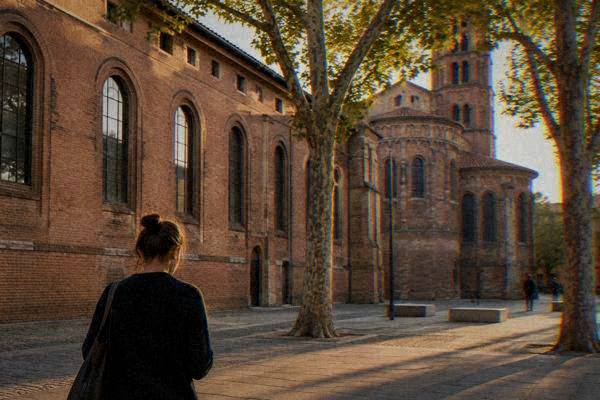
Toulouse is called La Ville Rose because its historic buildings, from townhouses to churches and the Capitole itself, are built of a pale pink terracotta brick that gives the streets their color. The nickname is the city's well-known character rather than a modern marketing label, and the brick still dominates the center. The color changes with the light, deepening to red-orange in the evening and softening at midday.
The nickname is simply what the city is called, in guidebooks, on the tourist office's own pages, and in everyday French speech. What matters for a visitor is that the brick is not a detail here, it is the default building material of the old center. Walk any street between the Capitole and the Garonne and the facades, the walls, the window frames and often the rooftops carry the same warm tone.
The color rewards timing. In flat midday light the brick reads pale and dusty. In the low sun of early morning or late afternoon, the same walls glow, and the whole center earns the name. Photographers plan around this, and so should anyone who wants the city to look the way it does in the postcards.
To catch the brick glowing in the right light, book a hotel in Toulouse here.
The pink brick also gives the city a visual coherence that few French cities share. Because one material dominates, the center reads as a single composition, and the landmarks that break the pattern, the white stone of Saint-Etienne cathedral, the dark river frontage of the Garonne, stand out sharply against it. If you want the full picture of what the city is known for beyond the brick, the what is Toulouse famous for guide covers the rest.
Where To See The Pink Brick At Its Best In Toulouse?
The pink brick shows at its best around the Place du Capitole and its surrounding streets, at the Couvent des Jacobins, along the Garonne quays near the Pont Neuf, and in the side streets of the Carmes and Saint-Etienne quarters. Each spot shows a different face of the same material, from grand public buildings to small courtyard walls. The Capitole and the Jacobins are the two headline sights.
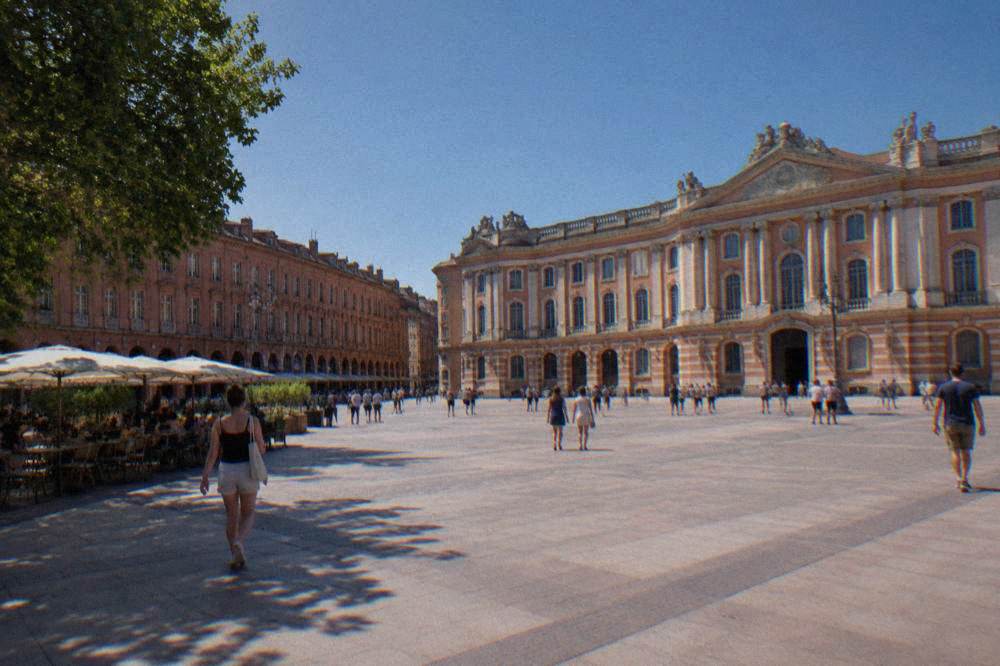
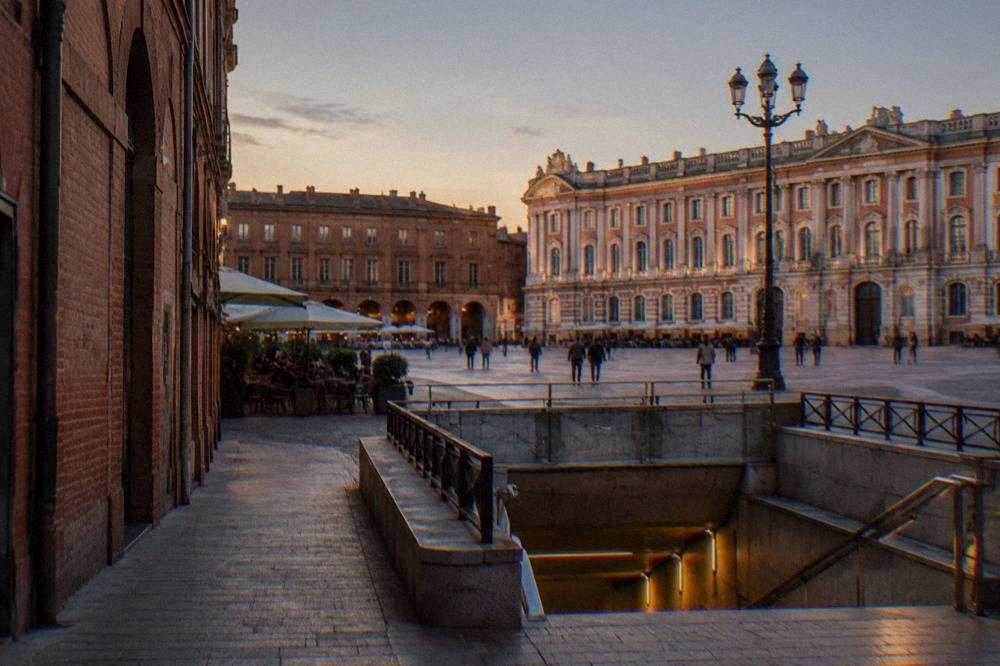
The Capitole is the city's municipal heart, and its long pink facade lines one whole side of the Place du Capitole. The square opens wide here, so the brick gets full sun for much of the day, and the arcades throw bands of shade across it that shift visibly as the afternoon passes. It is the single place where the nickname makes immediate sense.
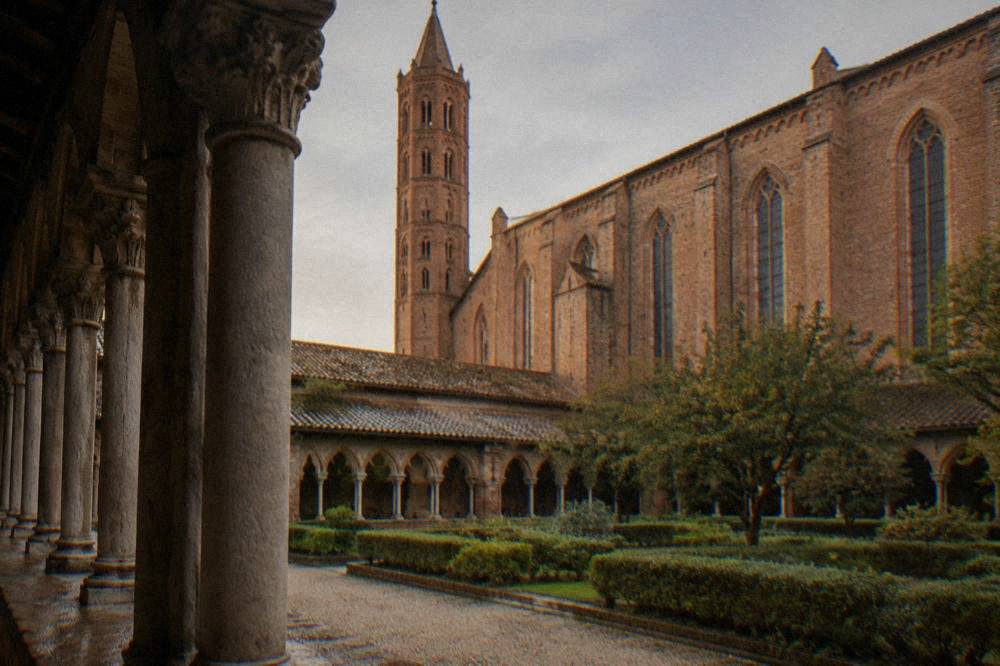
The Couvent des Jacobins, a short walk south, shows the brick used at its most severe and beautiful, in a Gothic convent church whose walls and columns are all the same warm tone. The city's page notes the church's roof is under restoration, with the site staying open to visitors. The convent is free on the first Sunday of the month except when a temporary exhibition is on, a rule stated for the Jacobins specifically, not for every museum in the city. The Couvent des Jacobins guide has the detail.
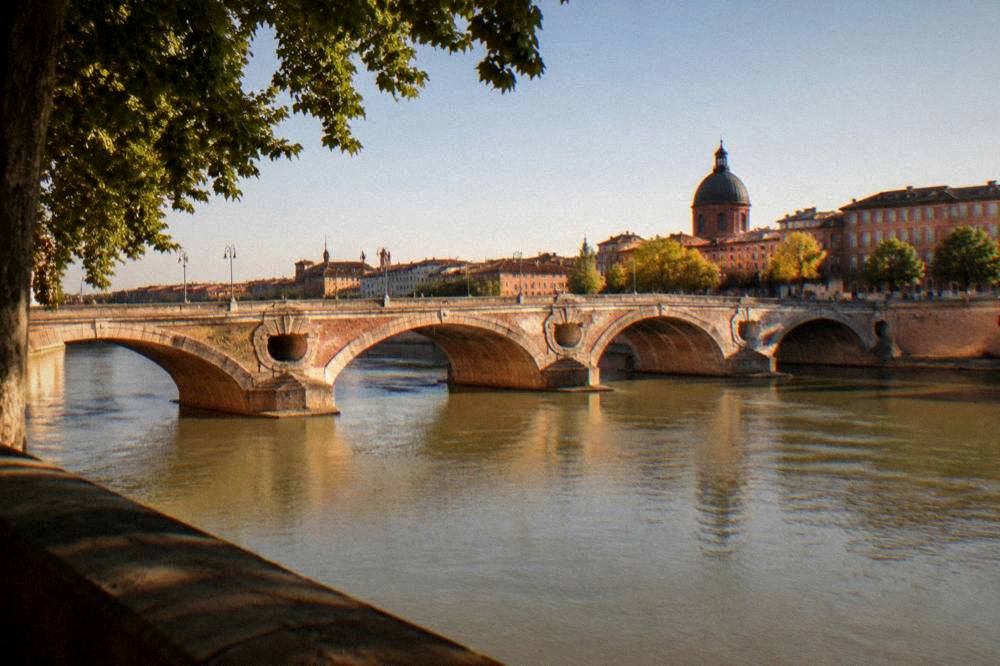
Along the Garonne, the quays and the Pont Neuf frame the brick against water. The river frontage is where the color reads warmest at sunset, because the low western light hits the facades directly. The Garonne riverside and Pont Neuf guides cover the walks.
The table below pulls together the main places to see the color, and what each one shows.
| Place | What the pink brick shows there | Best light |
|---|---|---|
| Place du Capitole | Grand public facade and arcades | Afternoon to sunset |
| Couvent des Jacobins | Gothic church walls and cloister | Morning |
| Garonne quays and Pont Neuf | River frontage reflected in water | Sunset |
| Carmes quarter | Narrow streets of townhouses | Midday |
| Saint-Etienne quarter | Streets around the stone cathedral | Morning |
| Basilique Saint-Sernin | Brick and stone Romanesque church | Late afternoon |
The Basilique Saint-Sernin deserves its own mention. The basilica is listed as part of the UNESCO "Routes of Santiago de Compostela in France" property, inscribed in 1998, and it is a major stop on the Via Tolosana. Its brick-and-stone mass sits just outside the densest pink streets, and the Basilica of Saint-Sernin guide covers it fully.
To hear the stories behind these streets while walking them, the Discover Toulouse: Self-Guided Audio Tour of the Pink City is built exactly around this route. It is priced in euros, and Check availability before you go.
How Does The Light Change The Pink City Through The Day?
The pink brick changes color dramatically with the light: pale and dusty under a flat midday sky, warm rose in the morning, and deep red-orange in the hour before sunset. Early morning is the quietest time to photograph it, and the last two hours of daylight are when the city most earns the nickname. Planning a day around the light is the difference between a good visit and a great one.
A practical day shape looks like this. Start early at the Jacobins or in the Carmes streets, when the light is low from the east and the streets are quiet. Give the middle of the day to interiors, the Capitole's painted rooms, the museums, the covered Marche Victor Hugo. Come back outside from late afternoon and walk west toward the Garonne, so the setting sun is behind you and the facades ahead are lit head-on.
The quays near the Pont Neuf are the classic evening spot, because the western light hits the frontage directly and the river doubles the color in reflection. The Toulouse at night guide picks up where the sunset ends.
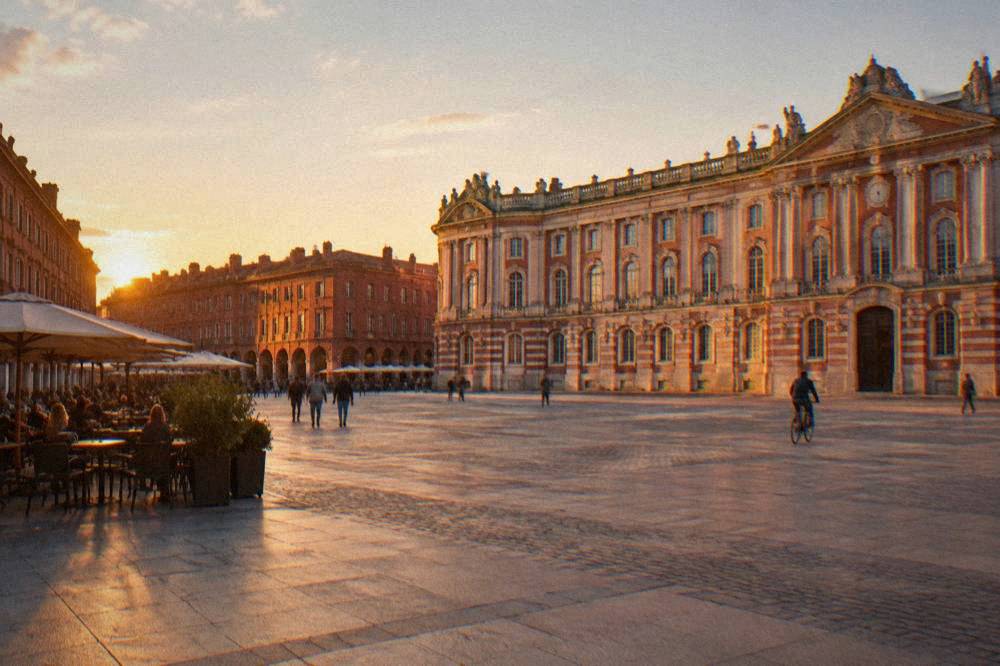
For photographers, the Toulouse photography spots guide maps the viewpoints in detail. The essential rule is simple: the brick rewards the hours when visitors are at dinner.
What Does The Best Time Of Year To Visit Mean For The Pink City?
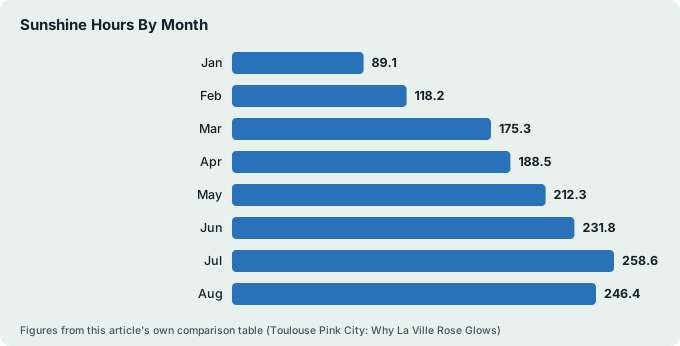
The best months to see the pink city are May, June and September, when warm light, long evenings and manageable crowds coincide. Meteo-France's 1991-2020 normals for Toulouse-Blagnac give the city 2,075.1 hours of sunshine a year, with July the sunniest month at 258.6 hours. The surprise in the data is that May, not a winter month, is the wettest, at 73.6 mm of rain.
The climate table below is drawn from those Meteo-France normals for the Toulouse-Blagnac station. It is the honest basis for choosing a month, and it corrects a common assumption: visitors expect a wet Atlantic-style winter, and instead the data shows spring carrying the most rain.
| Month | Mean C | Rain mm | Sunshine hours |
|---|---|---|---|
| Jan | 6.3 | 52.5 | 89.1 |
| Feb | 7.1 | 37.2 | 118.2 |
| Mar | 10.3 | 45.3 | 175.3 |
| Apr | 12.7 | 65.2 | 188.5 |
| May | 16.4 | 73.6 | 212.3 |
| Jun | 20.3 | 64.2 | 231.8 |
| Jul | 22.6 | 40.1 | 258.6 |
| Aug | 22.8 | 44.6 | 246.4 |
| Sep | 19.3 | 45.7 | 210.1 |
| Oct | 15.3 | 54.3 | 155.2 |
| Nov | 9.9 | 55.0 | 99.9 |
| Dec | 7.0 | 49.3 | 89.7 |
July and August are the warmest months, at 22.6 C and 22.8 C mean, and July carries 11.5 days a year above 30 C, so summer visitors should plan indoor hours for the early afternoon. The records for the station, covering 1947 to June 2025, run from 42.4 C on 23 August 2023 down to -19.2 C on 15 February 1956, a range that explains both the summer siesta rhythm and the rarity of hard frost.
For the full seasonal picture, including what the rain days mean for planning, see Toulouse weather and best time to visit Toulouse. If your dates fall in late spring, the events calendar matters too, and the Toulouse events guide collects what is dated and confirmed.
How Much Does It Cost To Visit The Pink City's Sights?
A single museum visit in Toulouse runs from EUR 5 to EUR 12 at the normal rates the tourist office lists, and the Pass Tourisme at EUR 26 for stays of one to three days pays off from the third activity onward. It includes a free guided tour from the tourist office, and adding EUR 10 buys ten public-transport trips. Cite de l'espace's normal adult rate is EUR 29, discounted rather than free with the pass.
The tourist office's Pass Tourisme page lists the normal rates below, each of which becomes free with the pass. The pass details are covered fully in the Toulouse Pass Tourisme guide.
| Sight | Normal adult rate | With the Pass Tourisme |
|---|---|---|
| Fondation Bemberg | EUR 12 | Free |
| Museum de Toulouse | EUR 12 | Free |
| Les Abattoirs | EUR 12 | Free |
| Musee des Augustins | EUR 5 | Free |
| Couvent des Jacobins | EUR 5 | Free |
| Cite de l'espace | EUR 29 | Discounted |
Two status notes matter for planning. The Musee des Augustins is temporarily closed from 21 September to 2 October 2026 for great-cloister works, and its Gothic halls, the sacristy, the Notre-Dame de Pitie hall and the chapter house, reopen on 3 October 2026 from 10:00. The Musee Saint-Raymond closed on 3 November 2025 for renovation and modernisation works and reopened on 3 April 2026. More of these guides are collected on Toulouse Travel Guide.
Getting between these sights is cheap. The Tisseo catalogue lists the fares below, and the getting around Toulouse guide explains the network.
| Tisseo ticket | Price |
|---|---|
| Single trip | EUR 1.90 |
| Single trip bought on board | EUR 2.50 |
| 10 trips | EUR 16.00 |
| Day pass | EUR 7.20 |
| 3-day pass | EUR 14.30 |
| Airport single | EUR 9.50 |
One note on the airport: tram T2 to Toulouse-Blagnac has been closed since 5 June 2023 and stays closed until the end of 2026 because of the metro Line C works, so the Navette bus is the public link, running one departure every 15 minutes. The Toulouse airport to city center guide has the detail.
Where Does The Pink City Keep Its Quietest Corners?
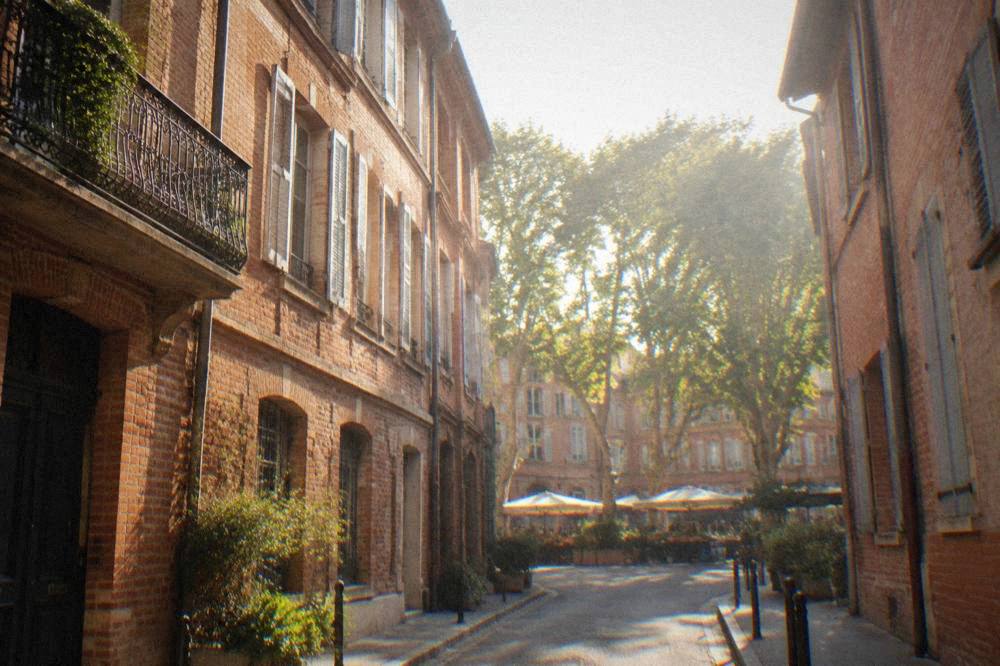
The quietest pink-brick corners of Toulouse sit in the Saint-Aubin and Carmes quarters, along the streets behind the Saint-Etienne cathedral, and in the courtyard of the Hotel de Bernuy, a Renaissance townhouse whose pink walls and stone tower can be viewed from the street. These are places where the brick is domestic rather than monumental, and where the early morning belongs to residents rather than visitors.
Saint-Aubin, just east of the Saint-Etienne cathedral, is a quarter of small pink facades, a Sunday market square, and streets that slope toward the river. The Carmes quarter, closer to the center, mixes the same brick with narrow lanes that stay cool in the afternoon. Both are covered in the Carmes and Saint-Etienne area guides.
The Hotel de Bernuy is the standout single building among these. Its courtyard is a Renaissance merchant's statement, pink brick rising around a stone staircase tower, and the Hotel de Bernuy guide explains what can be seen from outside and what needs a visit inside. The Toulouse walking tours guide collects routes that stitch these quarters together.
For a slower way to cover the same ground, the Toulouse E-Bike Tour and the Panoramic Toulouse, electric bike tour, and cable car both pass through the brick quarters.
Which Day Trips Show More Pink Brick Near Toulouse?
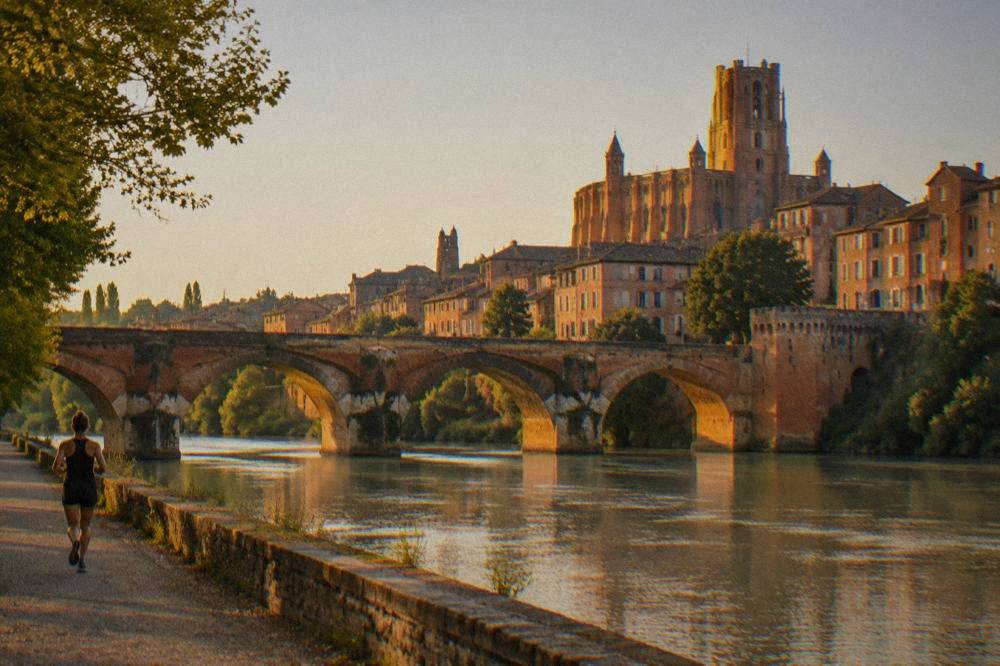
The pink brick does not stop at the city limits. Albi, a short train ride northeast, builds its cathedral and old bridges from a similar warm brick, and Cordes-sur-Ciel crowns a hilltop with the same material. The Canal du Midi, UNESCO-listed since 1996, threads through brick villages south of the city. All three are practical day trips from Toulouse.
Albi is the closest thing to a second pink city. Its cathedral is one of the largest brick buildings in the world, and the old town's lanes and river frontage carry the same tone as Toulouse's. Cordes-sur-Ciel, perched above it, is a medieval hill town whose facades glow at sunset exactly the way La Ville Rose does. The Albi and Cordes-sur-Ciel guides cover both, and the day trips from Toulouse hub collects the rest.
The Canal du Midi was inscribed by UNESCO in 1996 under criteria i, ii, iv and vi, and its plane-tree-lined banks begin in Toulouse itself. The Canal du Midi guide covers the waterway, and a cruise on it is one of the best ways to see the brick towns from the water. The UNESCO-listed Canal du Midi cruise tour with commentary runs from the city.
For the Albi and Cordes combination in one organized day, the Albi and Cordes sur Ciel Private Day Tour from Toulouse handles the transfers.
What Should A Pink City Itinerary Look Like?
A good pink city itinerary gives the brick three light sessions: an early morning in the Carmes or Saint-Aubin streets, a midday block indoors at the Capitole or a museum, and a late-afternoon walk west to the Garonne quays ending at the Pont Neuf at sunset. Two days is enough for the center, and a third day can go to the canal or a brick day trip.
The one day in Toulouse, 2 days in Toulouse and 3 days in Toulouse guides lay out full plans. The essential skeleton for a color-focused visit:
| Session | Where | Why |
|---|---|---|
| Early morning | Carmes or Saint-Aubin streets | Low east light, quiet lanes |
| Midday | Capitole interiors, museums, Marche Victor Hugo | Brick reads pale, interiors shine |
| Late afternoon | Walk from Place du Capitole toward the river | Sun drops behind the facades |
| Sunset | Garonne quays and Pont Neuf | Direct western light, reflections |
| Evening | Dinner in the brick old center | Floodlit streets |
Food belongs in this itinerary, not as a detour but because the eating streets are the brick streets. Cassoulet is the dish to look for, the cassoulet guide explains it, and the Toulouse food and Marche Victor Hugo guides cover the rest. No specific restaurant's prices or hours are needed to eat well here, the market and the old center do the work.
For anyone who wants the stories behind the streets while walking them at their own pace, the self-guided audio tour of the pink city remains the simplest fit. It pairs naturally with a first evening on the quays: do the walk in the afternoon light, then finish at the river as the color peaks.
However you structure the days, the same principle holds across every plan in this guide: chase the light, not the checklist. The pink city gives its best color to the people who are standing in the right street at the right hour, and the rest of the visit can be arranged around that simple fact.
Common Questions About The Toulouse Pink City
Why Is Toulouse Called The Pink City?
Toulouse is called La Ville Rose because its historic buildings are built of a pale pink brick that colors the whole old center. The nickname is the city's well-known character, used by the tourist office and in everyday speech.
Where Can You See The Pink Brick Best?
At the Place du Capitole, the Couvent des Jacobins, the Garonne quays near the Pont Neuf, and in the Carmes and Saint-Aubin quarters. Sunset on the river frontage is when the color glows hardest.
What Time Of Day Is Best For Photographing The Pink City?
The last two hours of daylight, when the low western sun hits the facades directly, and early morning, when the streets are quiet and the light is soft. Midday light flattens the color.
Do Other Towns Near Toulouse Have The Same Pink Brick?
Yes. Albi's cathedral and old town use a similar warm brick, Cordes-sur-Ciel crowns a hilltop with it, and the UNESCO-listed Canal du Midi passes brick villages south of the city. All are practical day trips.
Is The Pink City Walkable?
The historic center is compact and the main pink-brick sights sit within a short walk of each other, from the Capitole to the Jacobins and the Garonne quays. The Tisseo network covers anything farther out.
What Is The Best Month To See Toulouse Pink?
May, June and September combine warm light with long evenings. July is the sunniest month at 258.6 hours of sunshine per the Meteo-France 1991-2020 normals, but May is the wettest month at 73.6 mm of rain, so pack for showers in spring.
The pink city rewards slow looking. Plan the light, pick a couple of quarters rather than every sight, and let the brick do the rest.