Toulouse Weather
Toulouse, the pink-brick city on the Garonne in the Occitanie region of southwestern France, sits in a climate visitors misjudge before they arrive. The official Meteo-France 1991-2020 normals for the Toulouse-Blagnac station give the year in hard numbers: a mean daily maximum of 18.8C, 627 mm of rain spread over 95.8 rain days, and 2,075.1 hours of sunshine. This guide reads those numbers month by month, so the packing list and the calendar both come from data rather than guesswork.
Short answer
Toulouse has a temperate climate with four distinct seasons: hot, dry summers and mild winters. Meteo-France's 1991-2020 normals for Toulouse-Blagnac show an annual mean maximum of 18.8C, 627 mm of rain over 95.8 rain days, and 2,075.1 hours of sun per year. May is the wettest month at 73.6 mm, and July is the sunniest at 258.6 hours, with a record high of 42.4C set on 23 August 2023.
Toulouse, the pink-brick "La Ville Rose" on the Garonne in the Occitanie region of southwestern France, has a climate that surprises people twice: once in May, when the rain peaks, and once in late August, when the thermometer can touch levels nobody associates with southwestern France. The city's weather story is best told with the official Meteo-France 1991-2020 climate normals for the Toulouse-Blagnac station, which record an annual mean daily maximum of 18.8C, an annual mean daily minimum of 9.6C, 627 mm of rain falling across 95.8 rain days, and 2,075.1 hours of sunshine per year. Those four numbers frame everything below, from which month to book to what goes in the suitcase.
Before the month-by-month detail, one planning note: this page is about weather, not about what to do once you are there. For the wider picture, the best time to visit Toulouse guide weighs weather against crowds and prices, and the things to do and see overview covers the city itself. If you are still deciding whether the city deserves the trip at all, is Toulouse worth visiting answers that question directly.
What Kind Of Climate Does Toulouse Have?
Toulouse has a temperate climate with four distinct seasons: warm, dry summers; mild, relatively cool winters; and spring and autumn that carry most of the year's rain. Meteo-France's 1991-2020 normals for Toulouse-Blagnac put the annual mean maximum at 18.8C and the annual mean minimum at 9.6C, with 627 mm of rain over 95.8 rain days and 2,075.1 hours of sun.
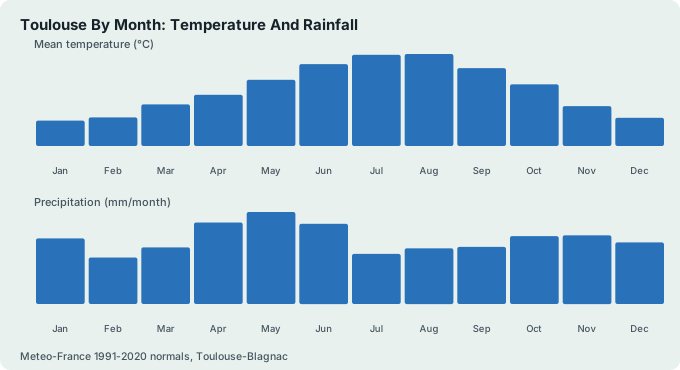
The character of the year is uneven in a way that matters for planning. Winter is not the wet period, which runs against the intuition of visitors from Atlantic or northern climates. The wettest month in Toulouse is May, at 73.6 mm, with April at 65.2 mm and June at 64.2 mm close behind. February, by contrast, is the driest month of the year at 37.2 mm. The rain does not fall as a constant drizzle either: the normals count rain days, days with at least 1 mm of precipitation, and even the wettest months sit near ten such days, leaving the rest dry.
Summer behaves like a Mediterranean-leaning summer with an Atlantic moderating hand. July is the sunniest month at 258.6 hours, and August follows at 246.4 hours, while the mean daily maximum climbs to 28.2C in July and 28.5C in August. The normals also count days reaching 30C or more: 11.5 in July and 11.3 in August, with 6 in June and 3.5 in September. That is real heat, but not desert heat, and the mean nightly minimums of 17.0C and 17.1C mean evenings stay warm rather than cooling sharply.
The records frame the extremes. Over the period from 1947 to June 2025, the highest temperature recorded at the station was 42.4C on 23 August 2023, and the lowest was -19.2C on 15 February 1956. Both are outliers: the mean daily minimum in January, the coldest month, is 2.9C, and the mean daily maximum that month is 9.7C. A winter visitor to Toulouse should expect cold mornings and cool afternoons, not a deep freeze.
| Season | Mean daily max | Mean daily min | Character |
|---|---|---|---|
| Winter (Dec-Feb) | 9.7-11.2C | 2.9-3.6C | Cool, mostly dry, short days |
| Spring (Mar-May) | 15.0-21.4C | 5.5-11.4C | Mild, the wettest stretch of the year |
| Summer (Jun-Aug) | 25.7-28.5C | 15.0-17.1C | Hot, sunny, occasional 30C-plus days |
| Autumn (Sep-Nov) | 13.5-24.8C | 6.3-13.9C | Warm in September, cooling fast by November |
What Is The Wettest Month In Toulouse?
May is the wettest month in Toulouse, averaging 73.6 mm of rain across the 1991-2020 normals, and the surprise is that the wettest stretch of the year sits in late spring rather than in winter. April follows at 65.2 mm and June at 64.2 mm, while February is the driest month at 37.2 mm.
This is the single fact about Toulouse weather that most planning advice gets wrong. A visitor packing for February on the assumption that "winter is the rainy season" would pack for the wrong month: February averages 37.2 mm, barely half of May's total, and counts 7.8 rain days against May's 9.9. November, often assumed to be grey and soaked, averages 55.0 mm, and December 49.3 mm. The spring peak is real and consistent in the record.
The practical reading is not "avoid May" but "plan around showers in May." With 9.9 rain days in the month, plenty of dry time remains, and the mean daily maximum of 21.4C makes May one of the most pleasant months for walking the city. The rain that does fall tends to matter more for outdoor plans than for indoor ones, and Toulouse has enough covered ground to absorb a wet afternoon.
| Month | Rain (mm) | Rain days (>=1 mm) | Mean daily max |
|---|---|---|---|
| Jan | 52.5 | 9.2 | 9.7C |
| Feb | 37.2 | 7.8 | 11.2C |
| Mar | 45.3 | 8.2 | 15.0C |
| Apr | 65.2 | 9.3 | 17.6C |
| May | 73.6 | 9.9 | 21.4C |
| Jun | 64.2 | 7.1 | 25.7C |
| Jul | 40.1 | 5.7 | 28.2C |
| Aug | 44.6 | 5.9 | 28.5C |
| Sep | 45.7 | 6.6 | 24.8C |
| Oct | 54.3 | 7.5 | 19.7C |
| Nov | 55.0 | 10.0 | 13.5C |
| Dec | 49.3 | 8.7 | 10.4C |
For the days when the sky does open, the rainy day in Toulouse guide lists the indoor options, and the city's museum coverage is deep enough that a wet day is rarely a lost day. The Toulouse museums guide is the natural companion there.
What Is The Sunniest Month In Toulouse?
July is the sunniest month in Toulouse, with 258.6 hours of sunshine in the 1991-2020 normals, followed by August at 246.4 hours and June at 231.8 hours. July is also one of the driest months, with just 40.1 mm of rain over 5.7 rain days, and it counts 11.5 days a year reaching 30C.
The summer half of the year owns the sunshine table. From May onward the monthly totals climb steeply: 212.3 hours in May, 231.8 in June, then the July peak. Even September, technically autumn, holds 210.1 hours, more than May. The dark months are November at 99.9 hours and January at 89.1 hours, with December close behind at 89.7 hours. Anyone sensitive to short, grey days should weight a Toulouse visit toward April through September.
The pairing of July's sunshine with its low rainfall is what defines the local summer. A July day in Toulouse is, on the averages, warm, dry and bright, with hot spells measured by the 30C-plus day count rather than assumed. August behaves almost identically, at 44.6 mm of rain, 246.4 hours of sun and 11.3 days at or above 30C. The record high of 42.4C, set on 23 August 2023, shows the ceiling of what a late-August heat event can do, though it stands well outside the averages.
| Month | Sunshine (hours) | Days at 30C or more |
|---|---|---|
| Jan | 89.1 | 0 |
| Feb | 118.2 | 0 |
| Mar | 175.3 | 0 |
| Apr | 188.5 | 0 |
| May | 212.3 | 0.6 |
| Jun | 231.8 | 6 |
| Jul | 258.6 | 11.5 |
| Aug | 246.4 | 11.3 |
| Sep | 210.1 | 3.5 |
| Oct | 155.2 | 0.1 |
| Nov | 99.9 | 0 |
| Dec | 89.7 | 0 |
Sunshine and heat together shape what kind of touring makes sense in high summer, and the selections below are the ones this site rates for that mix of street time and indoor stops.
How Hot Does Toulouse Get In Summer?
Summer in Toulouse is genuinely hot: the mean daily maximum reaches 28.5C in August and 28.2C in July, with 11.5 days in July and 11.3 in August hitting 30C or more, and the all-time record high of 42.4C set on 23 August 2023. Nights stay warm too, with mean minimums of 17.0C in July and 17.1C in August.
The heat builds in stages rather than arriving at once. June's mean daily maximum is 25.7C with only 6 days at 30C or more, so early June feels like a warm late spring. By July the pattern is fixed: hot afternoons, warm evenings, and rain that arrives in brief episodes rather than long fronts, with only 40.1 mm across the whole month. September cools in name more than in feel at first, holding a mean maximum of 24.8C, before October drops to 19.7C and the summer is clearly over.
For visitors, the practical consequences are about scheduling. The hot hours run through the early and mid afternoon, which makes mornings and evenings the natural walking times in July and August. The pink brick of La Ville Rose throws light and heat back off its facades on bright afternoons, and shaded streets and indoor stops earn their place in a summer itinerary. Water, a hat and a midday pause are not tourist clichés here in July; they are the sensible reading of the numbers above.
Heat also changes what is worth booking. A walking tour that covers the Capitole and Saint-Sernin core is better in the cooler hours, and indoor anchors like the Couvent des Jacobins or the Musee des Augustins sit in the middle of the day rather than at its edges. The chef-led food and history tour that this site features, Check availability, pairs street walking with indoor stops, which is a fair summer shape.
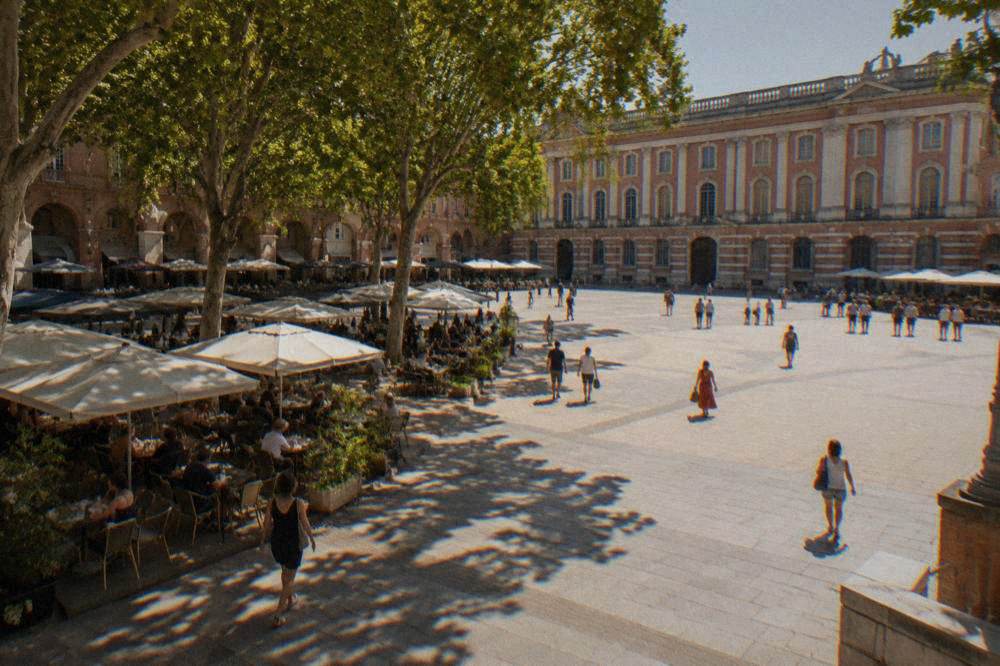
A private guide adds flexibility on the hottest days, since the route can bend toward shade and covered passages when the afternoon peaks.
How Cold Does Toulouse Get In Winter?
Winter in Toulouse is mild on the averages but capable of real cold: January, the coldest month, has a mean daily maximum of 9.7C and a mean daily minimum of 2.9C, while the all-time record low is -19.2C, recorded on 15 February 1956. December and February are similar, with mean minimums of 3.6C and 3.1C.
The averages describe a city where winter means coats and cold mornings rather than snow management. The mean daily maximum never drops below 9.7C in any winter month, so afternoons are regularly cool rather than bitter, and the sunshine table shows 89.1 hours in January and 118.2 in February, low but not the near-darkness of northern Europe. The record low of -19.2C from February 1956 is a historical extreme, not a planning scenario, and the 1991-2020 normals sit far above it.
What winter visitors actually notice is the combination of cool air and damp rather than deep cold. Rainfall is moderate, 52.5 mm in January and 49.3 mm in December, and the rain-day counts of 9.2 and 8.7 indicate how often measurable rain falls. Frost is plausible on many winter mornings given minimums near 3C, so early starts feel sharper than the afternoon numbers suggest.
Winter is also the season when Toulouse's indoor life carries the itinerary. The Toulouse museums roster, the covered Marche Victor Hugo, and the cassoulet kitchens described in the Toulouse food and cassoulet guides are exactly the cold-weather version of the city. The Christmas market, which the city's listings place on Place du Capitole from 26 November to 27 December 2026, gives late December a reason of its own.
Cold months are eating months in Toulouse, and the featured tour below is the indoor option this site rates first for a chilly evening.
| Month | Mean daily max | Mean daily min | Sunshine (hours) |
|---|---|---|---|
| Dec | 10.4C | 3.6C | 89.7 |
| Jan | 9.7C | 2.9C | 89.1 |
| Feb | 11.2C | 3.1C | 118.2 |
What Is The Best Month To Visit Toulouse For Good Weather?
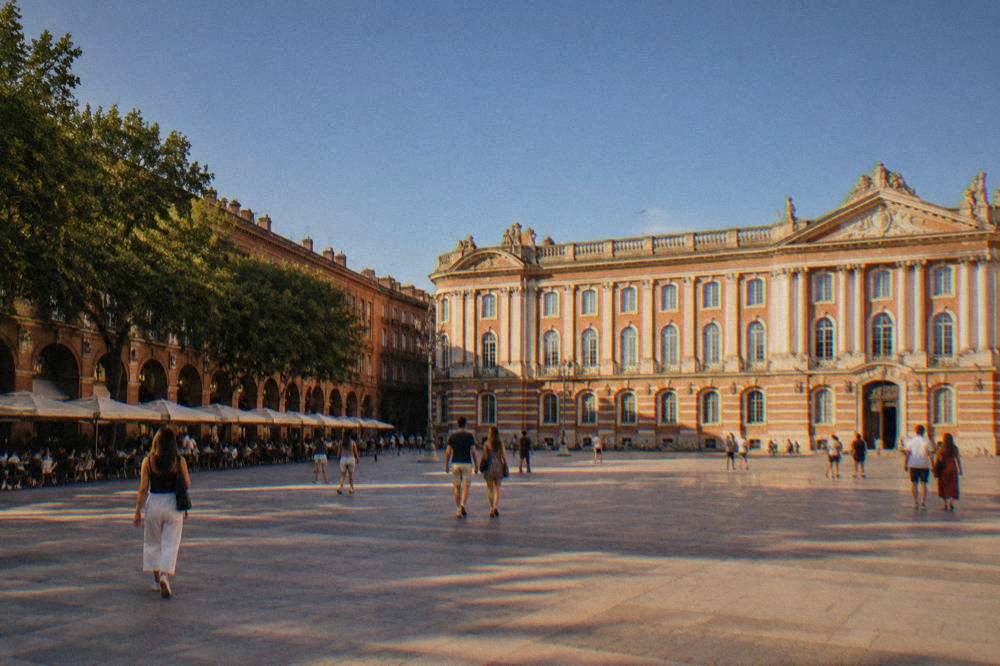
June and September are the strongest weather months in Toulouse on the 1991-2020 normals: June pairs a 25.7C mean daily maximum with 231.8 hours of sun, and September holds 24.8C with 210.1 hours, while both carry less rain than the May-to-June peak. Late April and May are mild but wetter, at 65.2 mm and 73.6 mm of rain respectively.
June delivers near-summer warmth with only 6 days a year reaching 30C in the averages, and its 64.2 mm of rain sits at the tail of the spring wet stretch rather than its center. September is the mirror image: the heat has eased from August's 28.5C mean maximum, the sun total of 210.1 hours still beats May, and rainfall is down to 45.7 mm over 6.6 rain days. Either month gives the best ratio of warmth to discomfort in the table.
May deserves its defense despite the rainfall crown. Its mean daily maximum of 21.4C and 212.3 hours of sun make it a beautiful month when the sky is clear, and 9.9 rain days still leaves plenty of dry time. The honest framing is that May offers the best temperatures of the shoulder season with the highest shower risk of the year, a trade some visitors will take happily.
October is the quiet compromise. The mean maximum of 19.7C and 155.2 hours of sun describe a mild, autumnal month, with 54.3 mm of rain spread over 7.5 rain days. It is cooler than May and wetter than June or September, but comfortably warmer than November, which drops to a 13.5C mean maximum and 99.9 hours of sun.
Does It Rain A Lot In Toulouse?
Toulouse averages 627 mm of rain per year spread over 95.8 rain days, which is moderate rather than wet by French standards: the rain is concentrated in late spring, with May at 73.6 mm the wettest month, while July at 40.1 mm and February at 37.2 mm are the driest. No month averages fewer than five rain days.
The annual total of 627 mm, from the Meteo-France 1991-2020 normals for Toulouse-Blagnac, translates to a little under 1.7 mm per day averaged across the year, but the distribution is what matters. The year splits into a wetter shoulder from April to June and a drier high summer, with a secondary mild dampening in October and November. Even the dampest month, May, keeps measurable rain to under ten days on average, and the sunniest months keep it to fewer than six.
The answer to "does it rain a lot" is therefore seasonal. A July or August visitor can expect long dry stretches punctuated by the occasional storm, with 5.7 and 5.9 rain days respectively. An April visitor should plan for the possibility of showers and pack accordingly, while accepting a mean maximum of 17.6C that makes the month pleasant when it is dry.
| Question | Answer from the 1991-2020 normals |
|---|---|
| Annual rainfall | 627 mm |
| Annual rain days (>=1 mm) | 95.8 |
| Wettest month | May, 73.6 mm |
| Driest month | February, 37.2 mm |
| Fewest rain days | July, 5.7 |
| Most rain days | November, 10.0 |
What Should You Pack For Toulouse Weather?
Pack for Toulouse in layers matched to the season: light clothing, sun protection and a water bottle for June through August, when mean maximums reach 28.5C and 30C days are common; a waterproof layer for April through June, when rain runs 64.2 to 73.6 mm per month; and a warm coat for December through February, when mean minimums sit between 2.9C and 3.6C.
Summer packing is about heat management. With 11.5 days at 30C or more in July and 11.3 in August, and a record high of 42.4C, the summer kit is light fabrics, a hat, sunscreen and the habit of carrying water. Evenings stay warm, with mean minimums above 17C, so heavy evening layers are unnecessary. A light layer for air-conditioned interiors covers the rest.
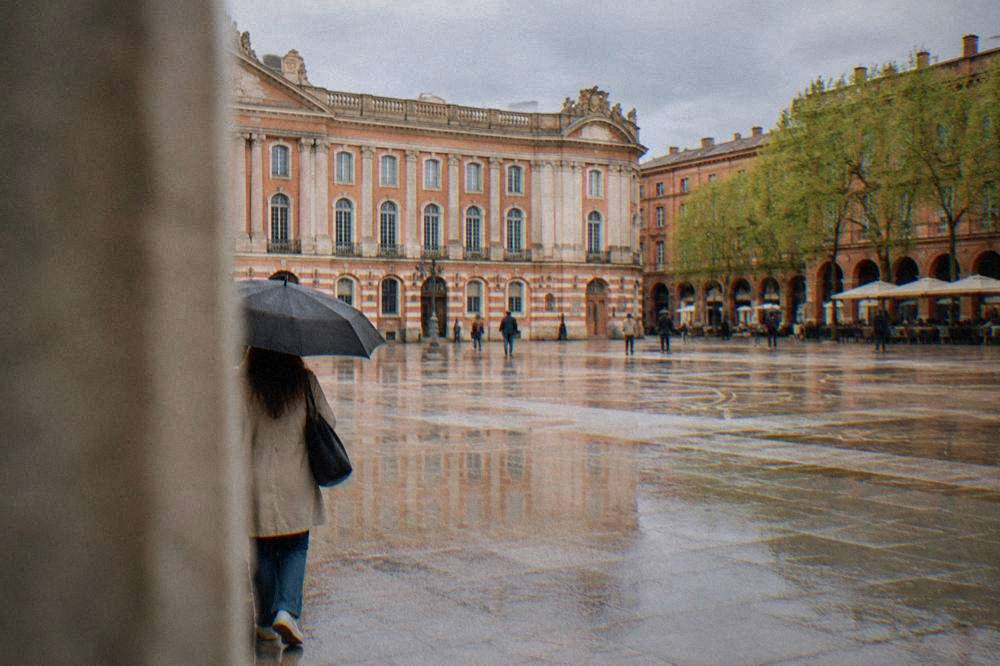
Spring and autumn packing is about the shower risk. The April-to-June stretch carries the year's highest rainfall totals, and October adds 54.3 mm of its own, so a compact waterproof jacket or a small umbrella earns its place in the bag from April through June and again in October and November. Temperatures in these months span a wide daily range: April runs from a 7.9C mean minimum to a 17.6C mean maximum, which is exactly the profile that rewards layers.
Winter packing is straightforward cold-weather gear. Mean minimums of 2.9C to 3.6C from December through February mean a proper coat, and mornings can feel damp as well as cold. The reward for winter visitors is the driest part of the calendar outside high summer, with February's 37.2 mm the driest month of the year, and the city's indoor life from museums to market halls in full swing.
How Does Toulouse Weather Affect Planning A Trip?
Toulouse weather rewards matching the itinerary to the season: hot, dry July and August days argue for early starts, shaded middays and evening walks; the wet May-to-June stretch argues for indoor anchors on standby; and mild, drier February and October suit walking-heavy plans. The normals show every month has both a workable mean maximum and a real weather cost.
The heat logic is the clearest. On a July day with a 28.2C mean maximum and a real chance of passing 30C, the sensible shape is a morning walk, an indoor or shaded midday, and a return to the streets in the evening. Toulouse's compact center makes this easy, and the getting around Toulouse guide covers the metro and bus fares that connect the pieces without long exposed walks.
The rain logic matters most in May, the wettest month at 73.6 mm. The plan is not to stay in but to hold indoor options ready: the museum roster, the covered Marche Victor Hugo, and the churches and convents that anchor the Toulouse churches coverage. A shower in May costs an hour, not a day, when the alternates are chosen in advance.
The cold-weather logic is about light and warmth. January's 89.1 hours of sun and 9.7C mean maximum describe short, cool days, so winter itineraries should front-load the outdoor highlights into the middle of the day and give the mornings and late afternoons to indoor stops. February is milder and drier, at 11.2C and 37.2 mm, and is one of the city's quietest weather bargains.
On a wet or sweltering day, the aviation museum is the indoor pick this site rates first, since the exhibition hall keeps a steady indoor climate year-round.
Does The Weather Change What Toulouse Tours Make Sense?
Yes: the season should drive the tour choice, because the 1991-2020 normals make summer heat and the May-to-June rain stretch predictable enough to plan around. Hot July and August days favor tours with indoor components or evening timing, the wet spring months favor food and museum-based options, and the mild, dry months of June, September and October suit any format, including full walking circuits.
The chef-led food and history tour that this site features is close to weather-proof, since it moves between kitchens, market stops and street segments rather than depending on a full day outdoors. The same logic applies to the private walking tour with a local, where a guide can reroute a circuit toward shaded or covered stretches on a hot afternoon, and to Aeroscopia, the aviation museum, whose climate-controlled exhibition hall makes it a reliable pick on both wet and hot days. Each of these is listed on the operator's live listing with current availability.
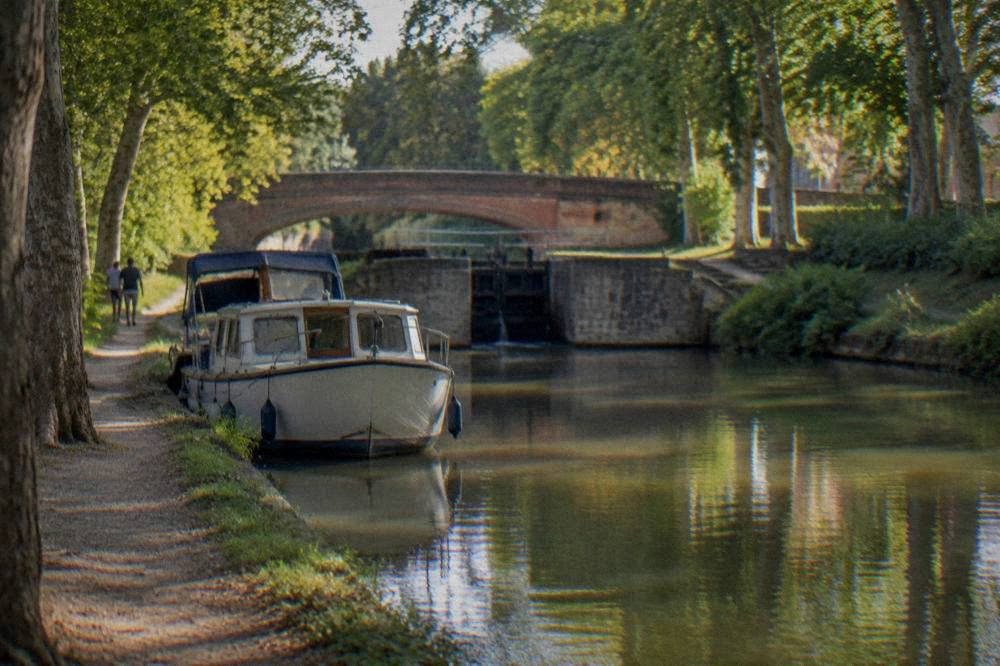
The season-by-season fit is worth stating plainly. In July and August, with mean maximums above 28C and 30C days routine, tours with long unshaded stretches belong in the morning, and anything water-adjacent, like the Canal du Midi cruise options covered in the canal-du-midi-boat-trips guide, gains appeal in the afternoon heat. In May, the wettest month, indoor-heavy formats win. In February, the driest month, walking formats face no weather penalty at all beyond the cold.
How Does Toulouse Weather Compare Month By Month?
Month by month, Toulouse runs from a January mean of 6.3C to an August mean of 22.8C, with rainfall peaking in May at 73.6 mm and bottoming out in February at 37.2 mm, and sunshine running from 89.1 hours in January to 258.6 hours in July. Each month pairs a mean temperature with a rain and sun figure that together define its planning profile.
The monthly mean temperatures, the average of the daily maximum and minimum, give the quickest overview of the year's arc. January is the coldest at 6.3C, December next at 7.0C, and February at 7.1C. Spring climbs through 10.3C in March and 12.7C in April to 16.4C in May, and summer peaks at 22.6C in July and 22.8C in August. September holds 19.3C, October falls to 15.3C, and November drops to 9.9C.
Reading the means alongside the rain and sun columns turns each month into a planning decision. March, at 10.3C and 45.3 mm with 175.3 hours of sun, is a cool but bright shoulder month. June, at 20.3C with 64.2 mm and 231.8 hours, is warm and bright with a residual shower risk. October, at 15.3C and 54.3 mm, is mild and autumnal. The table below carries the full set.
| Month | Mean temp | Rain (mm) | Sunshine (hours) |
|---|---|---|---|
| Jan | 6.3C | 52.5 | 89.1 |
| Feb | 7.1C | 37.2 | 118.2 |
| Mar | 10.3C | 45.3 | 175.3 |
| Apr | 12.7C | 65.2 | 188.5 |
| May | 16.4C | 73.6 | 212.3 |
| Jun | 20.3C | 64.2 | 231.8 |
| Jul | 22.6C | 40.1 | 258.6 |
| Aug | 22.8C | 44.6 | 246.4 |
| Sep | 19.3C | 45.7 | 210.1 |
| Oct | 15.3C | 54.3 | 155.2 |
| Nov | 9.9C | 55.0 | 99.9 |
| Dec | 7.0C | 49.3 | 89.7 |

Whatever the month on the calendar, the three picks below are the formats this site rates across the widest range of Toulouse conditions, from a 28C August afternoon to a showery May morning.
Common Questions About Toulouse Weather
Quick answers to what planners ask most about Toulouse weather.
What is the hottest month in Toulouse?
August is the hottest month on the mean daily maximum, at 28.5C, just ahead of July at 28.2C. August also holds the station's record high of 42.4C, set on 23 August 2023. On the monthly mean temperature, August edges July at 22.8C against 22.6C.
What is the coldest month in Toulouse?
January is the coldest month, with a mean daily maximum of 9.7C, a mean daily minimum of 2.9C and a monthly mean of 6.3C. The all-time record low of -19.2C was recorded on 15 February 1956, far below any modern average.
What is the rainiest month in Toulouse?
May is the rainiest month at 73.6 mm, ahead of April at 65.2 mm and June at 64.2 mm. On rain-day counts, November leads with 10.0 days of at least 1 mm, followed by May with 9.9.
Does it rain a lot in Toulouse?
Toulouse averages 627 mm of rain per year over 95.8 rain days, which is moderate. The rain concentrates in late spring, while July averages only 40.1 mm and February 37.2 mm. Dry conditions prevail throughout the year in every month.
When is the sunniest time to visit Toulouse?
July is the sunniest month at 258.6 hours, followed by August at 246.4 hours and June at 231.8 hours. September still delivers 210.1 hours, more than May, making early autumn a bright option with less heat.
Is Toulouse hot in summer?
Yes. July and August average mean daily maximums of 28.2C and 28.5C, with 11.5 and 11.3 days a year respectively reaching 30C or more, and warm nights above 17C. The record high of 42.4C shows the ceiling of a summer heat event.
The weather in Toulouse is predictable in its broad shape: a wet late spring, a hot and sunny high summer, a mild and bright September, and a cool, mostly dry winter. Planning against those numbers, rather than against assumptions carried over from Atlantic or Alpine France, is what turns a good trip into a comfortable one, and the rest of this site, starting from the Toulouse Travel Guide homepage, builds the itinerary that each season supports.