Garonne River
The Garonne River splits Toulouse in two and gives the city its bridges, its riverbank lawns and its best evening light. This guide covers what to see on each bank, the cruises that run on the water, and how to reach the riverside using the city's transit network.
Short answer
The Garonne River runs through the center of Toulouse in southwestern France, dividing the historic center from the Saint-Cyprian district. The riverside can be walked end to end in a morning, crossed on the Pont Neuf, explored by cruise, and it sits within a few minutes of several major museums. A Tisseo day pass costs EUR 7.20.
The Garonne River runs through the heart of Toulouse, the pink-brick prefecture of Haute-Garonne in the Occitanie region of southwestern France, and the water is the single best organizing feature for any visit. The commune counts 514,819 inhabitants (INSEE, population in 2023), and the river divides that city roughly in two: the historic center and its brick facades on the right bank, the Saint-Cyprian district and its quieter squares on the left. Everything worth planning around the water, from the bridges to the cruise departures to the museums within a short walk of the banks, is covered below.
What Is The Garonne River In Toulouse?
The Garonne is the large river that flows through the middle of Toulouse, separating the historic center on one bank from the Saint-Cyprian district on the other, and it is the reason the city's bridges, riverbank lawns and quays exist at all. The Canal du Midi, inscribed by UNESCO in 1996, also passes through the city, and the two waterways frame Toulouse's identity as a river town in southwestern France.
Toulouse is known as "La Ville Rose" for the pink brick that colors its facades, and that brick shows at its best along the water, where the late sun hits the quays. The river is not a scenic add-on at the edge of town. It cuts directly through the middle, so almost any walk between major sights crosses it or runs beside it. The Toulouse Travel Guide covers the whole city, but this page stays on the water.
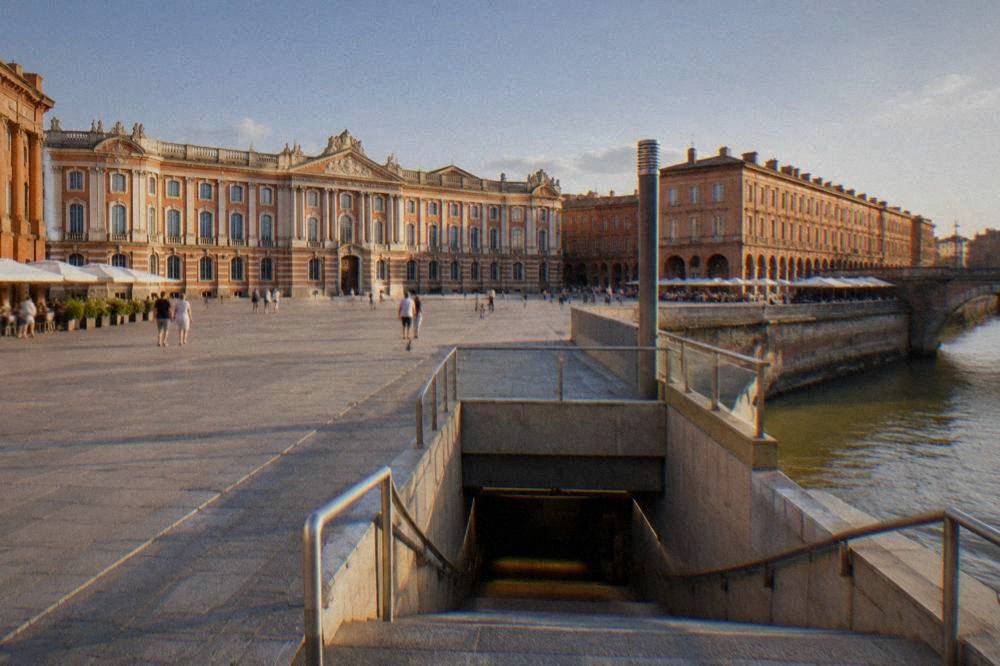
A few orientation facts help. The right bank holds the Capitole, the basilica of Saint-Sernin and the dense medieval street grid. The left bank holds Saint-Cyprian, the Hopital de la Grave with its dome, and the lawns of the Prairie des Filtres, which the Rio Loco festival uses for its June edition. The Canal du Midi, the UNESCO-listed waterway of 1996, has its own dedicated pages: see canal du Midi guide for the towpaths and Pont Neuf guide for the city's most famous bridge.
Where Does The Riverside Walk Start And What Can You See?
A full riverside walk in Toulouse runs from the Prairie des Filtres lawns on the left bank, across the Pont Neuf, along the right-bank quays past the Henry Martin and Darcy gardens, and up to the Bazacle, and the whole stretch can be covered in a morning at a slow pace with time for photos on every bridge. The banks are public, free to enter and open at all hours.
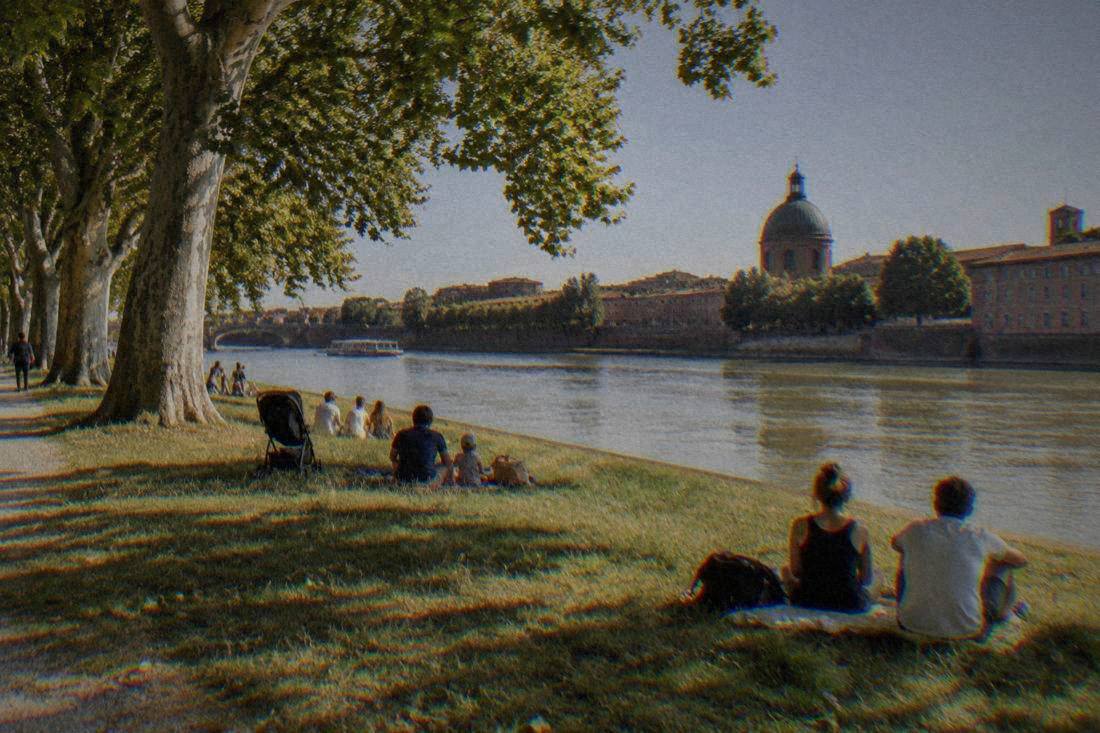
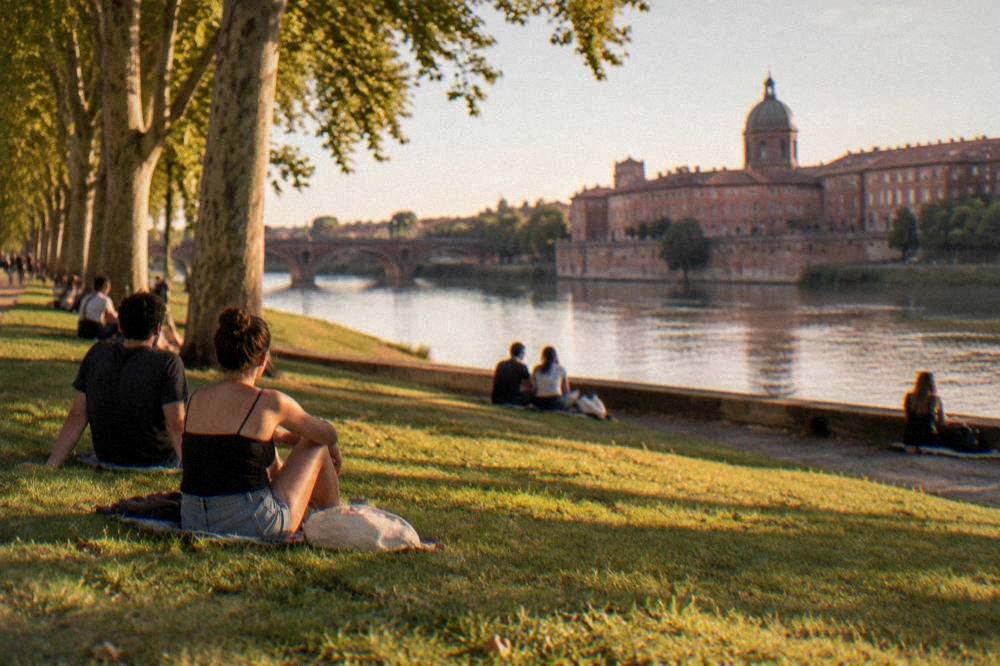
Start on the left bank. The Prairie des Filtres is the open lawn that faces the river directly, and in June it becomes the site of the Rio Loco festival, confirmed for 9 to 13 June 2027 with the theme "Noctiluca". The 2026 edition ran 10 to 14 June. On ordinary days it is simply the best patch of grass in the center for sitting facing the water. From there, walk toward the Pont Neuf, the old stone bridge that the city's postcard views are built around; the full Pont Neuf page covers it in detail.
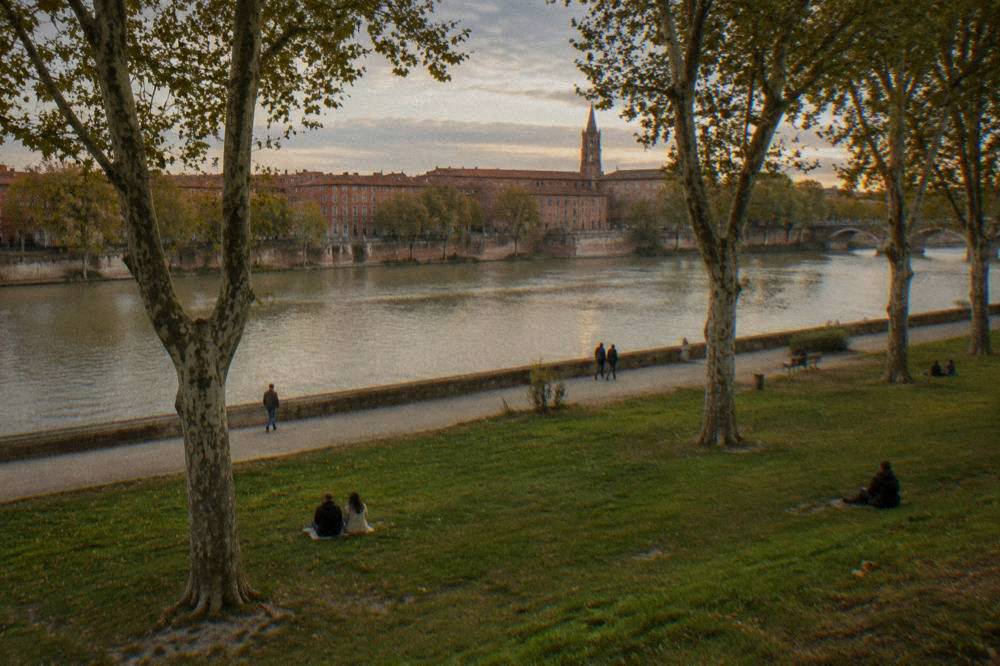
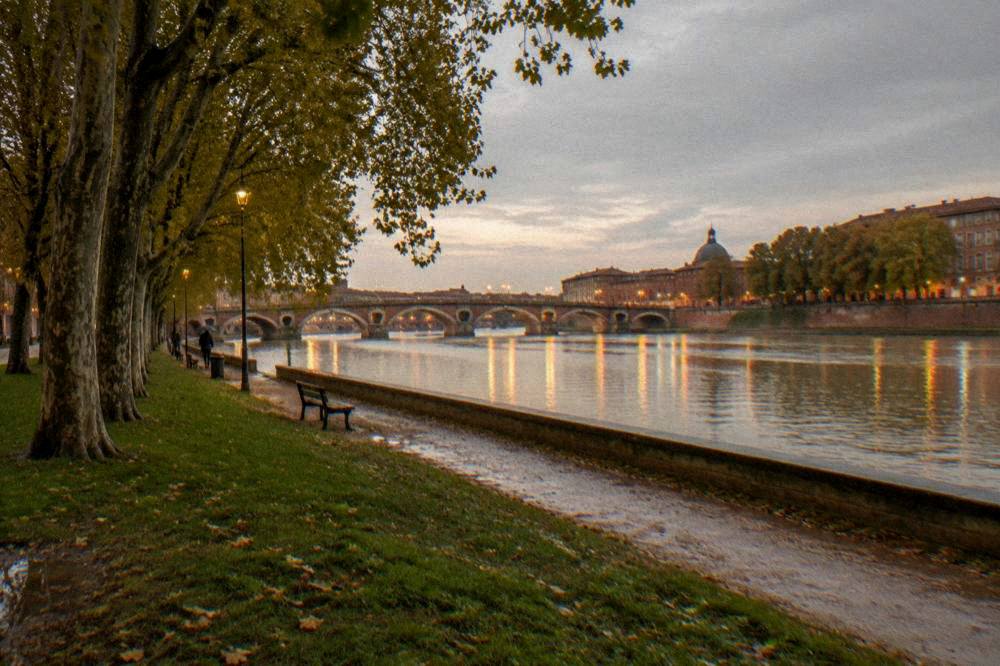
Cross to the right bank and continue along the quays. The gardens that line this side, including the Henry Martin and Darcy gardens, sit on a raised terrace above the water, and the walk passes under plane trees with the river on one side and brick walls on the other. Further along, the Bazacle is the riverside site with a viewing terrace over the weir, one of the classic vantage points for the skyline. The round dome of the Hopital de la Grave, on the left bank, anchors the view from here.
The two banks suit two moods. The right bank is the postcard side, with the terraced gardens and the densest concentration of sights. The left bank is the local side, wider, grassier and emptier in the middle of the day. Doing both, connected by a bridge crossing or two, is the standard loop.
If you would rather ride the riverside than walk it, the bike is the natural tool: the banks are flat, connected and car-free for long stretches.
The essential-of-Toulouse bike tour covers the city's highlights in one loop, and the riverbanks are a core part of its route territory. For walkers who want a guide rather than a map, the highlights walk below does the same job on foot.
Which Bridges Cross The Garonne In Toulouse?
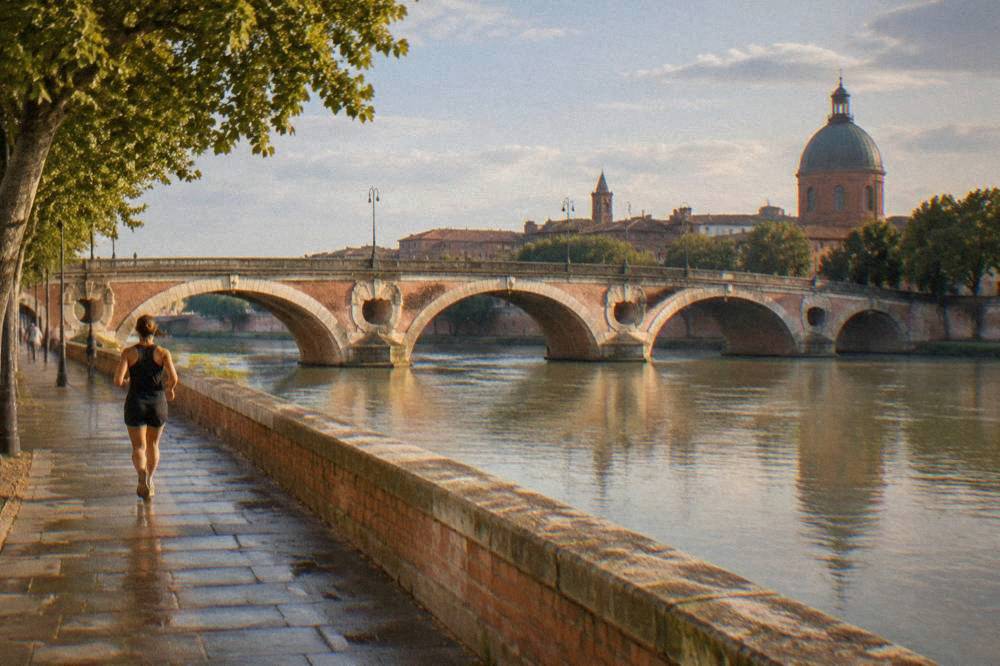
Several bridges cross the Garonne in central Toulouse, and the Pont Neuf is the famous one, the oldest-looking stone bridge in every postcard view, while the other crossings, including the Pont Saint-Pierre with its view of the Pont Neuf and the modern footbridges, each give a different angle on the river. All of them are free, open at all hours and walkable.
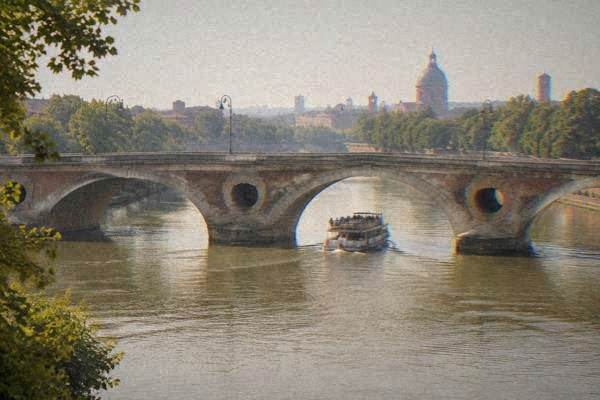
The Pont Neuf is the one to plan around. Its arches, its bumpers against the current and its position facing the dome of the Hopital de la Grave make it the single most photographed structure on the water in Toulouse. The dedicated Pont Neuf page goes into what to look for when you cross it.
The Pont Saint-Pierre, a steel footbridge between the left bank and the right-bank quays, is the viewing bridge: standing on it, you look straight at the Pont Neuf downstream. This is the shot that appears on the city's own promotional material. Beyond these, further crossings connect the districts north and south of the center, and the river's bridges are, in practice, the way any Toulouse walk stitches its two halves together.
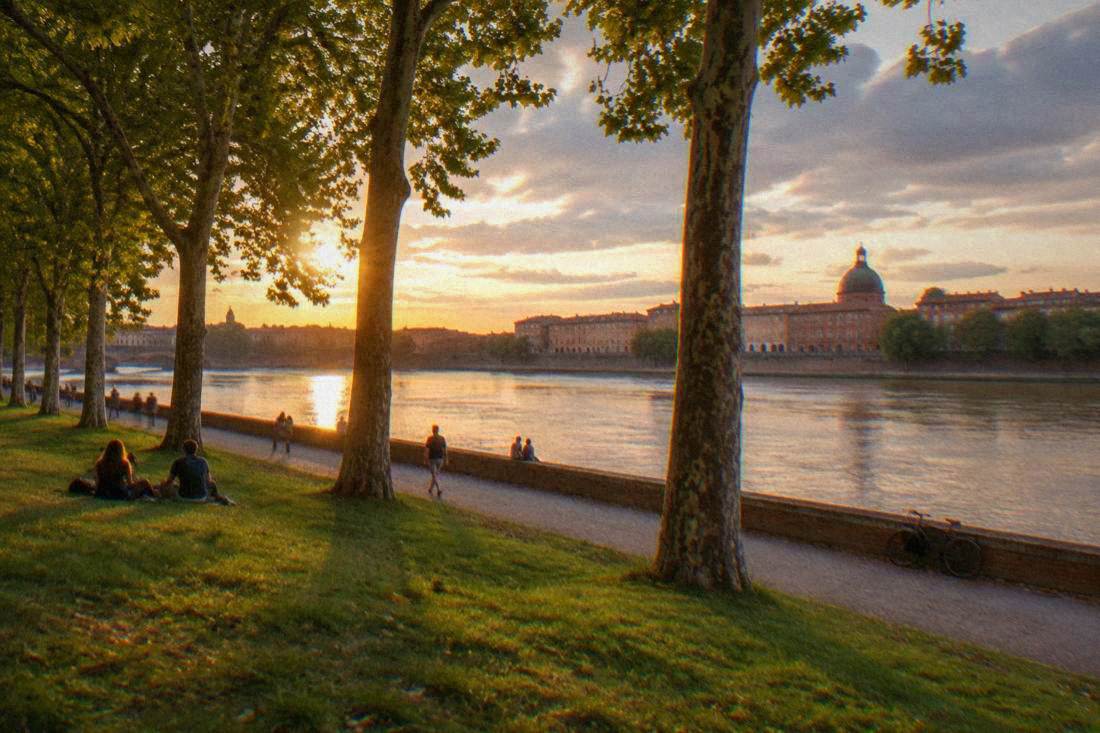
A practical note for photographers: the light works hardest in the late afternoon and early evening, when the sun is low over the left bank and the brick on the right bank goes deep pink. The photography spots guide lists the riverside among the city's key locations.
What Can You Do On The Garonne River Itself?
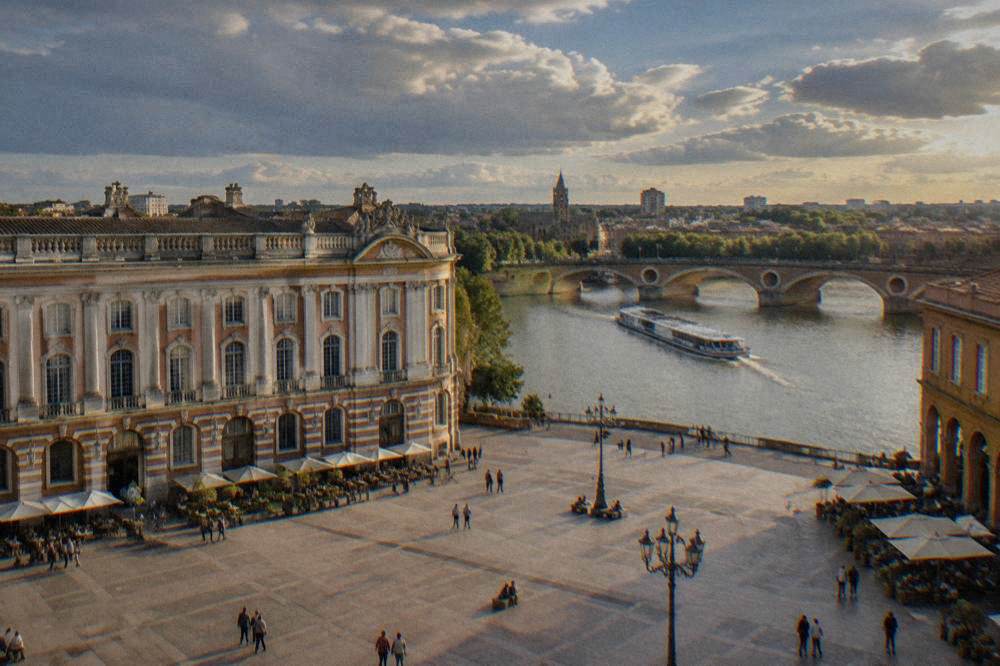
You can take a sightseeing cruise on the Garonne in central Toulouse, with narrated and commentary-based departures running from the central quays, and you can also cruise the UNESCO-listed Canal du Midi from the city, which is a separate waterway experience through locks and plane-tree towpaths. Both are bookable as products, and the river cruises stay within the city center.
The river itself carries sightseeing boats. The Discovery Cruise Tour of the Historic Center of Toulouse runs a loop on the water through the center, and the Aperitif Cruise Tour adds drinks to the same idea for an evening slot. These are the two ways to see the quays and bridges from water level without leaving the city.
The canal option is different in character. The Canal du Midi, inscribed by UNESCO in 1996 under criteria (i)(ii)(iv)(vi), is the tree-lined working canal, and cruise departures from Toulouse put you on that waterway with live commentary.
To drift along that tree-lined waterway with commentary, book a Canal du Midi cruise ticket here.
For the full picture of the canal, including the bike option along its towpath, see the canal du Midi guide and the Canal du Midi boat trips page. For the bike-and-cable-car combination that pairs river views with a hilltop finish, the panoramic electric bike tour below covers both.
One thing you cannot sensibly do is swim in the Garonne in the center. The current, the weir at the Bazacle and the working barge traffic make the central river a viewing water, not a bathing one, and no verified swimming spot on the Garonne in central Toulouse exists in this site's research.
Which Museums And Sights Sit Near The Garonne?
The streets within a short walk of the Garonne hold a dense share of Toulouse's major sights, including the Musee des Augustins, the Couvent des Jacobins, the Fondation Bemberg, Les Abattoirs and the cathedral, plus the Capitole and the basilica of Saint-Sernin slightly further back from the water, so a riverside base puts almost everything within walking reach.
The right bank, in particular, is where the museum cluster sits.
| Sight | Bank / district | What it is | Normal adult rate |
|---|---|---|---|
| Musee des Augustins | Right bank, old center | Fine arts museum in a former convent | EUR 5 |
| Couvent des Jacobins | Right bank, old center | Gothic convent church | EUR 5 |
| Fondation Bemberg | Right bank, Assézat | Fine arts collection | EUR 12 |
| Museum de Toulouse | Right bank, Jardin des Plantes side | Natural history museum | EUR 12 |
| Les Abattoirs | Left bank, Saint-Cyprian | Modern and contemporary art | EUR 12 |
| Toulouse Cathedral | Right bank, east of the old center | Cathedral church | Free entry (church) |
Two status notes matter for planning. The Musee des Augustins is temporarily closed from 21 September to 2 October 2026 for great-cloister works, and its Gothic halls (the sacristy, the Notre-Dame de Pitie hall and the chapter house) reopen on 3 October 2026 from 10:00; the Musee des Augustins page tracks this. The Couvent des Jacobins is free on the first Sunday of the month except when a temporary exhibition is on, and roof restoration work has been under way there while the site stays open to visitors.
The Pass Tourisme from the tourist office costs EUR 26 for stays of one to three days, includes a free guided tour from the tourist office, and makes the museums above free where listed; adding EUR 10 adds ten public-transport trips. The tourist office states the pass pays off from the third activity. Cite de l'espace, whose normal rate is EUR 29, is discounted rather than free with the pass, and it sits well away from the river; see the Cite de l'espace guide.
A guided walk is the efficient way to connect the river to the sights behind it, since the museums, the Capitole and the basilica of Saint-Sernin sit in one walkable belt.
When Is The Best Time To Walk The Garonne Riverside?
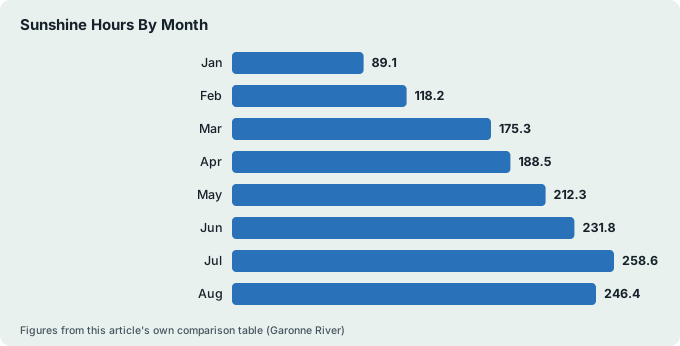
The best months for the Garonne riverside in Toulouse are late spring through early autumn, with July the sunniest month at 258.6 hours of sunshine and only 40.1 mm of rain, while May, despite pleasant temperatures, is actually the wettest month of the year at 73.6 mm, a fact from Meteo-France's 1991-2020 normals for Toulouse-Blagnac that surprises visitors.
The full monthly picture, from the Meteo-France fiche climatologique for the Toulouse-Blagnac station, is below. These are 1991-2020 climate normals, not a forecast, and they are the only climate figures this site treats as verified.
| Month | Mean temp C | Rain mm | Sunshine hours |
|---|---|---|---|
| Jan | 6.3 | 52.5 | 89.1 |
| Feb | 7.1 | 37.2 | 118.2 |
| Mar | 10.3 | 45.3 | 175.3 |
| Apr | 12.7 | 65.2 | 188.5 |
| May | 16.4 | 73.6 | 212.3 |
| Jun | 20.3 | 64.2 | 231.8 |
| Jul | 22.6 | 40.1 | 258.6 |
| Aug | 22.8 | 44.6 | 246.4 |
| Sep | 19.3 | 45.7 | 210.1 |
| Oct | 15.3 | 54.3 | 155.2 |
| Nov | 9.9 | 55.0 | 99.9 |
| Dec | 7.0 | 49.3 | 89.7 |
Read the table before packing. May is the wettest month at 73.6 mm, nearly double February's 37.2 mm, and April (65.2 mm) and June (64.2 mm) follow it. Then the pattern flips: July, the sunniest month, gets just 40.1 mm. August is the warmest month by mean temperature at 22.8 C, with 11.3 days a year at or above 30 C, and July has 11.5 such days. Annually the city records 627 mm of rain over 95.8 rain days and 2,075.1 hours of sun.
The extremes are on record too: the all-time high at this station is 42.4 C on 23 August 2023, and the record low is -19.2 C on 15 February 1956, from the records period 1947 to June 2025. Neither is what a typical visit looks like, but the summer high explains why locals move to the shaded left-bank lawns and the evening hours in July and August. For the full seasonal breakdown, see the best time to visit Toulouse guide and the Toulouse weather page.
How Do You Get To The Garonne Riverside?
The Garonne riverside sits in the center of Toulouse and needs no special ticket to reach, since the quays begin a few minutes' walk from the Capitole, but if you are arriving from further out or from the airport, the Tisseo network covers it, with a single trip at EUR 1.90, a day pass at EUR 7.20 and a 3-day pass at EUR 14.30, per the official Tisseo e-boutique catalogue.
The fare table, from the Tisseo catalogue, in full:
| Tisseo ticket | Price | Notes |
|---|---|---|
| Single trip | EUR 1.90 | Standard ticket |
| Single trip bought on board | EUR 2.50 | Last-minute purchase |
| 10 trips | EUR 16.00 | Multi-trip carnet |
| Day pass (Journee) | EUR 7.20 | 24 hours |
| 3-day pass | EUR 14.30 | No 2-day pass exists |
| Airport single | EUR 9.50 | Tisseo network plus Navette aeroport |
Two airport facts matter. Tram T2 to the airport has been closed since 5 June 2023 and stays closed until the end of 2026 because of the Line C metro works, so no one should plan a tram ride to or from the airport. The Navette aeroport bus runs one departure every 15 minutes and takes 20 to 40 minutes to the center; the Navette to the Matabiau bus station takes about 25 minutes. Buses 30 and 31 take about 45 minutes to the Capitole with changes. The airport handled 7,621,409 commercial passengers in 2025, down 2.8% on 2024.
Within the city, the metro and bus network reaches both banks, and the river is never more than one connection away from anywhere central. The getting around Toulouse guide covers the network in full, and the airport to city center page covers the arrival routes.
One forward-looking note: Metro Line C, the 27 km third line with 21 stations running Colomiers, Blagnac, Toulouse and Labege, is scheduled to open at the end of 2028, and its construction is what keeps the airport tram closed until the end of 2026. A Line B extension to Labege is planned, with no verified opening date to state.
What Events Happen On The Garonne Riverside?
The Garonne riverside hosts Toulouse's biggest outdoor events, led by Rio Loco on the Prairie des Filtres lawns, confirmed for 9 to 13 June 2027 with the theme Noctiluca, and the Christmas markets on Place du Capitole, the allees Jean-Jaures and square Charles-de-Gaulle from 26 November to 27 December 2026, all within a short walk of the water.
The verified riverside-adjacent event calendar:
| Event | Verified dates | Location |
|---|---|---|
| Piano aux Jacobins | 8 to 30 September 2026 | Couvent des Jacobins, right bank |
| Toulouse les Orgues (31st edition) | 7 to 18 October 2026 | Multiple venues; opening concert 7 October at Notre-Dame de la Daurade |
| Christmas markets | 26 November to 27 December 2026 | Place du Capitole, allees Jean-Jaures, square Charles-de-Gaulle |
| Rio Loco | 9 to 13 June 2027 | Prairie des Filtres, left bank |
The Notre-Dame de la Daurade, which hosts the Toulouse les Orgues opening concert, sits directly on the right bank of the Garonne; the Notre-Dame de la Daurade page covers it. The Couvent des Jacobins, venue for Piano aux Jacobins, is a few streets back from the water on the right bank, and the Prairie des Filtres is the left-bank lawn described in the walking section above.
The Toulouse events guide carries the fuller calendar.
If your visit lands on one of these dates, the riverside is both the venue and the best place to stay near, since the event sites and the walking routes overlap almost completely.
Common Questions About The Garonne River In Toulouse
Can you walk along the Garonne in Toulouse?
Yes. Both banks have public quays and walkable paths through the center, the right bank with its terraced gardens and the left bank with the open Prairie des Filtres lawns, and the whole central stretch links up via the bridges, including the Pont Neuf.
Can you take a boat on the Garonne River in Toulouse?
Yes. Sightseeing cruises run on the central Garonne, including a historic-center discovery cruise and an aperitif cruise with drinks, and separately the UNESCO-listed Canal du Midi carries narrated cruise departures from the city.
Which bridge is the famous one on the Garonne in Toulouse?
The Pont Neuf. It is the stone bridge in the classic postcard view, best photographed from the Pont Saint-Pierre footbridge or from the left-bank lawns, with the dome of the Hopital de la Grave in the frame.
Is the Garonne riverside free?
Yes. The quays, the lawns, the bridges and the walking routes are public and free. The costs come only from the optional extras: cruises, guided tours and the museums behind the banks, several of which are covered by the EUR 26 Pass Tourisme.
What is the wettest month for a riverside visit?
May, at 73.6 mm of rain on the Meteo-France 1991-2020 normals for Toulouse-Blagnac, nearly double February's 37.2 mm. July is the sunniest month at 258.6 hours of sunshine with only 40.1 mm of rain.
Is the Garonne in Toulouse connected to the Canal du Midi?
Both run through Toulouse, and the Canal du Midi, inscribed by UNESCO in 1996, is the city's second waterway alongside the river. The canal has its own towpaths and cruise departures, covered on the canal du Midi pages of this site.
The Garonne is the spine of Toulouse: walk it, cross it, cruise it, and time it against the climate table and the event calendar above, and the rest of the city arranges itself around the water.