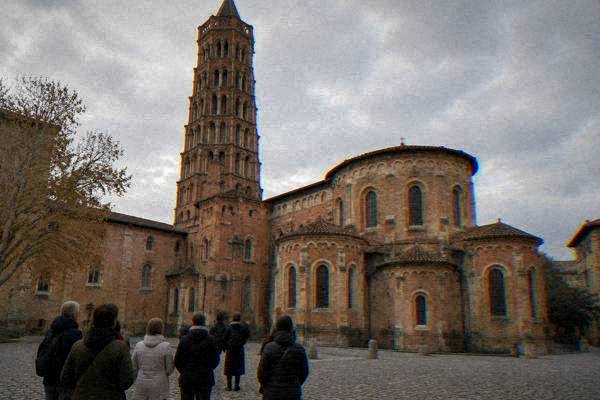
Basilique Saint-Sernin
The Basilique Saint-Sernin is the largest Romanesque church standing in Toulouse and a listed stop on the UNESCO-inscribed Routes of Santiago de Compostela in France. This guide covers what it is, why UNESCO lists it, what to see inside and how to plan a visit.
Short answer
The Basilique Saint-Sernin in Toulouse is part of the UNESCO World Heritage property Routes of Santiago de Compostela in France, inscribed in 1998. It sits on the Via Tolosana pilgrimage route, a short walk from the Capitole, and is one of the city's defining monuments.
The Basilique Saint-Sernin stands in the center of Toulouse, the pink-brick city on the Garonne in the Occitanie region of southwestern France, and it is the monument that anchors the city's pilgrim past. UNESCO lists the basilica as part of the Routes of Santiago de Compostela in France, a World Heritage property inscribed in 1998, and the city's own pages describe it as a major stop on the Via Tolosana, one of the four historic French roads toward Santiago. This guide from Toulouse Travel Guide covers what the church is, what UNESCO actually lists, what you can see inside and outside, what a visit costs, and how the basilica fits into a wider trip around the city and the region.
What Is The Basilique Saint-Sernin In Toulouse?
The Basilique Saint-Sernin is Toulouse's major Romanesque church and one of the stops on the Via Tolosana, the pilgrimage road that carried medieval pilgrims from southern France toward Santiago de Compostela. UNESCO has listed the basilica since 1998 as a component of the Routes of Santiago de Compostela in France, and the city classifies it as a Monument Historique, a protection it has held since 1840.
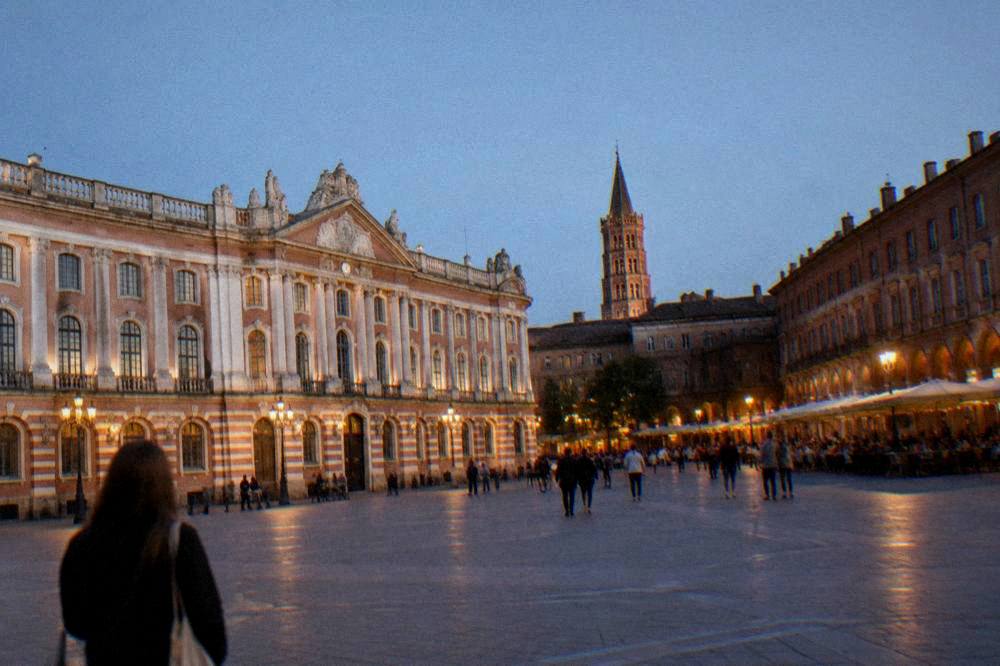
The church gives the surrounding neighborhood its name and its shape. It sits a short walk from the Capitole, the city's town hall and theater complex described on our Capitole de Toulouse page, and it anchors a quarter of small streets that pilgrims and visitors have crossed for centuries. The name itself carries the city's deepest story: the basilica holds the tomb of Saint Saturnin, Toulouse's first bishop, and the church was built around that tomb. For the full answer to that question, see our dedicated piece on which saint is buried in Toulouse.
What the sources support, and what they do not, matters here. The UNESCO inscription dates from 1998 and covers the basilica as part of the Santiago routes property; the Monument Historique protection dates from 1840; the Via Tolosana connection is stated on the metropole's own page for the basilica. Beyond those facts, this guide stays quiet on dates of construction, architects and dimensions, because none of those figures was verified on a primary source for this site. That restraint is deliberate.
Why Is The Basilique Saint-Sernin A UNESCO World Heritage Site?
UNESCO inscribed the Routes of Santiago de Compostela in France in 1998, and the Basilique Saint-Sernin is listed as one of the component monuments of that property, alongside buildings on the other historic French pilgrimage roads. The listing therefore attaches to the basilica's role on the Via Tolosana, the southern route, rather than to the church as a freestanding monument. Toulouse has exactly one other UNESCO connection: the Canal du Midi, inscribed in 1996.
The distinction matters because a lot of casual travel copy gets it wrong. The basilica is not a World Heritage Site on its own; it is a listed element of a larger serial property that spans the French pilgrimage network. The UNESCO record for the Santiago routes confirms the 1998 inscription, and the metropole's page for the basilica confirms both the listing and the Via Tolosana stop. The Canal du Midi, the 1996 inscription that runs through Toulouse and out toward the Mediterranean, is covered in our Canal du Midi guide.
For planning purposes, the practical effect is simple. If UNESCO sites are your travel currency, Toulouse gives you two of them within a single city, and the basilica is the one you can reach on foot from the main square in a few minutes. Pilgrims still pass through on the modern waymarked route, and the church remains an active place of worship as well as a monument.
What Can You See Inside And Around The Basilica?
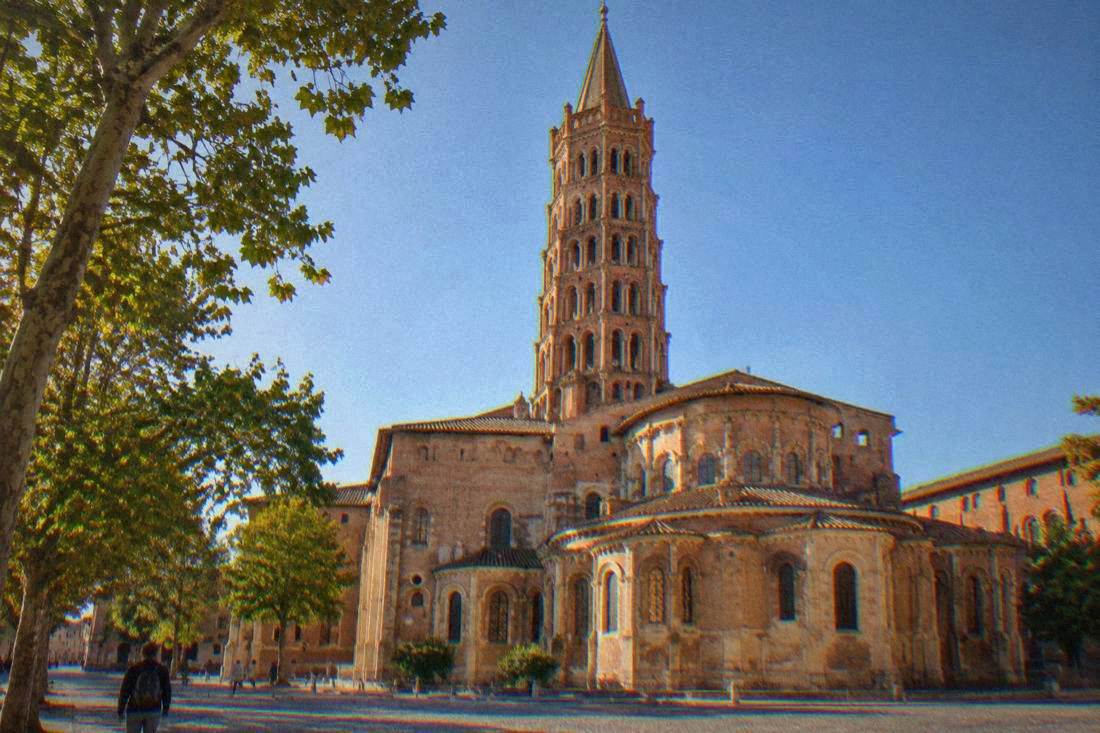
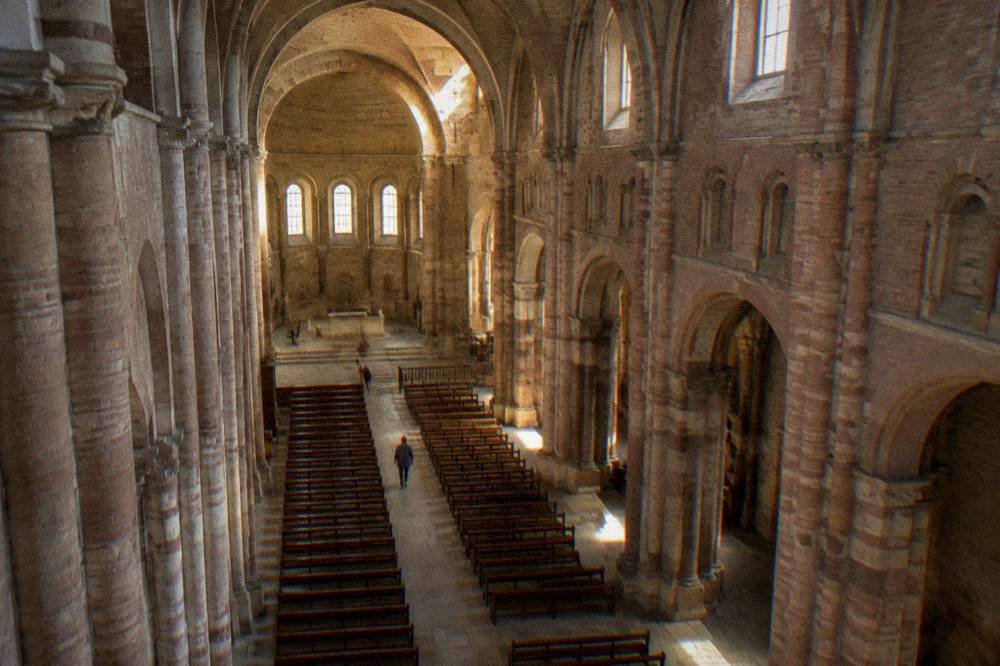
Inside, the basilica's core sights are the tomb of Saint Saturnin, the crypt area where his relics have been venerated, the stone vaulting of the nave and the bell tower that defines the Toulouse skyline. Around it, the quarter offers the Musee Saint-Raymond directly opposite, the medieval streets toward the Capitole and the riverside walk along the Garonne, all within a short stroll.
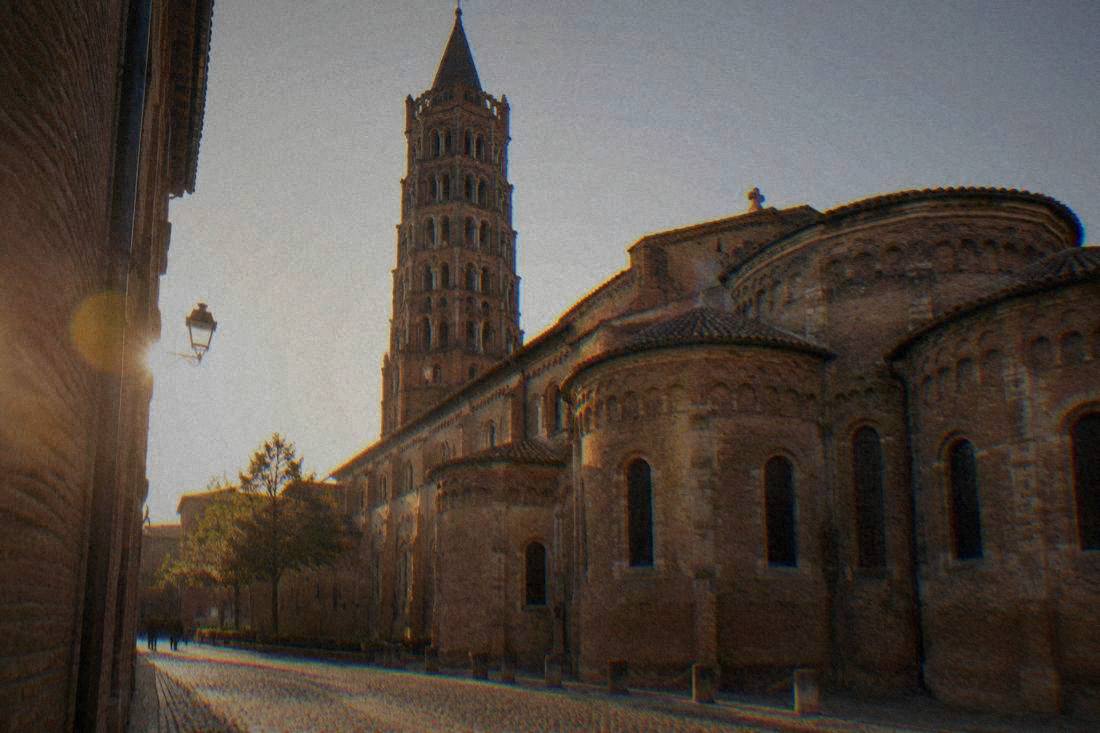
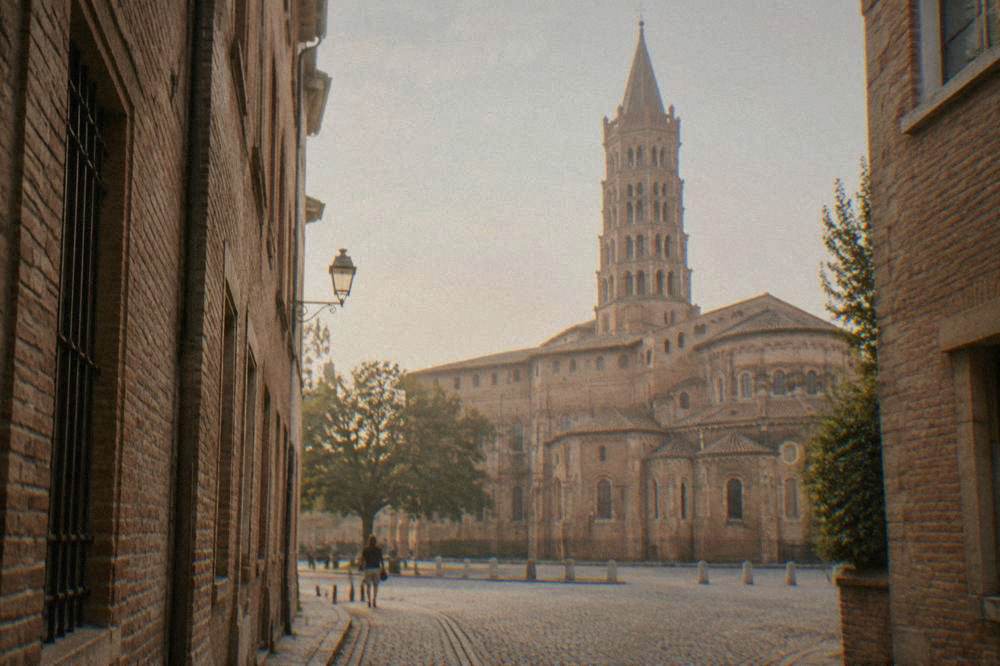
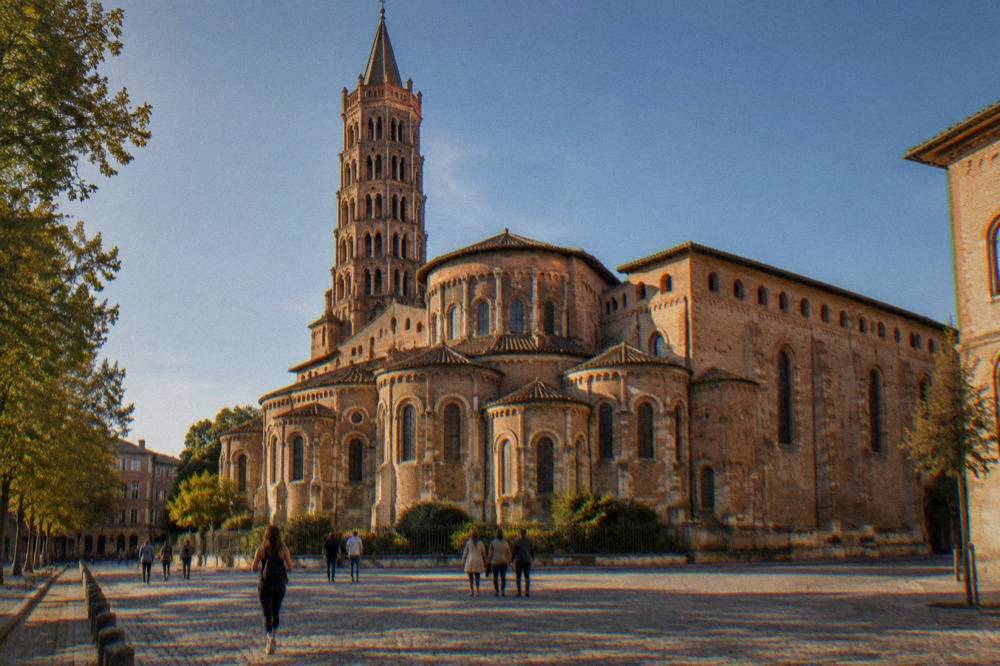
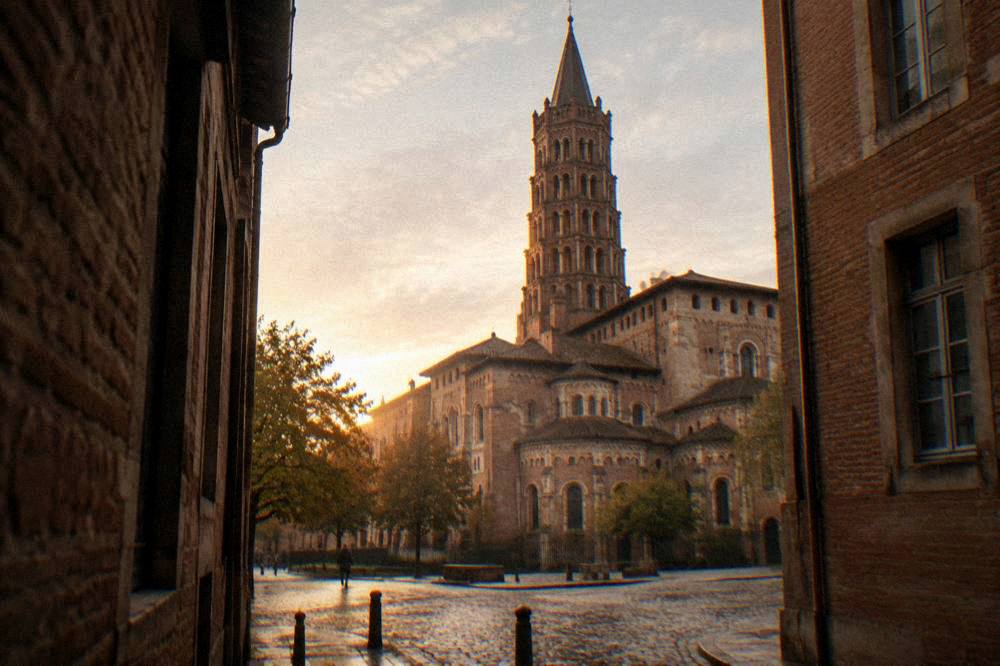
Start with the tower. The tiered stone spire is the single most recognizable silhouette in the city, and the square in front of the church is the place to see it whole. Inside, the church is built around its pilgrim function: the layout let medieval visitors reach the relics and move on without disturbing services, and the city's page describes the basilica as a major stop on the Via Tolosana. Look for the tomb of the saint, the carved stonework along the nave, and the contrast between the pale stone of the church and the pink brick of the streets outside.
Directly opposite the basilica stands the Musee Saint-Raymond, the city's museum of Roman antiquities. Its collection of Roman sculpture and artifacts is the natural companion to the basilica's medieval world. The museum closed on 3 November 2025 for renovation and modernisation works and reopened on 3 April 2026, with its exhibition "Gaulois, mais Romains !" running from 3 April 2026 to 3 January 2027. The Musee Saint-Raymond guide has full details. The Musee des Augustins partially reopened on 19 December 2025, is fully closed from 21 September to 2 October 2026 for great-cloister works, and reopens its Gothic halls on 3 October 2026 at 10:00.
If you want the basilica explained rather than just admired, a guided walk is the efficient choice. The Toulouse Must-See Walking Tour covers the headline monuments with a live guide, and the Toulouse Must-See Highlights with a Guide walk does the same at a faster pace. For a free, tip-based introduction, Harry's Free Tour on GuruWalk is a well-reviewed option that covers the historic center, including the basilica quarter, without an upfront price.
Rather wander the pink city at your own pace with commentary? Book a self-guided audio tour here.
Once you have had your fill of medieval stone, Toulouse offers a completely different half of itself, and it is the half the city is arguably just as famous for. The aerospace cluster around the Airbus site gives the basilica a modern counterweight, and the museum that opens it up to visitors sits a short ride from the center. It is the pairing that defines a full Toulouse itinerary: the pilgrim road in the morning, the assembly halls in the afternoon.
How Much Does It Cost To Visit The Basilique Saint-Sernin?
This page does not carry an admission price for the basilica itself, so this guide will not print one; check the monument's own information before you go. What is verified is the cost of everything around it: the nearby museums the tourist office lists at EUR 5 to EUR 12, the Pass Tourisme at EUR 26 with its free guided tour, and the Tisseo transport fares you will use to reach the quarter.
The honest answer about the church itself comes first. No primary source verified for this site states the basilica's current admission charge or hours, and a guide that invents a figure is doing you a disservice. The metropole's page for the basilica is the place to confirm both before a visit. What the available information does carry is the cost landscape around the monument, and it is a favorable one.
The tourist office's Pass Tourisme page lists the normal rates for the museums the pass covers, and those rates give you a realistic budget for the surrounding sights. The pass itself costs EUR 26 for stays of one to three days, pays off from the third activity, and includes a free guided tour from the tourist office; adding EUR 10 buys ten public-transport trips. The Cite de l'espace, whose normal adult rate the office lists at EUR 29, is discounted rather than free with the pass, a distinction worth knowing before you buy.
| Sight | Normal Rate Listed By The Tourist Office | With The Pass Tourisme |
|---|---|---|
| Fondation Bemberg | EUR 12 | Free |
| Museum de Toulouse | EUR 12 | Free |
| Les Abattoirs | EUR 12 | Free |
| Musee des Augustins | EUR 5 | Free |
| Couvent des Jacobins | EUR 5 | Free |
| Cite de l'espace | EUR 29 | Discounted, not free |
One more verified freebie belongs on any budget itinerary: the Couvent des Jacobins, a short walk away, is free on the first Sunday of the month except when a temporary exhibition is on. That rule is stated for the Jacobins only, so do not generalize it to other museums. Our Couvent des Jacobins guide explains what you get there.
When Is The Best Time To Visit The Basilica And Its Quarter?
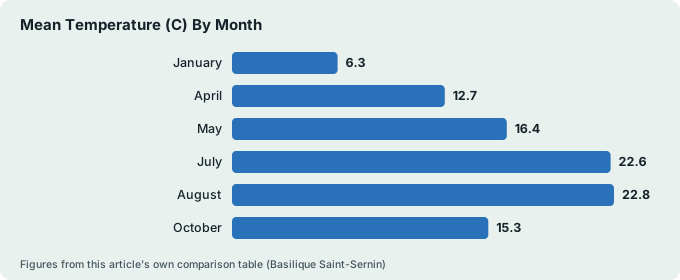
The most reliable window is late spring through early autumn, with July standing out in the Meteo-France 1991-2020 normals for Toulouse-Blagnac as the sunniest month at 258.6 hours of sunshine and one of the driest at 40.1 mm of rain. The counterintuitive fact is that May, not a winter month, is Toulouse's wettest month at 73.6 mm, so early summer planning should budget for showers.
The climate record for the city is specific enough to plan against. The annual totals come in at 627 mm of rain across 95.8 rain days and 2,075.1 hours of sun, with a mean daily maximum of 18.8C and a mean daily minimum of 9.6C. May leads the wet months at 73.6 mm, followed by April at 65.2 mm and June at 64.2 mm, while February is the driest at 37.2 mm. The extremes on record, 42.4C on 23 August 2023 and -19.2C on 15 February 1956, bracket a climate that is generally mild.
| Month | Mean Temperature (C) | Rain (mm) | Sunshine (Hours) |
|---|---|---|---|
| January | 6.3 | 52.5 | 89.1 |
| April | 12.7 | 65.2 | 188.5 |
| May | 16.4 | 73.6 | 212.3 |
| July | 22.6 | 40.1 | 258.6 |
| August | 22.8 | 44.6 | 246.4 |
| October | 15.3 | 54.3 | 155.2 |
For the basilica specifically, a stone church is a fair-weather and foul-weather sight at once: the square in front is at its best in the long summer light, while the interior is a genuine refuge on one of Toulouse's rainy May afternoons. If you are timing a whole trip, our Toulouse Weather and Best Time To Visit Toulouse guides carry the full month-by-month picture, and the autumn festival calendar is worth a look too: the verified dates include Toulouse les Orgues from 7 to 18 October 2026, whose opening concert is at Notre-Dame de la Daurade, and Piano aux Jacobins from 8 to 30 September 2026.
What Is Within Walking Distance Of The Basilique?
Within a short walk of the basilica you can reach the Capitole, the Saint-Etienne quarter with its cathedral, the Saint-Aubin neighborhood, the Marche Victor Hugo and the Garonne riverside with the Pont Neuf, which together make the church the natural starting point for a day in central Toulouse. The Musee Saint-Raymond sits directly opposite, and the Jacobins are a few streets south.
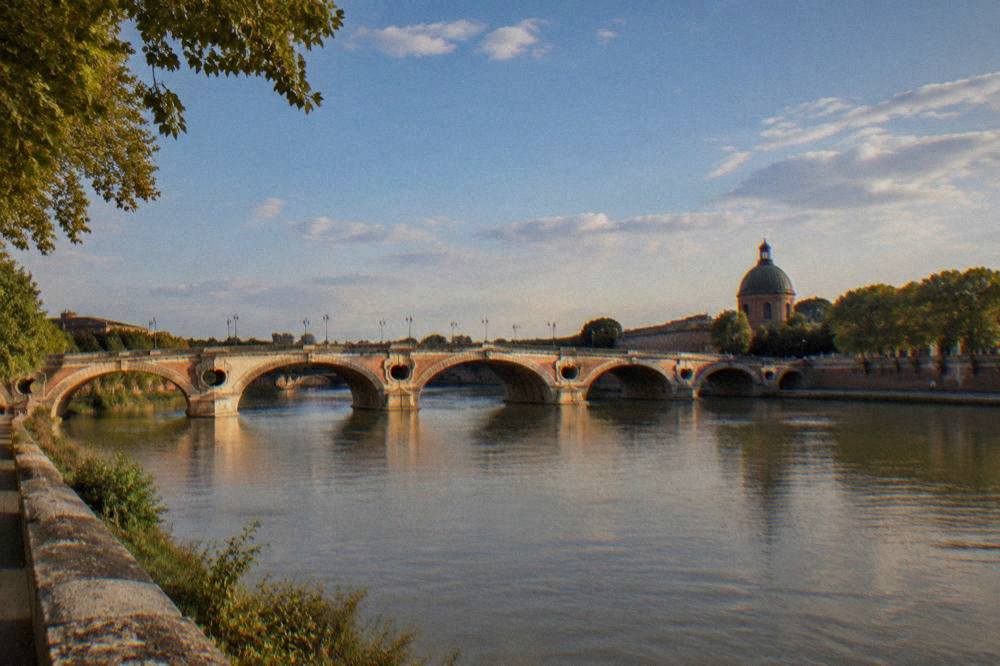
The basilica's position is the reason it works so well as a first stop. Heading one way brings you to the Capitole and the main square; heading the other brings you into the Saint-Etienne quarter and the Toulouse Cathedral. South and east lie the Saint-Aubin neighborhood, the Sunday market streets and the Marche Victor Hugo, the covered market where the city's food culture is on display. Cross toward the river and you reach the Garonne riverside and the Pont Neuf, the oldest bridge in the city and the classic viewpoint at dusk.
| Direction From The Basilica | What You Reach | Site Guide |
|---|---|---|
| Toward the main square | Capitole de Toulouse | Guide |
| Southeast | Saint-Etienne quarter and cathedral | Guide |
| East | Saint-Aubin neighborhood | Guide |
| South | Couvent des Jacobins | Guide |
| West toward the river | Garonne riverside and Pont Neuf | Guide |
Art lovers have two more stops within the same radius. The Fondation Bemberg, with its normal rate of EUR 12 listed by the tourist office, and Les Abattoirs, the modern art museum at the same listed rate, both sit close to the river. If you are building a full day around the basilica quarter, our One Day In Toulouse itinerary starts exactly here.
How Does Saint-Sernin Connect To Day Trips From Toulouse?
The basilica's role on the Via Tolosana makes it the natural anchor for pilgrimage-themed day trips from Toulouse, and the verified options include Saint-Bertrand-de-Comminges on the same historic route and Saint-Cirq-Lapopie on the Lot, both reachable as day trips from the city. Albi, whose UNESCO-listed cathedral sits on another of the Santiago roads' associated networks, is a bookable coach day trip from Toulouse.
The pilgrimage thread is the one that ties the region together. Saint-Bertrand-de-Comminges, covered in our day trip guide, is a cathedral town on the Via Tolosana itself, and it gives you the same medieval road in a completely different landscape. Saint-Cirq-Lapopie, one of the most photographed villages in the region, has its own guide. Both work as day trips from a Toulouse base, and the basilica is the city-end bookend for either.
| Day Trip Destination | Connection To Toulouse | Site Guide |
|---|---|---|
| Saint-Bertrand-de-Comminges | Cathedral town on the Via Tolosana | Guide |
| Saint-Cirq-Lapopie | Hilltop village on the Lot, day trip | Guide |
| Albi | UNESCO-listed cathedral city, bookable coach day trip | Guide |
| Carcassonne | Fortified city, bookable coach day trip | Guide |
If you would rather have the logistics handled, two bookable options in the city's tour roster fit directly. The Albi and Cordes day trip visits a UNESCO-listed cathedral city, and the open-top minibus sightseeing tour covers the basilica among the city's headline sights with an audio guide.
For the aerospace half of Toulouse's identity, the same quarter logic applies in reverse: the basilica is the historic pole, and Aeroscopia, the aviation museum near the Airbus site, is the modern one. Our Aeroscopia guide covers the museum, whose verified admission rates are EUR 16 adult and EUR 13 reduced, with an annual pass at EUR 26 and a family pass at EUR 80, open daily 9:30-18:00 with last entry at 17:00. The Airbus factory tours run by Manatour carry their own rules: an original passport or ID card is required, no photocopy or phone image accepted, and visitors must arrive well before the scheduled start. The Airbus Factory Tour guide has the full checklist.
| Aerospace Site | Verified Admission | Key Rule |
|---|---|---|
| Aeroscopia museum | Adult EUR 16, reduced EUR 13 | Open daily 9:30-18:00, last entry 17:00 |
| Aeroscopia annual pass | EUR 26 | Family pass EUR 80 |
| Manatour Airbus A350 factory tour | Adult EUR 18, reduced EUR 15 | Original passport or ID card required |
| Manatour Airbus A321 factory tour | Adult EUR 18, reduced EUR 15 | Arrive 30 minutes early, no cameras |
Common Questions About The Basilique Saint-Sernin
Is The Basilique Saint-Sernin UNESCO Listed?
Yes, but as part of a larger property. UNESCO inscribed the Routes of Santiago de Compostela in France in 1998, and the Basilique Saint-Sernin is listed as a component of that property. It is not a freestanding World Heritage Site, and Toulouse's only other UNESCO listing is the Canal du Midi, inscribed in 1996.
Which Saint Is Buried In The Basilique Saint-Sernin?
The basilica holds the tomb of Saint Saturnin, also known as Saint Sernin, Toulouse's first bishop, and the church was built around that tomb. The city's page for the basilica describes it as a major stop on the Via Tolosana, the southern pilgrimage road toward Santiago de Compostela. Our dedicated answer page covers the full story.
How Much Does It Cost To Visit The Basilique Saint-Sernin?
Check the monument's own information before you go. The surrounding sights are well documented: the tourist office lists the Couvent des Jacobins and Musee des Augustins at EUR 5 and the Fondation Bemberg, Museum de Toulouse and Les Abattoirs at EUR 12, all free with the EUR 26 Pass Tourisme.
What Is Near The Basilique Saint-Sernin?
The Musee Saint-Raymond stands directly opposite, having reopened on 3 April 2026 after its renovation and modernisation works. The Capitole, the Saint-Etienne quarter, the Saint-Aubin neighborhood, the Marche Victor Hugo, the Couvent des Jacobins and the Garonne riverside are all within a short walk.
When Is The Best Time Of Year To Visit?
July is the sunniest month in the Meteo-France 1991-2020 normals for Toulouse-Blagnac, at 258.6 hours of sunshine with only 40.1 mm of rain, making it a strong choice. May is unexpectedly the wettest month at 73.6 mm, so pack for showers if you come in late spring. The stone interior of the basilica is a good refuge on a rainy day in any season.
Can You Visit The Basilica On A Guided Tour Of Toulouse?
Yes. The basilica quarter is covered by the city's walking tours, including a live-guided must-see walk and a longer highlights walk, and by free, tip-based GuruWalk tours such as Harry's Free Tour. The open-top minibus sightseeing tour with audio guide also includes the basilica among the city's headline monuments.
The Basilique Saint-Sernin rewards exactly the kind of unhurried visit its pilgrim builders would have recognized: arrive from the Capitole side, take the tower in from the square, give the interior time, and finish with the walk down to the Garonne.