Toulouse Sunset: Where To Photograph The Pink City At Golden Hour
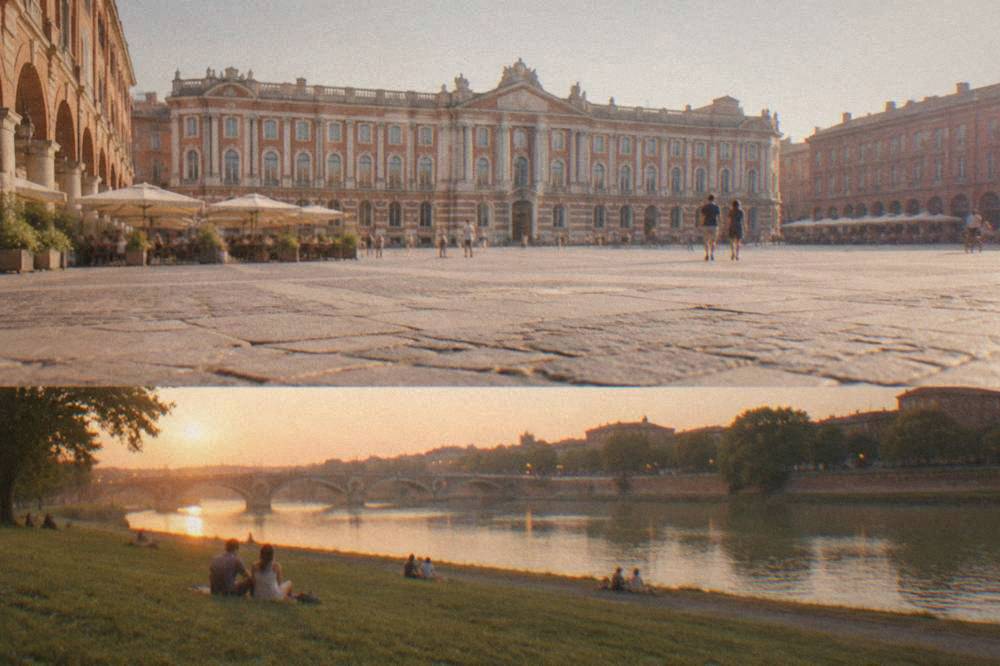
Toulouse earns its nickname, La Ville Rose, most honestly at the end of the day, when the low sun turns the city's pink brick the color of a coal fire and the Garonne carries the reflection downstream.
Short answer
The best Toulouse sunset spots are the Garonne banks around the Pont Neuf, the quai de la Daurade, the Prairie des Filtres and the elevated terraces near the Saint-Sernin basilica. Evening light on the pink brick is strongest in the hour before the sun drops behind the river's western bank.
Toulouse, the pink-brick city on the Garonne in the Occitanie region of southwestern France, is one of the most rewarding mid-size cities in Europe for evening photography. The brick that gives "La Ville Rose" its name changes character through the day, dull and dusty at noon, deep rose as the sun drops, and the river, the Canal du Midi and the towers of Saint-Sernin give the light something to work with. This guide lays out where to stand, when to go, and how to plan a sunset shoot around the city's most photogenic corners.
Where To Watch The Sunset In Toulouse?
The strongest Toulouse sunset viewpoints are strung along the Garonne: the Pont Neuf and the quai de la Daurade on the right bank, the Prairie des Filtres meadow on the left bank, and the elevated ground around the basilica of Saint-Sernin inland. Each gives a different frame, water and bridge, open sky, or rooftops and towers, and all sit within a short walk of the Capitole.
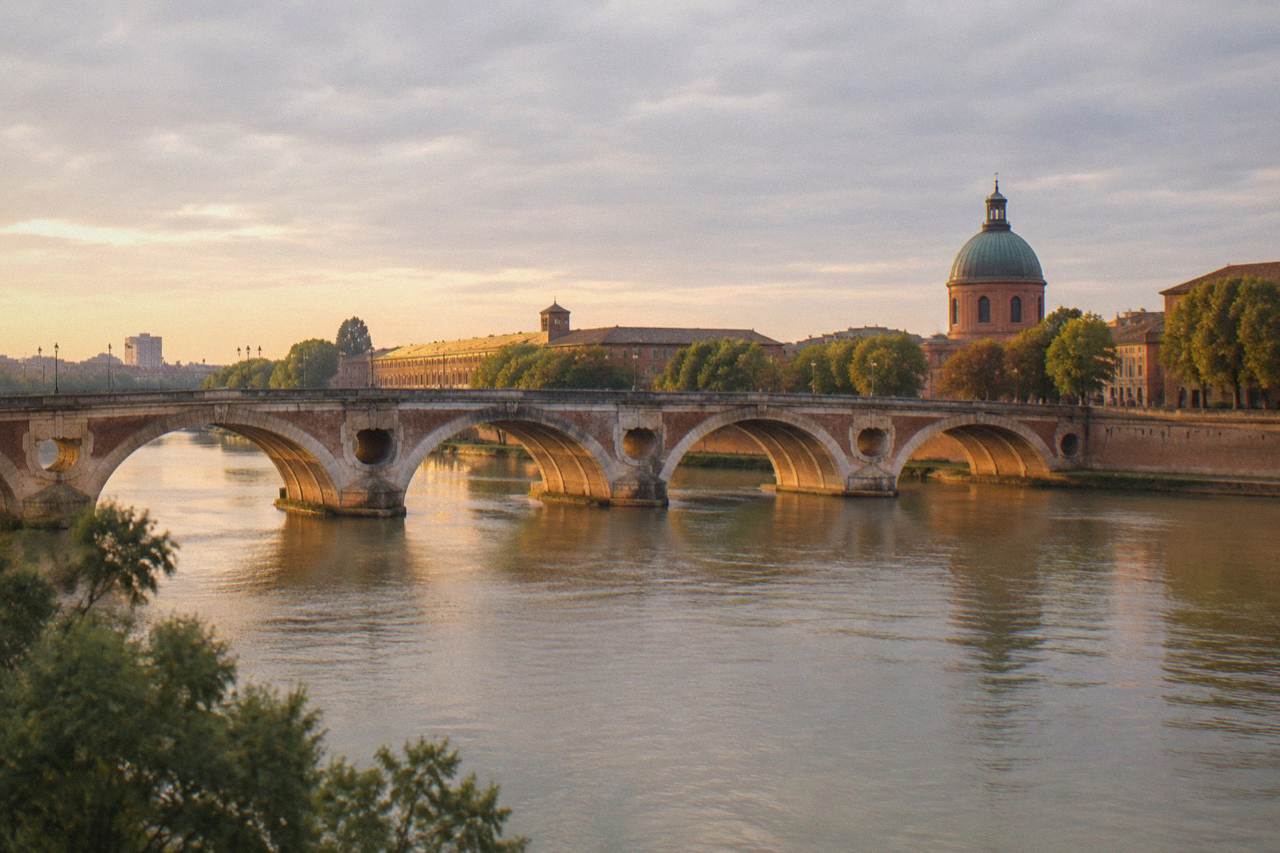
The river is the reason Toulouse photographs so well at dusk. The Garonne runs broadly through the city center, and its west-facing banks catch the last direct light while the east bank falls into shade, which is exactly the contrast a sunset shot wants. The quai de la Daurade, a stone quay below the Notre-Dame-de-la-Daurade church, looks straight across at the red-brick facades of the left bank, and the Pont Neuf gives you a foreground with arches that frame the water. For a fuller picture of the riverside, the Garonne riverside guide covers the whole stretch.
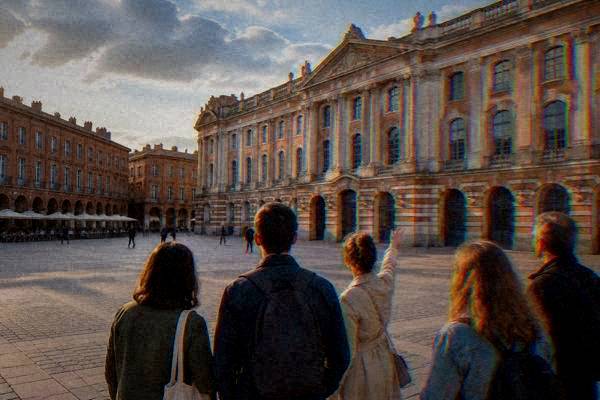
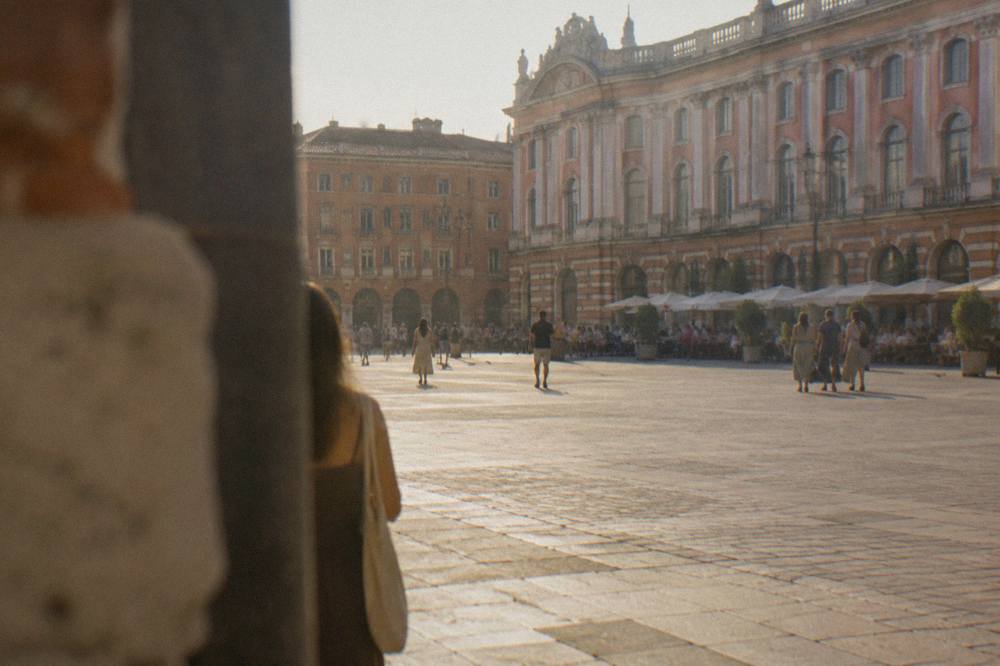
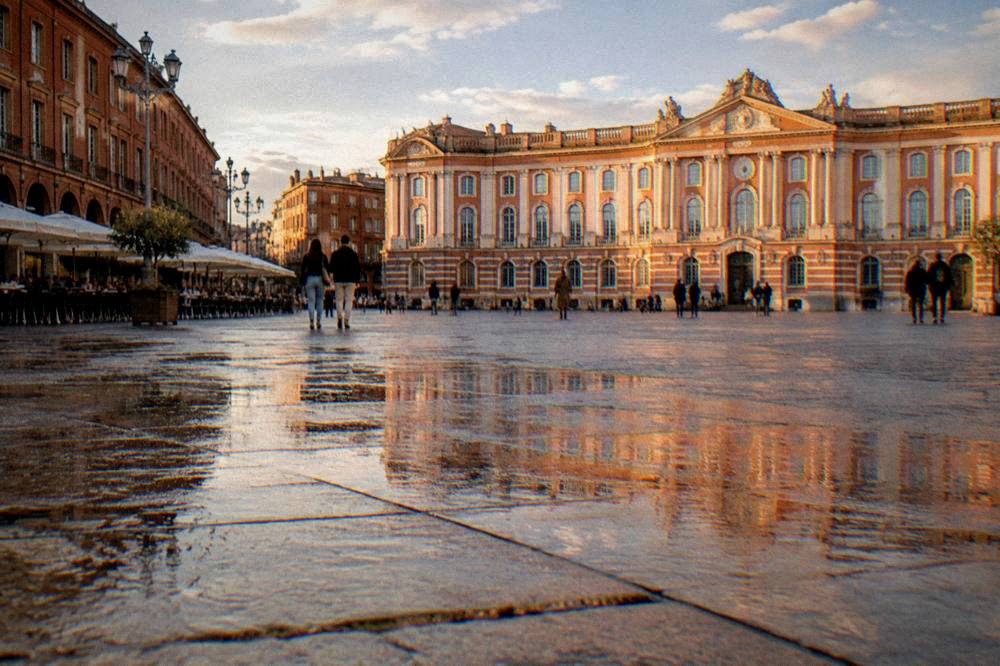
Inland, the light does something different. The streets around the Capitole and the Saint-Sernin basilica are narrow enough that the low sun rakes along the brick facades for a few minutes, throwing long shadows and turning the walls a saturated rose. Photographers who want the classic "pink city" wall shots should be walking, not standing still, in the last hour of daylight.
| Spot | What You Shoot | Why It Works At Sunset |
|---|---|---|
| Pont Neuf | Bridge arches, river, both banks | The bridge silhouette frames the western sky |
| Quai de la Daurade | Left-bank facades across the water | Direct view of sunlit brick over the river |
| Prairie des Filtres | Open riverbank, willows, water reflections | Uncluttered foreground for wide skies |
| Around Saint-Sernin | Tower, bell walls, narrow streets | Low sun rakes the pink brick walls |
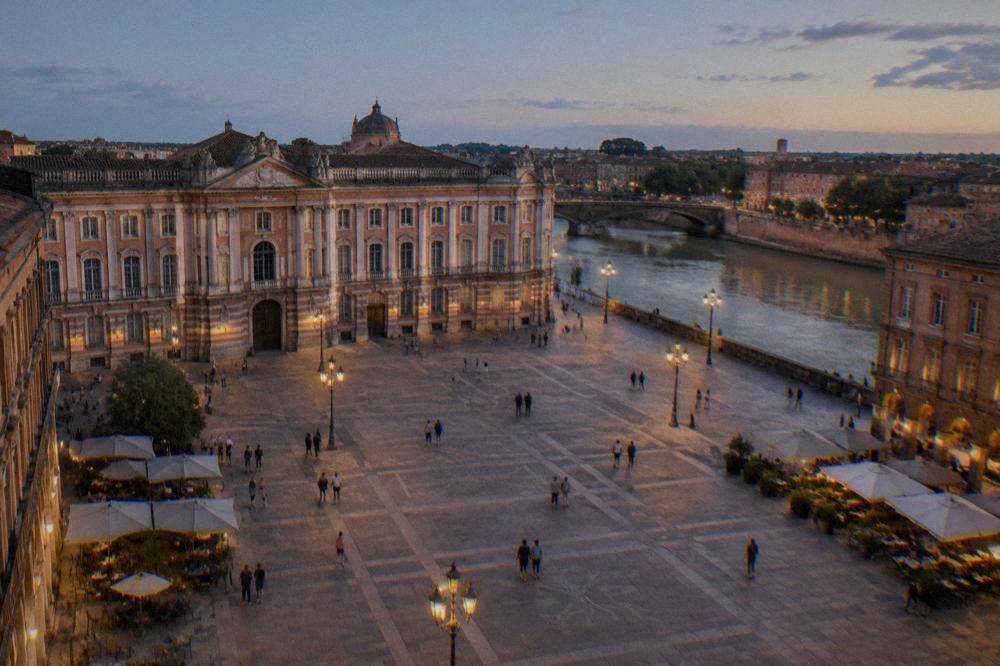
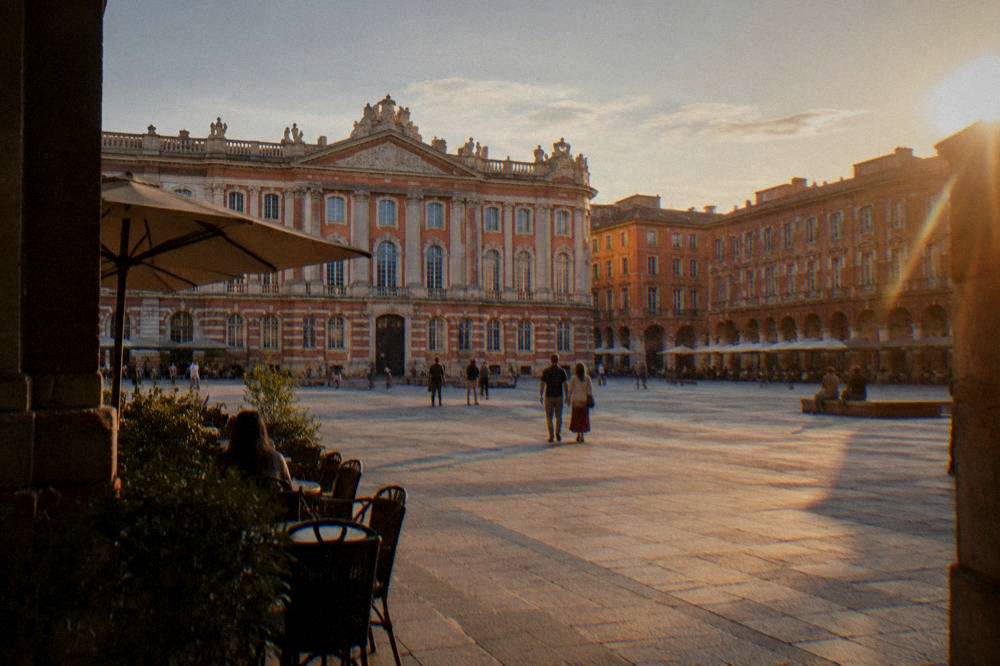
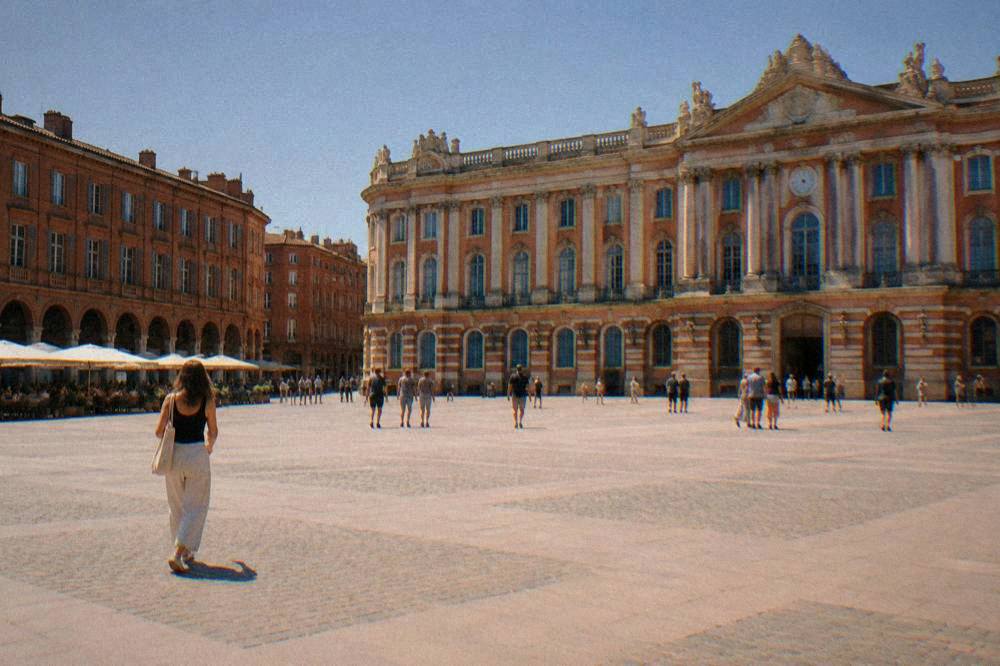
| Capitole square | Facade, evening crowds, street life | The building's frontage catches warm side light |
Why Do Toulouse's Pink Bricks Glow At Golden Hour?
Toulouse's buildings are built from a local pink brick, and warm evening light doubles the effect: the brick is already rose-toned, so the low sun saturates it rather than merely illuminating it. The result is a city that visibly changes color in the last hour of daylight, which is what earned it the nickname La Ville Rose.
What can be said plainly is what any visitor sees: the facades around the Capitole, the Jacobins and the Saint-Rome streets shift from pale pink at midday to a deep burnt rose at dusk, and photographers who plan around that shift get the city's signature look.
Timing matters more than equipment here. The color change is gradual, but the strongest saturation comes in the final stretch before the sun drops behind the western bank, when the light travels sideways through the atmosphere and lands almost horizontal on the walls. If you want the city's monuments explained while you scout angles, a guided walk such as the Toulouse Must-see Attractions Walking Tour With A Guide covers the headline buildings, and Check availability if a private format suits your pace. The Capitole guide and the basilica of Saint-Sernin guide go deeper on the two most photographed buildings.
Between the river and the brick there is a third ingredient: the sky. Toulouse averages 2,075.1 hours of sunshine a year according to Meteo-France's 1991-2020 normals for the Toulouse-Blagnac station, and July alone averages 258.6 hours, which means summer evenings give you a reliable chance of working light. The same normals show the city gets 627 mm of rain across 95.8 rain days a year, so a backup plan for cloud is worth having in every season.
Which Garonne Banks And Bridges Photograph Best At Dusk?
The right bank from the Pont Neuf to the quai de la Daurade gives the classic sunset frame, while the Prairie des Filtres on the left bank gives the widest open sky. Shoot the bridge from the Daurade side first, then cross to the meadow for reflections as the light fades, and finish on the bridge itself for the blue hour.
Work the river in that order and you use the light instead of chasing it. From the quai de la Daurade, the sun sets behind the left bank, so the facades across the water stay lit while the sky behind them burns down. The Prairie des Filtres, a grassy riverbank park downstream, faces the water without a railing, which makes it the easiest place to put a tripod down for long exposures once the color goes deep. The Pont Neuf guide details the bridge's own angles.
After the sun is gone, do not leave. The stretch after sunset, when the sky holds blue and the streetlights come on along the quay, is when Toulouse's riverside photographs best of all, with the bridge lamps and the lit facades reflected in a slow shutter. The Toulouse at night guide extends the evening from there.
| Riverbank Location | Subject | When To Stand There |
|---|---|---|
| Quai de la Daurade | Pont Neuf arches, left-bank facades | The hour before sunset |
| Prairie des Filtres | Wide sky, water reflections | Sunset into early blue hour |
| On the Pont Neuf | Both directions, river upstream and downstream | Blue hour, after the lamps come on |
| Left-bank quay below the dome de la Grave | Dome and river skyline | Late afternoon side light |
A river cruise is a second way to work this stretch, and the operator's listing carries the current times and prices. The UNESCO-listed Canal du Midi cruise tour with commentary covers the canal rather than the river, while the Toulouse Aperitif Cruise Tour puts you on the Garonne with a drink in hand, which some photographers prefer as a scouting run before a serious shoot.
A river cruise is a second way to work this stretch. Book an electric tuk-tuk tour here.
Which Monuments And Terraces Give The Best Elevated Or Framed Views?
The photogenic framed views inland are the Saint-Sernin basilica's tower seen down its approach streets, the Capitole's courtyard and facade, and the Couvent des Jacobins' palm-tree vault, while the dome de la Grave gives the most distinctive silhouette on the river skyline. Admission to several of these is inexpensive, and the tourist office's Pass Tourisme covers the main municipal museums and monuments.
For the monument interiors, the tourist office's Pass Tourisme page lists the normal rates its pass makes free: Fondation Bemberg at EUR 12, the Museum at EUR 12, Les Abattoirs at EUR 12, the Musee des Augustins at EUR 5 and the Couvent des Jacobins at EUR 5. The pass itself costs EUR 26 for stays of one to three days and, per the same page, pays off from the third activity, and adding EUR 10 buys ten public-transport trips. The Toulouse Pass Tourisme guide works through the arithmetic.
One date matters if your shoot includes the Musee des Augustins: the museum states it is temporarily closed from 21 September to 2 October 2026 for great-cloister works, and its Gothic halls, the sacristy, the Notre-Dame de Pitie hall and the chapter house, reopen on 3 October 2026 from 10:00. The Couvent des Jacobins is free on the first Sunday of the month except when a temporary exhibition is on, and roof restoration work on the church is under way while the site stays open to visitors. The wider set of guides lives on Toulouse Travel Guide.
| Monument | Normal Admission | Notes For Photographers |
|---|---|---|
| Couvent des Jacobins | EUR 5 | Free first Sundays except during temporary exhibitions |
| Musee des Augustins | EUR 5 | Closed 21 Sep to 2 Oct 2026, Gothic halls reopen 3 Oct 2026 |
| Fondation Bemberg | EUR 12 | Historic-district interior, check hours on site |
| Les Abattoirs | EUR 12 | Riverside contemporary art museum |
| Museum de Toulouse | EUR 12 | Near the Jardin des Plantes |
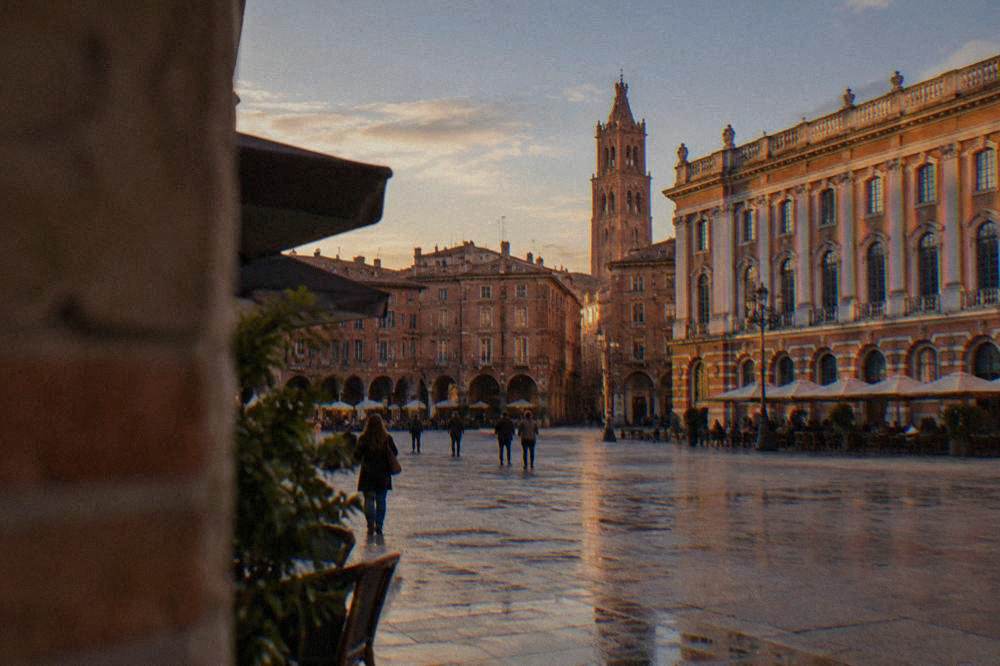
The basilica of Saint-Sernin deserves its own evening. It is a major stop on the Via Tolosana pilgrimage route and has been listed since 1998 as part of the UNESCO "Routes of Santiago de Compostela in France", which is the only UNESCO connection the building carries. Its tower, seen end-on down the rue du Taur or from the squares around it, is the single most recognizable silhouette in the city after the bridge, and the warm brick reads best when the sun is low enough to texture the stonework.
When Is The Best Season For A Toulouse Sunset?
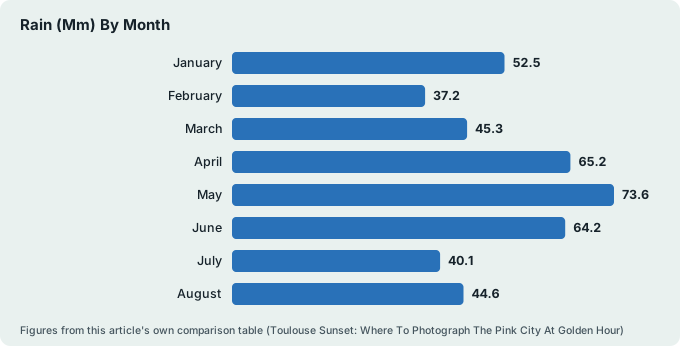
July and August give the most reliable evening light, with 258.6 and 246.4 hours of monthly sunshine respectively and only 40.1 and 44.6 mm of rain, while May is the wettest month at 73.6 mm despite warm temperatures. For pink-brick saturation with thinner crowds, late September and October offer 210.1 and 155.2 hours of sunshine and a lower sun angle.
The numbers come from Meteo-France's 1991-2020 climate normals for the Toulouse-Blagnac station, the same series that records an annual mean maximum of 18.8C, a mean minimum of 9.6C, and record extremes of 42.4C on 23 August 2023 and -19.2C on 15 February 1956. The surprise in the data, and a genuinely useful planning fact, is that the wettest month is May, not a winter month: April at 65.2 mm and June at 64.2 mm follow it, while February is the driest at 37.2 mm. Anyone scheduling a photography trip around "dry summer, wet winter" instinct gets Toulouse backwards in spring.
| Month | Mean Max (C) | Sunshine (Hours) | Rain (Mm) |
|---|---|---|---|
| January | 9.7 | 89.1 | 52.5 |
| February | 11.2 | 118.2 | 37.2 |
| March | 15.0 | 175.3 | 45.3 |
| April | 17.6 | 188.5 | 65.2 |
| May | 21.4 | 212.3 | 73.6 |
| June | 25.7 | 231.8 | 64.2 |
| July | 28.2 | 258.6 | 40.1 |
| August | 28.5 | 246.4 | 44.6 |
| September | 24.8 | 210.1 | 45.7 |
| October | 19.7 | 155.2 | 54.3 |
| November | 13.5 | 99.9 | 55.0 |
| December | 10.4 | 89.7 | 49.3 |
For season-by-season planning beyond light, the Toulouse weather guide and the best time to visit Toulouse guide carry the full picture, and the is Toulouse worth visiting guide answers the broader question.
How Should You Shoot Pink Brick And Low Light?
Shoot the saturated-brick streets with the sun off to your side, expose for the lit walls so they hold their rose tone, and switch to a tripod and a long exposure once the sun is down, when the river reflections and blue-hour sky need a stable camera and a slow shutter rather than a high sensitivity.
Pink brick is easy to overexpose in direct low sun, and the classic mistake is metering for the whole scene and blowing the walls out to salmon. Spot meter off the brick, or dial in a touch of negative exposure compensation, and let the shadows go dark, they should. Once the sun sets, the quays get dark quickly, and the reflections along the Garonne reward a stable camera and a slow shutter more than any amount of sensitivity pushing.
| Situation | Aperture Choice | Shutter Approach | Sensitivity |
|---|---|---|---|
| Sunlit brick street, sun at the side | Moderate, enough for street depth | Fast, handheld | Base setting |
| Bridge against the western sky | Smaller, for edge-to-edge sharpness | Fast, handheld | Base setting |
| Golden-hour river reflection | Moderate | Slower, brace or lean | Base to slightly raised |
| Blue hour on the quay | Smaller, for clean light points | Long, on a tripod | Base, on a tripod |
| Lit facade after dark | Wider, to gather light | Moderate, steady stance | Raised, as the light demands |
A phone does most of this well too, with one caveat: lock exposure by tapping on the brick, not the sky, or the phone will brighten the whole frame and wash the color out. The Toulouse walking tours guide pairs routes with the monuments above for photographers who like a plan.
How Do You Plan A Half-Day Sunset Photography Walk?
Start mid-afternoon at the Saint-Sernin basilica for the tower and street angles, walk down to the Capitole as the light warms, reach the quai de la Daurade for the main sunset, cross to the Prairie des Filtres for reflections, and finish on the Pont Neuf for blue hour. A Tisseo day pass at EUR 7.20 covers any tram or metro hops you need to shortcut the route.
The walk is all downhill or flat and can be done in ordinary shoes. The fares come from Tisseo's official e-boutique catalogue: a single trip is EUR 1.90, or EUR 2.50 bought last-minute on board, a 10-trip carnet is EUR 16.00, a day pass is EUR 7.20 and a 3-day pass is EUR 14.30, with no 2-day pass listed. If you are arriving the same day, an airport single covering the Tisseo network plus the airport shuttle is EUR 9.50, and the getting around Toulouse guide maps the network. Note that the tram line to the airport has been closed since 5 June 2023 for metro Line C works and stays closed until the end of 2026, so the shuttle bus is the public link; the Toulouse airport to city center guide covers that transfer in full.
| Tisseo Ticket | Price | Best For |
|---|---|---|
| Single trip | EUR 1.90 | One-off hops between spots |
| Single bought on board | EUR 2.50 | When you cannot reach a machine |
| 10 trips | EUR 16.00 | A multi-day stay with occasional rides |
| Day pass | EUR 7.20 | A full photography day of hopping |
| 3-day pass | EUR 14.30 | A long weekend of shooting |
If you would rather have a guide handle the monuments so you can concentrate on frames, the private walking format mentioned earlier is the natural fit, and the Toulouse Must-see Attractions Walking Tour With A Guide page lists what it covers. For an evening with a drink rather than a tripod, the aperitif cruise on the Garonne runs the same stretch of water you have just walked.
For a completely different sunset, the region beyond the city delivers some of France's most dramatic evening silhouettes. The day trips from Toulouse guide rounds up the options, and a medieval-cliffside destination like Rocamadour, covered on this site, turns golden hour into something closer to theater.
Common Questions About Photographing Sunsets In Toulouse
Quick answers to what photographers ask most about evening light in the pink city.
Where is the best place to watch the sunset in Toulouse?
The quai de la Daurade and the Pont Neuf give the classic river sunset, with the sun dropping behind the left bank while the pink-brick facades stay lit. The Prairie des Filtres meadow downstream gives the widest open sky and the easiest tripod position for reflections.
How long does golden hour last in Toulouse?
This site does not publish clock times for sunset, since they shift through the year, but the practical rule holds anywhere: the strongest color on the pink brick comes in the final stretch before the sun drops, and the stretch of blue hour after it is when the riverside photographs best of all.
Is Toulouse good for photography?
Yes. The pink brick gives the city a signature color that changes through the day, the Garonne and the Pont Neuf provide water and foreground, and monuments like the Saint-Sernin basilica and the Couvent des Jacobins add strong silhouettes and interiors. Meteo-France's normals show 2,075.1 hours of annual sunshine, so working light is a reasonable bet outside the wettest spring weeks.
What is the wettest month in Toulouse?
May, at 73.6 mm of rain in the 1991-2020 Meteo-France normals, ahead of April at 65.2 mm and June at 64.2 mm. February is the driest month at 37.2 mm, which surprises visitors who assume winter is the rainy season here.
Do I need a ticket for any of the sunset viewpoints?
No. The riverbanks, the Pont Neuf, the Prairie des Filtres and the streets around the Capitole and Saint-Sernin are public space. Tickets only come into play for monument interiors, and the tourist office lists the Couvent des Jacobins at EUR 5 and the Musee des Augustins at EUR 5 among the rates its Pass Tourisme covers.
Can I get to the sunset spots by public transport?
Yes. A Tisseo day pass at EUR 7.20 covers metro, tram and bus for the day, and a single trip is EUR 1.90. The riverside viewpoints are all within walking distance of the city center, so transport is only needed to shortcut the walk in from outer neighborhoods.
The evening light on the Garonne is the single best reason to keep your camera out past dinner in this city, and the walk above is built so you are standing on the Pont Neuf, not looking for it, when the lamps come on.