Bordeaux Vs Toulouse: Which French City Fits Your Trip?
Toulouse, the pink-brick city on the Garonne in southwestern France, and Bordeaux, the wine capital two direct trains away, both make a strong case for a French city break. Here is how they actually compare for food, wine, transport, cost and day trips.
Short answer
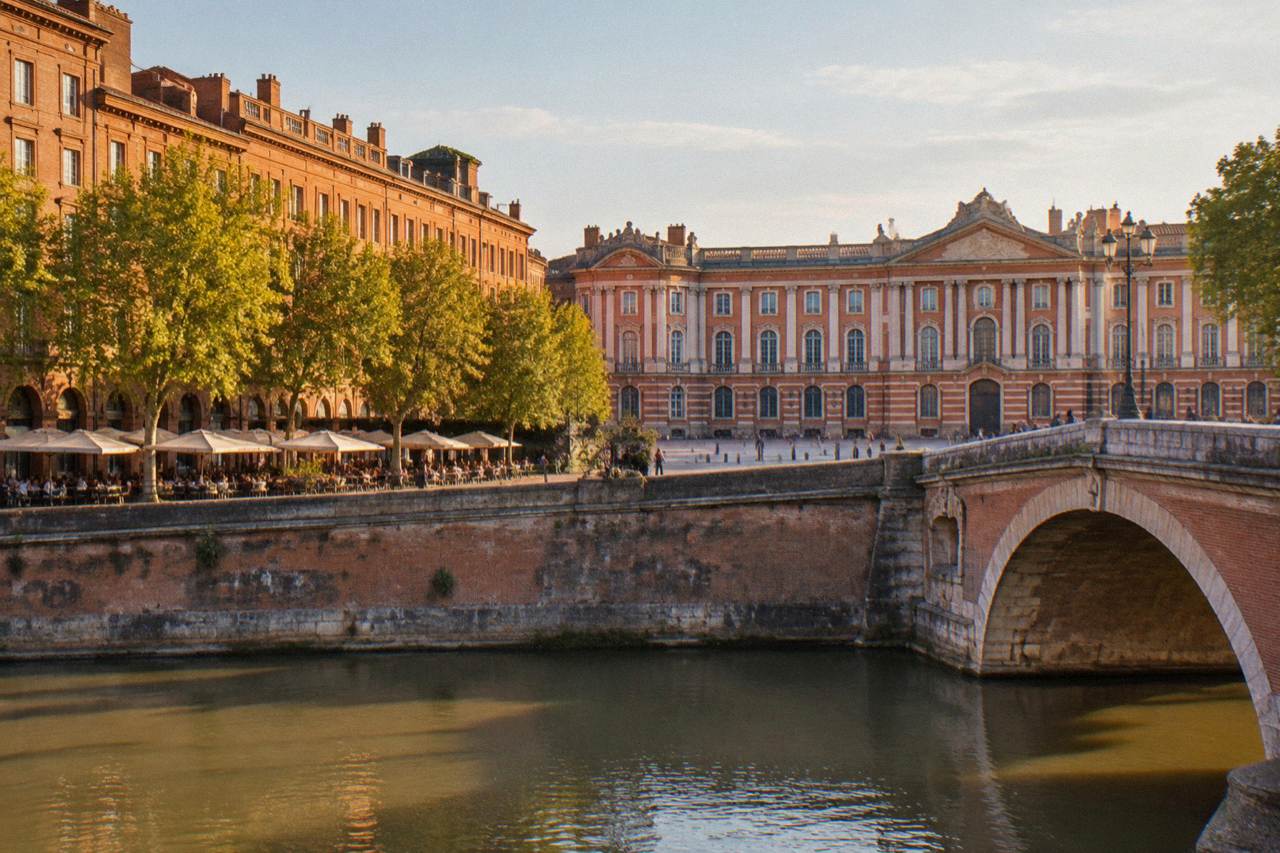
Toulouse, the pink-brick La Ville Rose on the Garonne in southwestern France, suits travelers who want aerospace sights, cassoulet, canal trips and Pyrenees day trips. Bordeaux suits wine-first visitors. Both are walkable river cities; Toulouse runs on the euro, has a EUR 26 Pass Tourisme and a metro day pass at EUR 7.20, and its wettest month is May, not winter.
Toulouse, the pink-brick city on the Garonne in the Occitanie region of southwestern France, gets compared to Bordeaux more than to any other French city, and the comparison is fair. Both are river cities with a big wine culture nearby, both have historic centers built from local stone and brick, and both sit on direct rail lines from Paris. The honest answer to "Bordeaux vs Toulouse" is that they reward different kinds of trips, and the differences are concrete: what you eat, what you drink, what you look at, and how far you can go in a day. This page lays those differences out with verified Toulouse figures, so the Toulouse side of the ledger is exact and the Bordeaux side stays qualitative rather than invented.
If you are still deciding whether the pink city deserves the ticket at all, start with the case for it on is Toulouse worth visiting, and for geography, where is Toulouse pins it on the map relative to the Atlantic coast and the mountains.
Which City Should You Choose, Bordeaux Or Toulouse?
Choose Toulouse if your trip leans on aerospace, cassoulet, canal boats and medieval day trips toward Carcassonne and the Pyrenees; choose Bordeaux if wine is the single reason you fly. Toulouse is the larger city of the two by commune population, at 514,819 inhabitants in the INSEE count for 2023, and it carries the nickname La Ville Rose for its pink brick. Neither choice is wrong, but they are different trips.
The two cities share a river, the Garonne, which is a genuine point of confusion for first-time visitors planning either trip. In Toulouse the river frames the Garonne riverside walks and the view from the Pont Neuf; in Bordeaux it widens toward the estuary country of the wine region. Both cities also carry a UNESCO credential in their orbit: Toulouse's Canal du Midi, inscribed in 1996, runs from the city toward the Mediterranean, and the Basilique Saint-Sernin has been listed since 1998 as part of the Routes of Santiago de Compostela in France.
What Toulouse has that Bordeaux cannot match is the aerospace layer. Airbus assembles its aircraft in and around the city, and you can read how to see it on the Airbus factory tour page. Bordeaux's counterweight is the vineyard layer: the chateaux of its wine region begin at the city's edge. If your party splits on this, the rail link between the two means you can technically do both, and the Toulouse to Bordeaux page covers that route without invented journey times, because no official timetable figure could be verified.
What Does Each City Look And Feel Like?
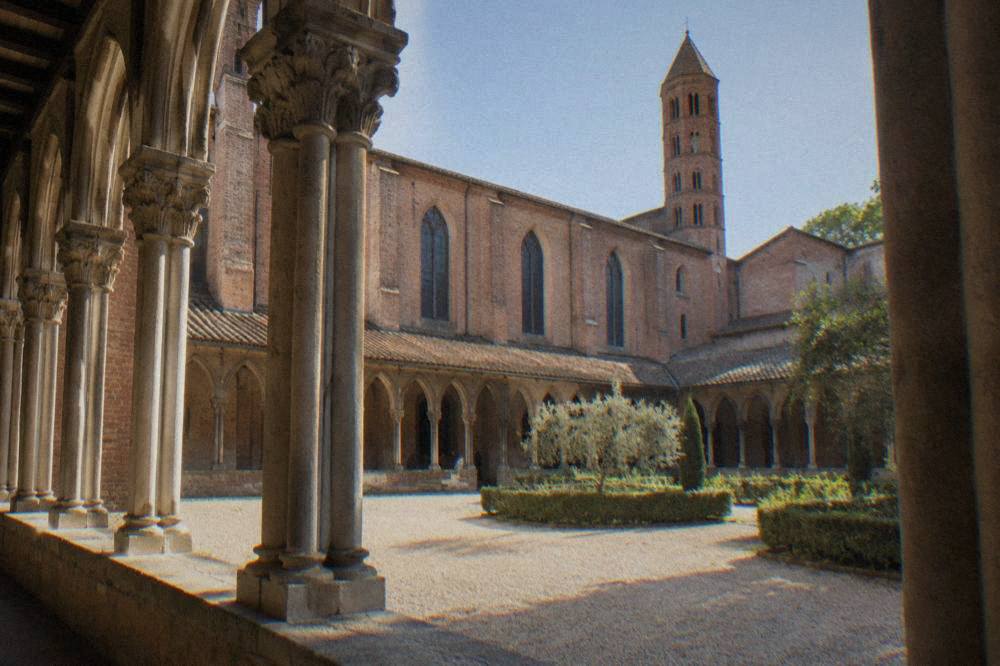
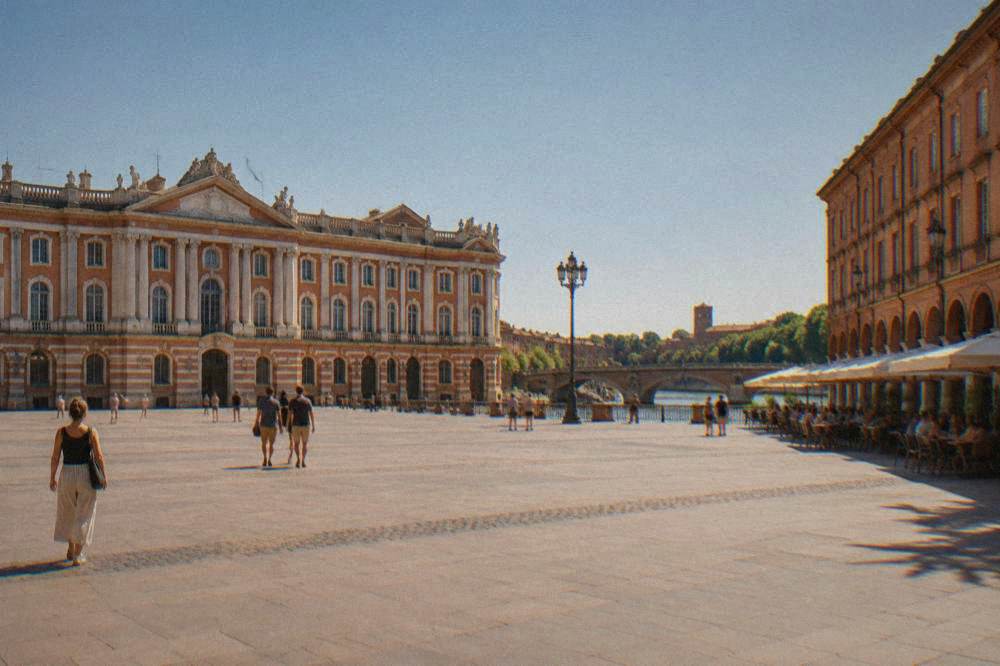
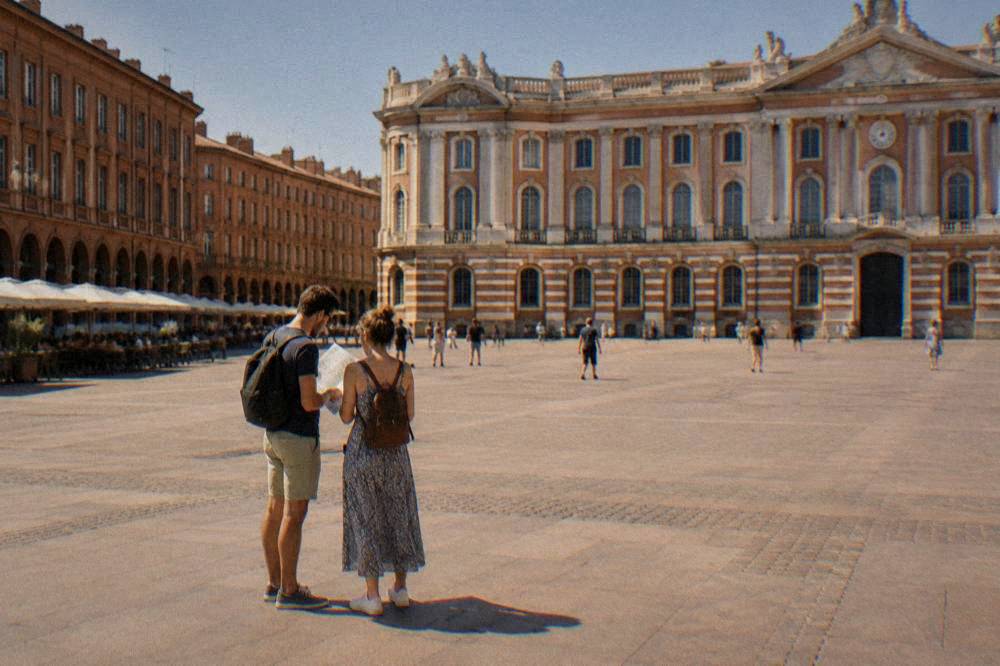
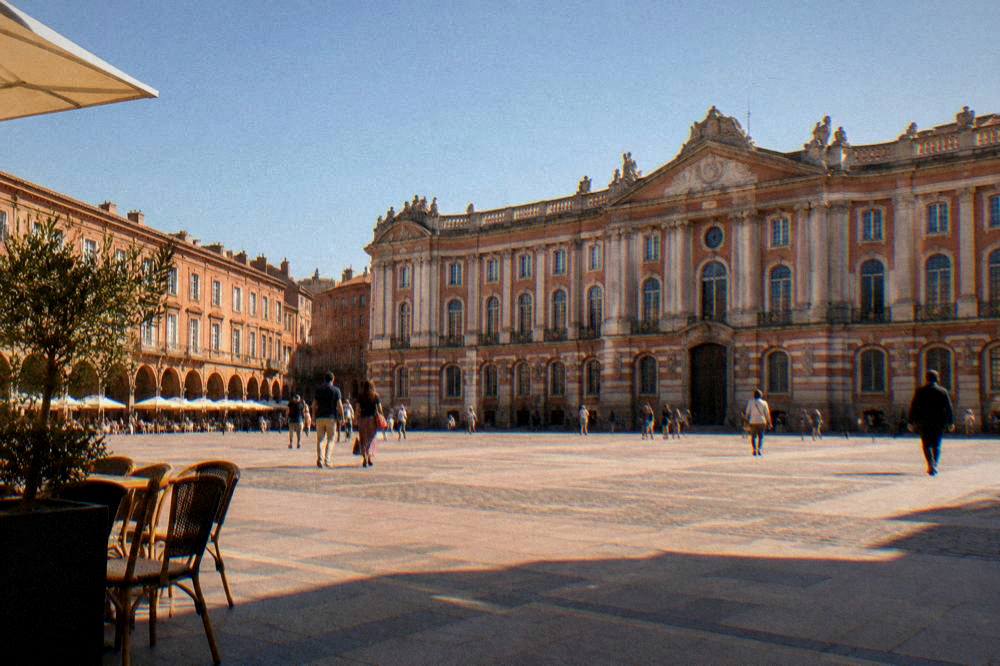
Toulouse is built from pink brick, which gives the historic center a warm terracotta tone at sunset that is the source of the La Ville Rose nickname; Bordeaux is built largely from pale limestone, which gives it a cooler, classical look. In Toulouse the landmarks are the Capitole, Saint-Sernin and the Jacobins convent; the brick core is compact and walkable, with the Garonne along the western edge.
The pink brick is the single thing visitors remember about Toulouse's streets, and it is best seen on foot. The Capitole, the city hall and theater on the main square, anchors one end of the historic center, and the Capitole de Toulouse guide covers what is inside. The Basilica of Saint-Sernin is the largest Romanesque survivor on the pilgrim roads and the city's UNESCO-listed monument, and the Couvent des Jacobins holds its famous palm-tree vault. If you want the full argument for the pink city's fame, what is Toulouse famous for lists it properly.
Bordeaux's center, by contrast, is a classical eighteenth-century ensemble around its own grand theater, and the city's identity leans outward to the vineyards rather than inward to monuments. Neither feel is better, but they photograph differently: Toulouse glows orange in the evening light, Bordeaux glows white. For photographers deciding between them, the photography spots page shows where the pink brick looks its best.
The practical layer differs too. Toulouse's transport prices are published and exact, which helps planners:
| Tisseo ticket (official catalogue) | Price |
|---|---|
| Single trip | EUR 1.90 |
| Single trip bought on board | EUR 2.50 |
| 10 trips | EUR 16.00 |
| Day pass | EUR 7.20 |
| 3-day pass | EUR 14.30 |
| Airport single (network plus Navette aeroport) | EUR 9.50 |
There is no 2-day pass in the catalogue, so a 3-day stay takes the 3-day pass or two day passes. The full system, including the airport connection and the metro works, is broken down on getting around Toulouse.
How Do The Food And Wine Scenes Compare?
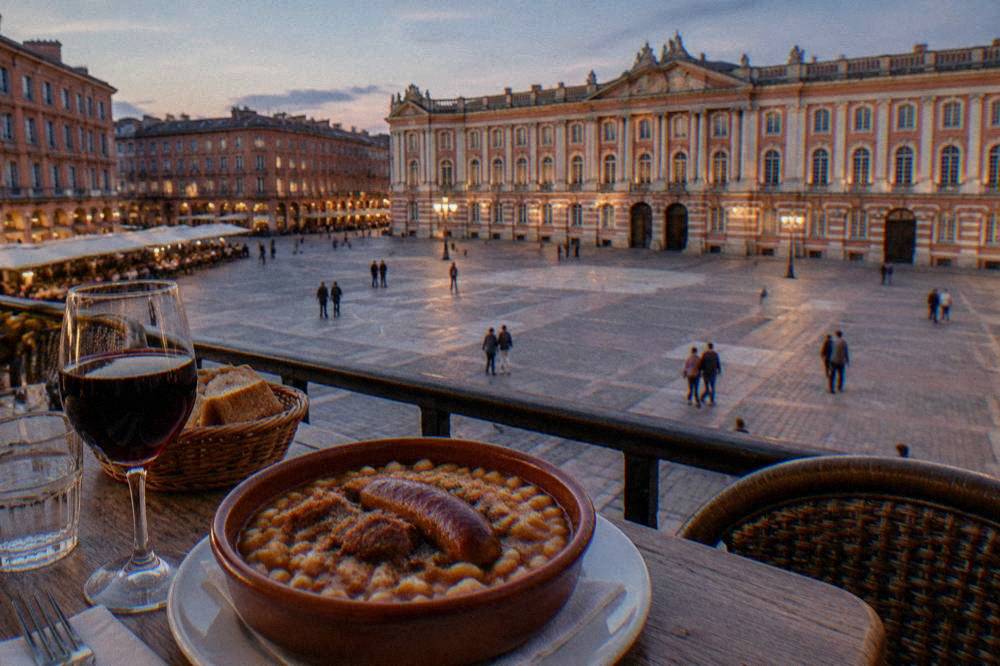
Toulouse eats heavier and drinks closer to home: the signature dish is cassoulet, the local sausage carries the city's name, and the nearby wine regions are Fronton and Gaillac; Bordeaux is defined by its wine first and its food second, with the world's most famous vineyards on the doorstep. In Toulouse a food tour with a chef or a market walk through the Victor Hugo market is the way in.
Cassoulet is the dish that separates the two cities most cleanly. It is a slow-cooked bean and meat casserole, and Toulouse is one of the towns that claims it, with the local Toulouse sausage in the pot. The cassoulet page explains what goes in it, and Toulouse food covers the wider plate, from the sausage to the violet sweets the city is also known for. Bordeaux has no equivalent single dish; its table is built around what the vineyards produce.
Wine is where the comparison flips. Bordeaux needs no introduction and no explanation of why its name sells bottles worldwide. Toulouse's wine identity is smaller and quieter: the Fronton appellation just north of the city grows Negrette, and the Gaillac wine route is an easy day out. The city's own wine bars pour these local bottles, and a guided walk through them with a local expert is the fastest way to taste the difference. The Toulouse wine page maps the region's bottles properly.
For eating out, the practical planning note is that restaurant prices are not verified for either city on this site's sources, so no figure is quoted here. What is verified is the shape of the market scene: the Victor Hugo market is the city's central food market, and the marche Victor Hugo guide covers what to buy from its stalls. Where locals actually eat is answered on where do locals eat in Toulouse.
How Easy Is It To Reach Each City?
Toulouse is served by Toulouse-Blagnac airport, which handled 7,621,409 commercial passengers in 2025, and by the Navette aeroport bus, which runs every 15 minutes and takes 20 to 40 minutes to the center; Bordeaux is served by its own airport and by the Paris rail line. The Toulouse tram to the airport has been closed since 5 June 2023 and stays closed until the end of 2026, so the bus is the connection.
The airport detail matters because it is the one place where a wrong instruction still circulates: some older guides tell readers to take the tram to Toulouse-Blagnac, and that tram, T2, does not run. The Navette leaves for the center every 15 minutes, and the Navette to the Matabiau bus station takes about 25 minutes. Buses 30 and 31 take about 45 minutes to the Capitole with changes. The full arrival playbook is on Toulouse airport to city center, and the airport itself is covered on Toulouse airport.
Rail is the other axis of the comparison. Both cities sit on direct lines from Paris, and the Paris to Toulouse page covers that route. No official timetable figure for any Toulouse train journey could be verified, so this page gives no minute counts for the Toulouse to Bordeaux leg either; the route page keeps the same discipline. If you are flying in rather than training, flights to Toulouse lists the direct connections.
| Toulouse-Blagnac airport fact | Figure |
|---|---|
| Commercial passengers, 2025 | 7,621,409 |
| Change vs 2024 | down 2.8% |
| Navette aeroport frequency | every 15 minutes |
| Navette to the center | 20 to 40 minutes |
| Navette to Matabiau bus station | about 25 minutes |
| Tram T2 to the airport | closed since 5 June 2023, until end of 2026 |
What Does A Trip To Toulouse Cost?
The Toulouse tourist office's Pass Tourisme costs EUR 26 for stays of one to three days, includes a free guided tour from the office, and pays off from the third activity; adding EUR 10 buys ten public-transport trips. The office's own rate table shows the museums it covers, from the Couvent des Jacobins at EUR 5 to the Bemberg collection at EUR 12. Bordeaux's equivalent pass is a different product and no figure for it is quoted here.
The pass math is the useful part for a comparison shopper. The tourist office lists the normal rates for the sites the pass covers, and against those the EUR 26 price breaks even from the third activity onward, with the guided tour included. Cite de l'espace, the space park on the city's edge, is discounted rather than free with the pass; its normal adult rate is EUR 29 and tickets start at EUR 22.50 on its own homepage. The full breakdown, including what the pass does not cover, is on Toulouse Pass Tourisme.
| Site (tourist office rate table) | Normal rate | With the Pass |
|---|---|---|
| Fondation Bemberg | EUR 12 | free |
| Museum de Toulouse | EUR 12 | free |
| Les Abattoirs | EUR 12 | free |
| Musee des Augustins | EUR 5 | free |
| Couvent des Jacobins | EUR 5 | free |
| Cite de l'espace | EUR 29 | discounted |
One timing note that affects both cities' budgets: the tourist tax. In Toulouse, non-classified or pending-classification lodging, which includes most platform rentals, pays 5% of the pre-tax nightly price per person under the Toulouse Metropole rule. Per-star flat rates were not verified on the official page, so none are printed here. For the wider budget picture, Toulouse cost does the arithmetic, and Toulouse on a budget covers the cheap end of the trip.
When Is The Best Time To Visit Toulouse?
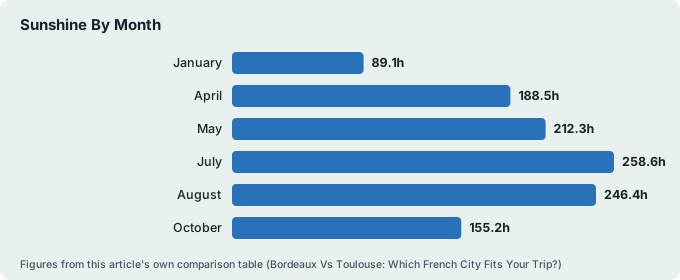
The best time to visit Toulouse is late spring through early autumn, because Meteo-France's 1991-2020 normals for Toulouse-Blagnac show the sunniest month is July at 258.6 hours of sunshine and the wettest month is May at 73.6 mm of rain, a pattern visitors do not expect. The city averages 2,075.1 hours of sun and 627 mm of rain per year.
The surprise in the climate record is that the wettest month is not in winter. May leads with 73.6 mm, April follows at 65.2 mm and June at 64.2 mm, while February is the driest month at 37.2 mm. Then the rain eases: July gets just 40.1 mm alongside those 258.6 hours of sun. The record high is 42.4C, set on 23 August 2023, and the record low is -19.2C, from 15 February 1956, both from the official Meteo-France fiche for the Toulouse-Blagnac station.
| Month | Mean daily maximum | Mean daily minimum | Rain | Sunshine |
|---|---|---|---|---|
| January | 9.7C | 2.9C | 52.5 mm | 89.1 h |
| April | 17.6C | 7.9C | 65.2 mm | 188.5 h |
| May | 21.4C | 11.4C | 73.6 mm | 212.3 h |
| July | 28.2C | 17.0C | 40.1 mm | 258.6 h |
| August | 28.5C | 17.1C | 44.6 mm | 246.4 h |
| October | 19.7C | 10.9C | 54.3 mm | 155.2 h |
Events can anchor the timing too, and Toulouse's calendar has firm dates for the seasons ahead: Piano aux Jacobins ran 8 to 30 September 2026, Toulouse les Orgues runs 7 to 18 October 2026 with its opening concert at Notre-Dame de la Daurade, the Christmas markets run 26 November to 27 December 2026, and Rio Loco returns 9 to 13 June 2027 with the theme Noctiluca. The month-by-month detail is on best time to visit Toulouse, and the raw numbers are on Toulouse weather.
| Event | Dates |
|---|---|
| Piano aux Jacobins | 8 to 30 September 2026 |
| Toulouse les Orgues (31st edition) | 7 to 18 October 2026 |
| Christmas markets (Capitole, Jean-Jaures, Charles-de-Gaulle) | 26 November to 27 December 2026 |
| Rio Loco | 9 to 13 June 2027 |
Which Day Trips Set Toulouse Apart?
Toulouse's day-trip range is the widest in southwestern France: Carcassonne's walled city, Albi's UNESCO-listed cathedral town, the Pyrenees roughly 100 km south, and the Canal du Midi, inscribed by UNESCO in 1996, all sit within a day's reach. Bordeaux's day trips are dominated by vineyard visits. If your trip is built on day trips rather than on the city itself, Toulouse wins the comparison on range.
The medieval day trips are the headline. Carcassonne is the most famous day trip from either city's region, and the Carcassonne guide covers the citadel; the day trips from Toulouse hub lists the rest, from Albi and Cordes-sur-Ciel to Rocamadour and Lourdes. A full-day guided circuit that strings Albi, Carcassonne and Cordes-sur-Ciel together with lunch included removes the rental-car question entirely.
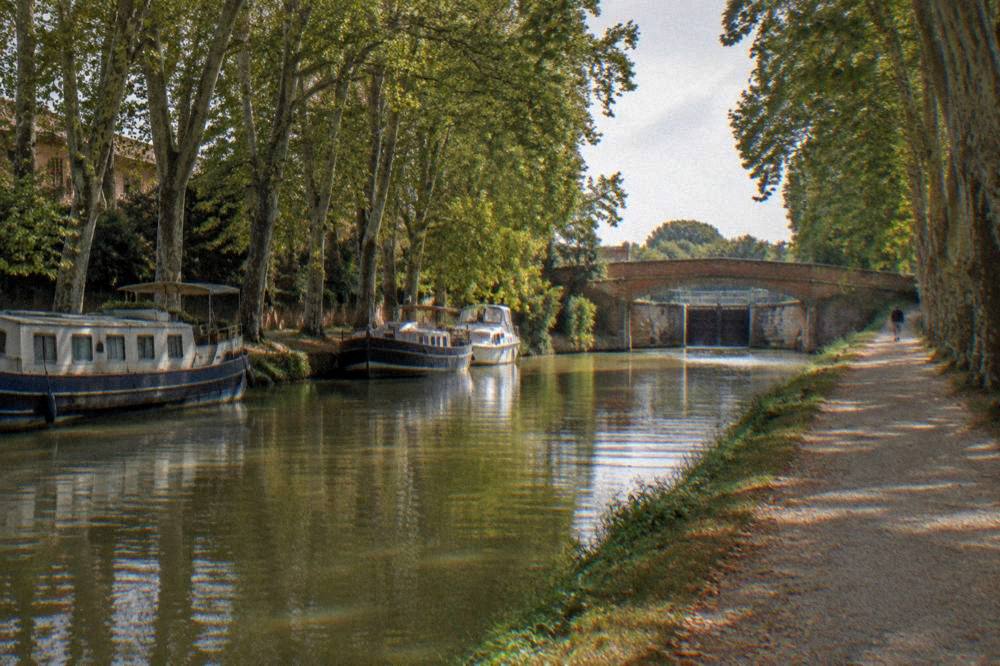
The canal is the day trip that belongs to Toulouse alone. The Canal du Midi, UNESCO-inscribed in 1996 under criteria i, ii, iv and vi, begins its run toward the Mediterranean from the city, and you can take a commented cruise on it without leaving the region. The Canal du Midi guide covers the water side, and canal trips covers the boats.
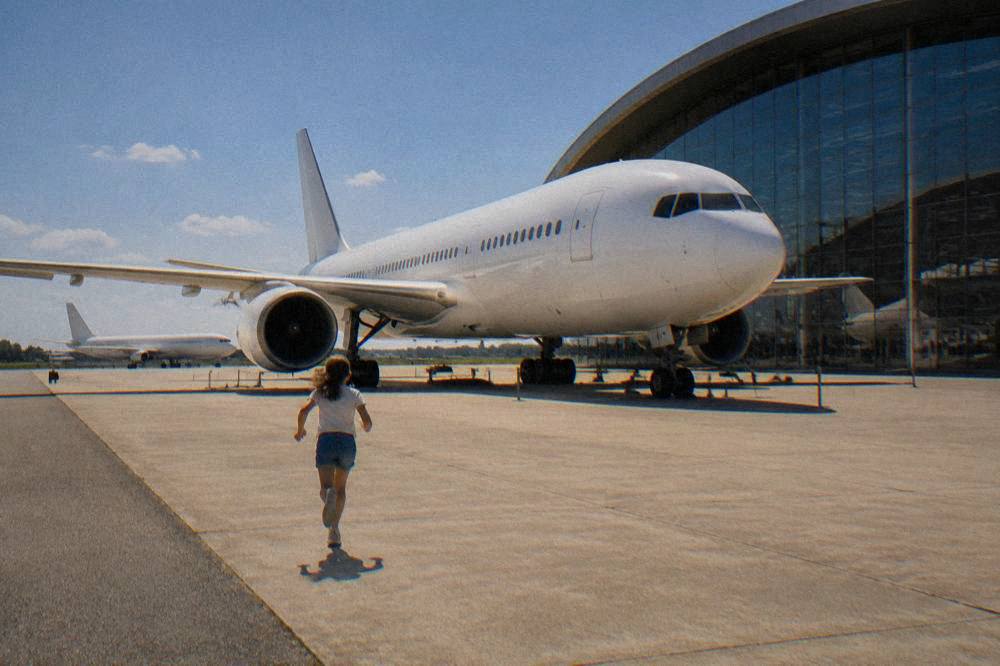
The aerospace half-day is the other Toulouse-only option, and it splits into two products: the Aeroscopia museum, adult EUR 16, reduced EUR 13, open daily 9:30-18:00 with last entry at 17:00, and the Airbus factory tours run by Manatour, which take 1h30 for either the A350 or A321 line at EUR 18 adult, and require the original passport or ID card, no photocopy and no phone image, with arrival well ahead of the visit. The Aeroscopia page covers the museum side.
| Aerospace visit | Price | Key detail |
|---|---|---|
| Aeroscopia adult | EUR 16 | open daily 9:30-18:00, last entry 17:00 |
| Aeroscopia reduced | EUR 13 | closed 25 Dec, 1 Jan, 7 May 2026 |
| Aeroscopia family pass | EUR 80 | exhibition hall not heated or air-conditioned |
| Airbus A350 factory tour (adult) | EUR 18 | 1h30, original ID required |
| Airbus A321 factory tour (adult) | EUR 18 | 1h30, arrive 30 minutes early |
Where Should You Stay In Each City?
In Toulouse the practical choice is between the Capitole and Saint-Sernin quarter in the center, the Carmes and Saint-Cyprian areas across or near the river, and the Compans-Caffarelli district to the north; the city's lodging is spread across a compact center where the metro's two running lines and the buses cover the rest. Bordeaux's center is smaller and its best-known districts ring the old town. No nightly rate for either city is quoted here.
The center of Toulouse is where the pink-brick core, the Capitole and the main shopping streets sit, and it is the default for a first visit. The where to stay in Toulouse page breaks the districts down with their characters, and the Carmes and Saint-Cyprian guides cover the two riverside alternatives. For a two-city trip, the same logic applies in Bordeaux: stay central, walk everywhere, and use the trams only for the station and the airport.
If the pink-brick core sounds like your base, book a Toulouse hotel here.
No nightly price, no star-rate tax figure and no specific hotel rate appears on this page.
Bordeaux Vs Toulouse: The Verdict
Pick Toulouse for a trip that mixes a walkable pink-brick center with aerospace museums, cassoulet and sausage, canal cruises on a UNESCO waterway, and day trips to Carcassonne, Albi and the Pyrenees; pick Bordeaux when wine is the whole point of the journey. Toulouse's verified prices, from the EUR 1.90 metro single to the EUR 26 Pass Tourisme, make it an easy city to budget, and its May-peak rainfall pattern rewards a July or September visit.
The honest framing is that these are two of the best city breaks in southwestern France and they do not overlap much. A traveler who cares about Romanesque churches, space rockets and heavy bean stews will be bored in a vineyard and delighted in Toulouse. A traveler who cares about cellar visits and first-growth appellations will find Toulouse's Fronton and Gaillac bottles interesting but secondary. The Toulouse vs Lyon comparison runs the same test against France's food capital if a third city is on your shortlist.
For the wine-curious who land on Toulouse, the local wine-bar walk with a local expert is the bridge between the two cities' strengths, and the Toulouse restaurants page picks up the table side. Whichever city wins your dates, the pink city's own audio walk, the Uncover Secrets with Toulouse In-App Audio Tour, is a good first evening in the brick lanes; you can Check availability before you fly.
Common Questions About Bordeaux Vs Toulouse
Is Toulouse better than Bordeaux?
Neither is better overall; they serve different trips. Toulouse offers aerospace attractions, cassoulet, a UNESCO-listed canal and day trips to Carcassonne and the Pyrenees, while Bordeaux is built around its wine region. If food and day-trip range lead your list, Toulouse is the stronger pick.
Is Toulouse bigger than Bordeaux?
The commune of Toulouse counted 514,819 inhabitants in the INSEE population for 2023. No metropolitan-area figure and no city ranking was verified for either city on official sources, so this page states no size comparison beyond that commune number.
Can you visit both Toulouse and Bordeaux on one trip?
Yes. A direct train links the two cities, and the Toulouse to Bordeaux route page on this site covers it. No journey time is quoted here; check the operator's own site for current schedules.
Which city is cheaper, Toulouse or Bordeaux?
No verified nightly hotel rate or restaurant price exists for either city in this site's sources, so no honest comparison figure is printed. On the attraction side, Toulouse's costs are published: a metro day pass is EUR 7.20, the Pass Tourisme is EUR 26, and the tourist office's rate table lists museum entry from EUR 5 to EUR 12.
What is the rainiest month in Toulouse?
May is the wettest month, at 73.6 mm of rain in the Meteo-France 1991-2020 normals for Toulouse-Blagnac, ahead of April at 65.2 mm and June at 64.2 mm. February is the driest month at 37.2 mm. July, the sunniest month at 258.6 hours, gets only 40.1 mm.
Does Toulouse have good wine like Bordeaux?
Toulouse is not a wine capital, but it has its own nearby appellations: Fronton, which grows the Negrette grape, and the Gaillac region, both reachable as day trips. The city's wine bars pour these local bottles, and a guided wine-bar walk with a local expert is the easiest introduction.
For everything the pink city itself offers, the Toulouse Travel Guide homepage is the full index, from the Capitole to the Canal du Midi.