Toulouse Rainy Day
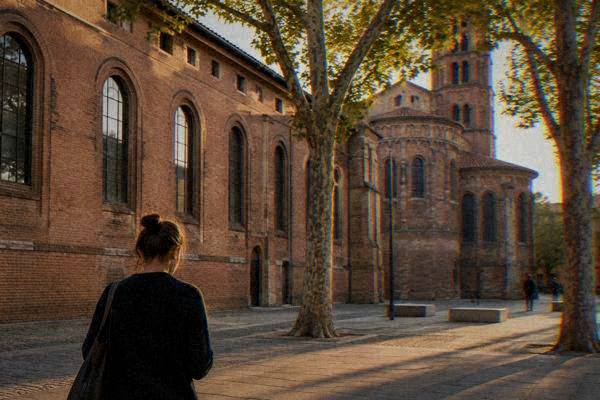
Rain in Toulouse does not end the day. The pink-brick city in southwestern France packs its museums, markets, and covered halls within a short walk of each other, and its climate data shows the rain comes in short bursts, not all-day downpours.
Short answer
Toulouse handles rain well: the Musee des Augustins, Couvent des Jacobins, Fondation Bemberg, and Les Abattoirs all sit in the historic center, the Marche Victor Hugo is under cover, and the Pass Tourisme at EUR 26 covers several of them plus a guided tour. A single Tisseo ticket costs EUR 1.90, so moving between dry stops is cheap.
Rain changes the plan in Toulouse, but it rarely cancels it. The city, a pink-brick prefecture on the Garonne in the Occitanie region of southwestern France, keeps an unusual amount of its life under cover: church naves, cloisters, a market hall, museum palazzos, and an aviation museum the size of an airfield. Meteo-France's 1991-2020 normals for Toulouse-Blagnac record 627 mm of rain over 95.8 rain days a year, which works out to brief, passing rain rather than the all-day soakers of northern Europe. This page lays out a full wet-weather plan: which museums earn an afternoon, what the Pass Tourisme actually covers, what a tram or metro ticket costs, and which day trips still work when the sky is grey.
What Can You Do In Toulouse When It Rains?
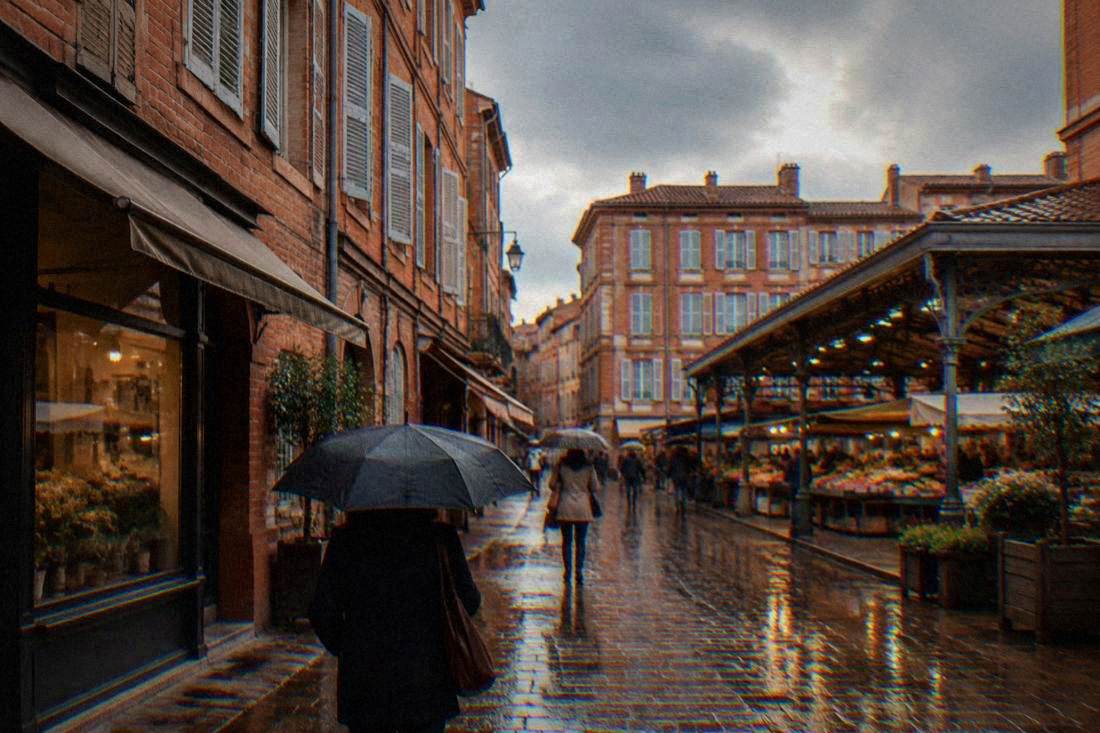
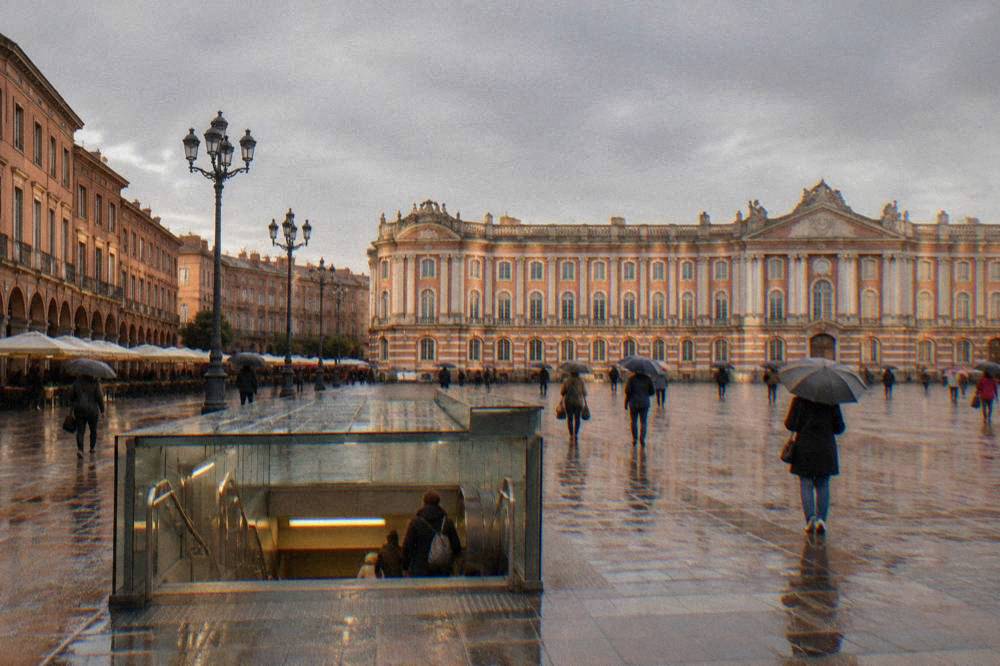
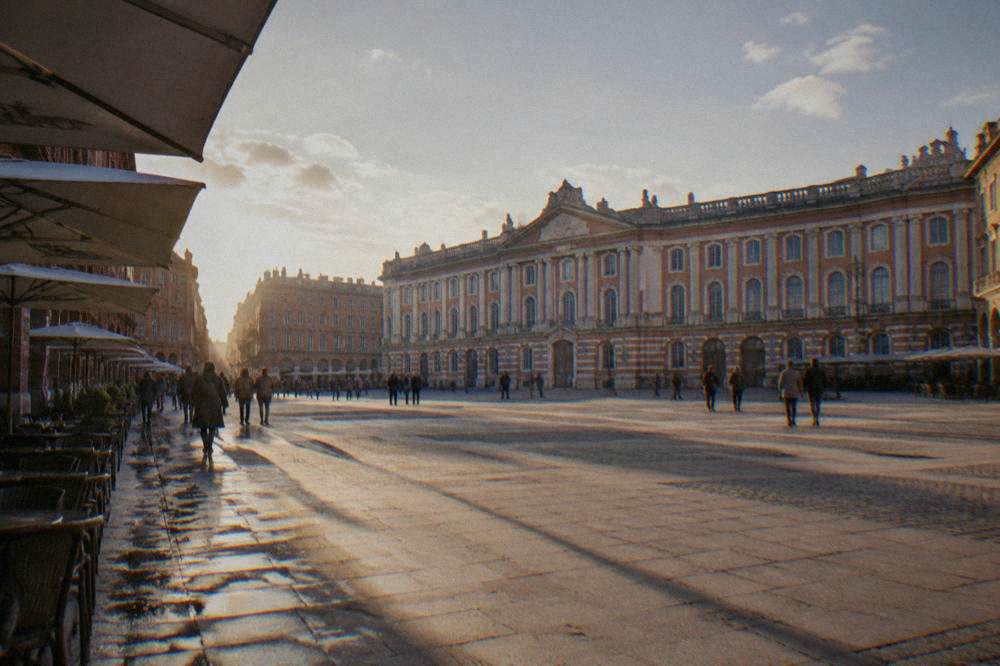
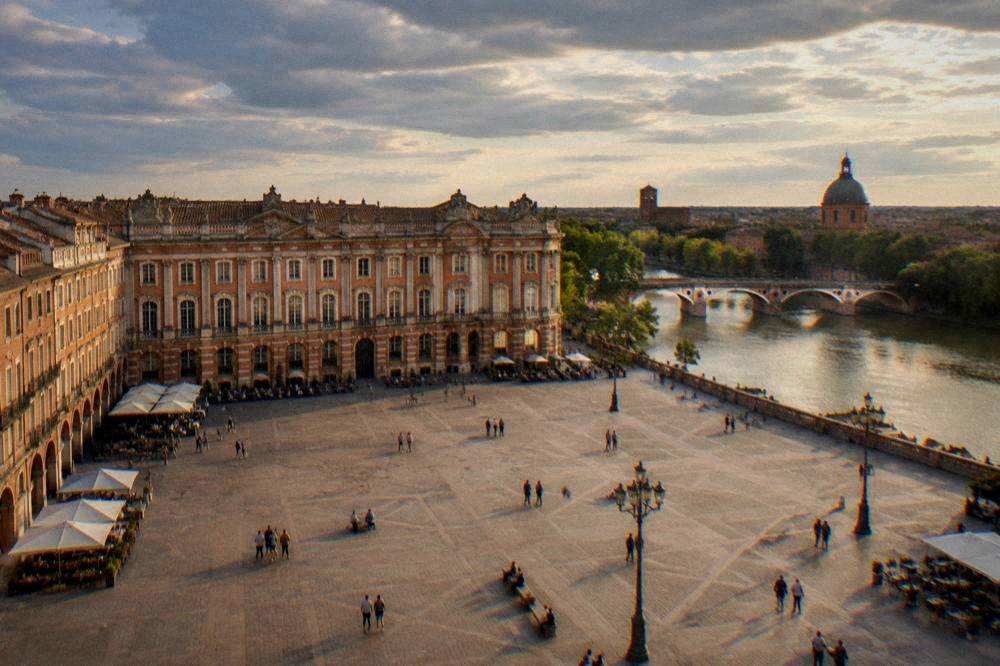
A rainy day in Toulouse runs on interiors: the Musee des Augustins, the Couvent des Jacobins, the Fondation Bemberg, and Les Abattoirs are all within the historic center, the Marche Victor Hugo is under a covered hall, and the Pass Tourisme at EUR 26 covers several of them plus a free guided tour from the tourist office. A single Tisseo ticket at EUR 1.90 moves you between dry stops. The pink-brick center is compact enough that a wet walk between two monuments rarely lasts long, and the arcades around the Capitole give shelter in the worst minutes.
The tourist office's Pass Tourisme page lists the normal rates its pass replaces: Fondation Bemberg EUR 12, the Museum de Toulouse EUR 12, Les Abattoirs EUR 12, Musee des Augustins EUR 5, and Couvent des Jacobins EUR 5. The office says the pass pays off from the third activity, which a wet afternoon usually delivers. The pass is sold for stays of one to three days and includes a free guided tour departing from the office, with an option of EUR 10 more for ten public-transport trips.
For a first taste of the layout before the rain starts, the one day in Toulouse itinerary gives the dry-weather route, and the getting around guide covers the metro, tram, and bus network in detail. If the rain settles in for the whole stay, the 3 days in Toulouse itinerary shows which day to sacrifice to the museums and which to keep for the riverside.
Which Museums In Toulouse Are Best For A Wet Afternoon?
The Musee des Augustins, the Fondation Bemberg, Les Abattoirs, and the Couvent des Jacobins are the core rainy-day set, all in or near the historic center, with counter prices of EUR 5 to EUR 12 each according to the tourist office's rate table. The Musee des Augustins is the city's fine-arts museum in a former convent, and the Jacobins is a Gothic church whose interior needs no weather at all. Add the Museum de Toulouse for natural history and you have more painted, sculpted, and cloistered square footage than one wet afternoon can absorb.
The Augustins deserves the first slot for a practical reason: it partially reopened in December 2025 after more than six years of works, and its Gothic halls, the sacristy, the Notre-Dame de Pitie hall, and the chapter house, reopen to the public on 3 October 2026 from 10:00. The museum warns of a full temporary closure from 21 September to 2 October 2026 for great-cloister works, so a visitor in that fortnight should plan around it. The Musee des Augustins guide carries the details.
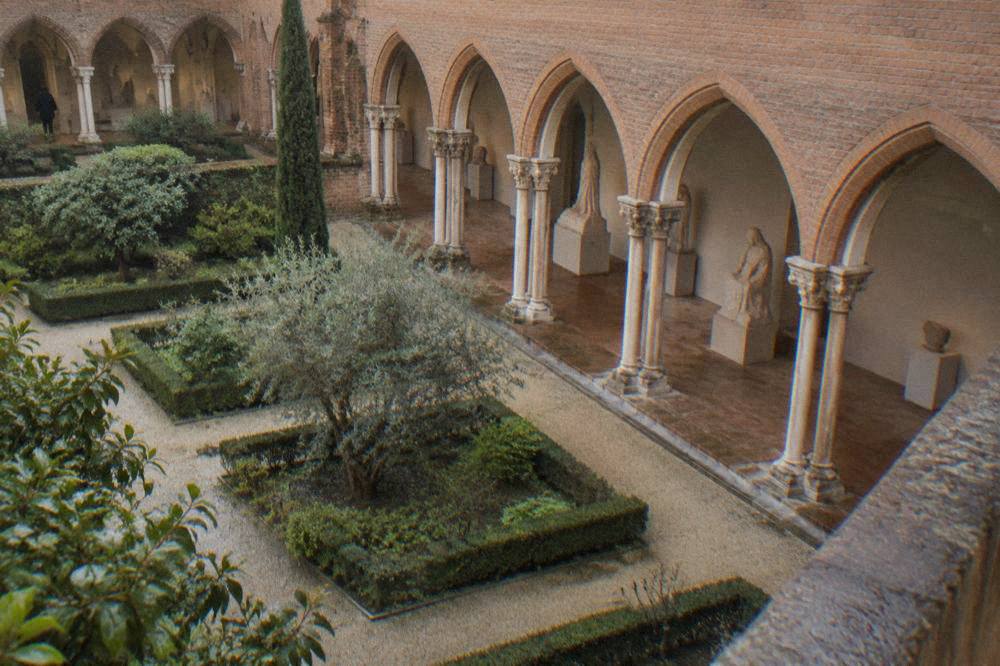
The Fondation Bemberg sits in a private hotel near the Capitole and holds the painting collection, while Les Abattoirs, the city's modern-art museum, sits across the Garonne in Saint-Cyprien, a short metro ride away. The Les Abattoirs guide and the Saint-Cyprien area guide cover that bank of the river. The Fondation Bemberg guide covers the collection itself.
| Indoor stop | Normal adult rate (tourist office) | Free with Pass Tourisme | Wet-weather note |
|---|---|---|---|
| Musee des Augustins | EUR 5 | Yes | Closed 21 Sep to 2 Oct 2026; Gothic halls reopen 3 Oct 2026 |
| Couvent des Jacobins | EUR 5 | Yes | Free on the first Sunday of the month except during temporary exhibitions |
| Fondation Bemberg | EUR 12 | Yes | Painting and objet d'art collections in a historic hotel particulier |
| Les Abattoirs | EUR 12 | Yes | Modern art, across the Garonne in Saint-Cyprien |
| Museum de Toulouse | EUR 12 | Yes | Natural history, near the Jardin des Plantes |
The Jacobins has one more card to play: the metropole's page for the convent states it is free on the first Sunday of the month, except when a temporary exhibition is running, and that rule is stated for the Jacobins only, so do not assume it elsewhere. Roof restoration work on the church was still under way into 2026, with the site staying open to visitors throughout.
A self-guided audio option keeps the walking part of the day flexible. The Discover Toulouse self-guided audio tour of the pink city covers the historic center at whatever pace the rain allows, ducking into churches and covered passages on the way, and you can Check availability on the operator's live listing. The audio tour's own page describes the route.
Can The Pass Tourisme Save You Money On A Rainy Day?
Yes, and a rainy day is exactly what the Pass Tourisme is built for: at EUR 26 for one to three days it covers the Augustins, the Jacobins, the Bemberg, Les Abattoirs, and the Museum de Toulouse at their counter prices, includes a free guided tour from the tourist office, and adds ten transport trips for EUR 10 more. The tourist office itself frames the break-even point at the third activity, and a wet afternoon usually delivers four or five.
The pass is activated on first use, so it does not start ticking the moment you buy it. That matters on a trip built around weather windows: buy it on the morning the rain arrives, spend it on museums, and keep the dry days for the Canal du Midi and the riverside. The office's page notes that the Cite de l'espace is discounted rather than free with the pass, against its normal adult rate of EUR 29.
The arithmetic is what sells it. The tourist office's own rate table prices the five covered stops at EUR 5 to EUR 12 each, and the pass costs EUR 26, so a day that strings together three or four of them comes out ahead on admission alone before counting the guided tour. A single wet afternoon in the historic center can plausibly clear the Augustins, the Bemberg, and the Jacobins in sequence, all within a short walk of each other.
| Pass Tourisme detail | Figure (tourist office) |
|---|---|
| Price | EUR 26 |
| Validity | 1 to 3 days, activated on first use |
| Included | Municipal museums and monuments, one free guided tour from the tourist office |
| Transport option | +EUR 10 for ten trips on metro, bus, and tram |
| Break-even | From the third activity |
| Cite de l'espace | Discounted, not free (normal adult rate EUR 29) |
One planning note for families: the pass's museum list is adult-oriented, so a rainy day with children usually runs through the Cite de l'espace or the Halle de la Machine instead. The Toulouse with kids itinerary sequences both, and the rainy day options for families overlap heavily with this page.
How Do You Get Around Toulouse In The Rain Without Getting Soaked?
A single Tisseo ticket costs EUR 1.90, a day pass EUR 7.20, and a 3-day pass EUR 14.30, and the network's metro and tram lines put a covered station within a short walk of the main museums. The official Tisseo e-boutique catalogue lists all of these, plus a ten-trip carnet at EUR 16.00 and an airport single at EUR 9.50. For a day of hopping between the Augustins, the Bemberg, and Les Abattoirs, the day pass is the practical buy.
The catalogue also lists a last-minute single bought on board at EUR 2.50, which is the penalty for boarding without a ticket, so buy before you travel. There is no two-day pass in the catalogue, only the day and the 3-day versions, so a two-day visit chooses between two day passes and one 3-day pass.
| Tisseo ticket | Price (official catalogue) | Best for |
|---|---|---|
| Single trip | EUR 1.90 | One or two hops between museums |
| Single bought on board | EUR 2.50 | Avoid: the last-minute price |
| 10 trips | EUR 16.00 | Pairs and families over several days |
| Day pass | EUR 7.20 | A full rainy day of hopping |
| 3-day pass | EUR 14.30 | A long weekend of mixed weather |
| Airport single | EUR 9.50 | Tisseo network plus the Navette aeroport |
The airport connection has a trap worth knowing: tram T2 to the airport has been closed since 5 June 2023 and stays closed until the end of 2026 for the Line C metro works, so the airport's page directs arriving passengers to the Navette aeroport bus, which runs one departure every 15 minutes and takes 20 to 40 minutes to the center. The Toulouse airport to city center guide covers the full transfer, and the airport guide covers the terminals.
Does It Rain A Lot In Toulouse?
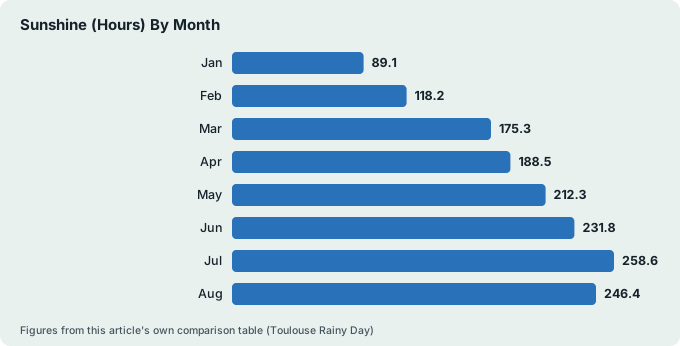
Toulouse averages 627 mm of rain over 95.8 rain days a year, per Meteo-France's 1991-2020 normals for Toulouse-Blagnac, and the wettest month is May at 73.6 mm, not a winter month: April follows at 65.2 mm and June at 64.2 mm, while February is the driest at 37.2 mm. The counterintuitive pattern is that late spring, not midwinter, delivers the most water, and the summer months turn comparatively dry, with July recording just 40.1 mm alongside 258.6 hours of sunshine, the sunniest month of the year.
For a rainy-day planner the numbers carry two lessons. First, a "rainy day in Toulouse" is statistically most likely in May, so spring visitors should pack for it even though the month reads warm, with a mean daily maximum of 21.4C. Second, the rain is spread across many months in moderate amounts rather than concentrated in a sodden season, which is why the city's indoor infrastructure matters year-round.
| Month | Mean daily max (C) | Mean daily min (C) | Rain (mm) | Rain days (>= 1 mm) | Sunshine (hours) |
|---|---|---|---|---|---|
| Jan | 9.7 | 2.9 | 52.5 | 9.2 | 89.1 |
| Feb | 11.2 | 3.1 | 37.2 | 7.8 | 118.2 |
| Mar | 15.0 | 5.5 | 45.3 | 8.2 | 175.3 |
| Apr | 17.6 | 7.9 | 65.2 | 9.3 | 188.5 |
| May | 21.4 | 11.4 | 73.6 | 9.9 | 212.3 |
| Jun | 25.7 | 15.0 | 64.2 | 7.1 | 231.8 |
| Jul | 28.2 | 17.0 | 40.1 | 5.7 | 258.6 |
| Aug | 28.5 | 17.1 | 44.6 | 5.9 | 246.4 |
| Sep | 24.8 | 13.9 | 45.7 | 6.6 | 210.1 |
| Oct | 19.7 | 10.9 | 54.3 | 7.5 | 155.2 |
| Nov | 13.5 | 6.3 | 55.0 | 10.0 | 99.9 |
| Dec | 10.4 | 3.6 | 49.3 | 8.7 | 89.7 |
The records bracket the range: Meteo-France's fiche for the station lists the record high as 42.4C on 23 August 2023 and the record low as -19.2C on 15 February 1956, across a records window running from 1947 to June 2025. Neither extreme is a rain problem, but the summer high is a reminder that the same indoor stops that shelter a May shower also air-condition a July afternoon, or in Aeroscopia's case, as its practical page states, do not heat or air-condition the exhibition hall at all.
The Toulouse weather guide and the best time to visit guide unpack the seasonal logic month by month, and the blog answer on whether it rains a lot in Toulouse states the headline numbers in question form.
Which Food Stops Work When The Weather Turns?
The Marche Victor Hugo is the anchor: a covered market hall a short walk from the Capitole, where the stalls and the surrounding bars serve cassoulet, Toulouse sausage, and cheeses without anyone stepping outside. The tourist office and the metropole both list it among the city's markets, and its stalls sit entirely under the hall's roof. Around it, the Carmes quarter's covered arcades and the streets behind the Capitole hold enough lunchrooms that a wet lunch never requires a long crossing.
The Marche Victor Hugo guide maps the stalls and the surrounding bars in detail. The classic wet-weather plate is cassoulet, the slow-cooked bean and meat casserole whose local version carries the Toulouse sausage, and the cassoulet guide explains what distinguishes the Toulouse recipe from the Castelnaudary one. The Toulouse food guide widens the list, and the Toulouse restaurants guide covers where the city's tables cluster by quarter.
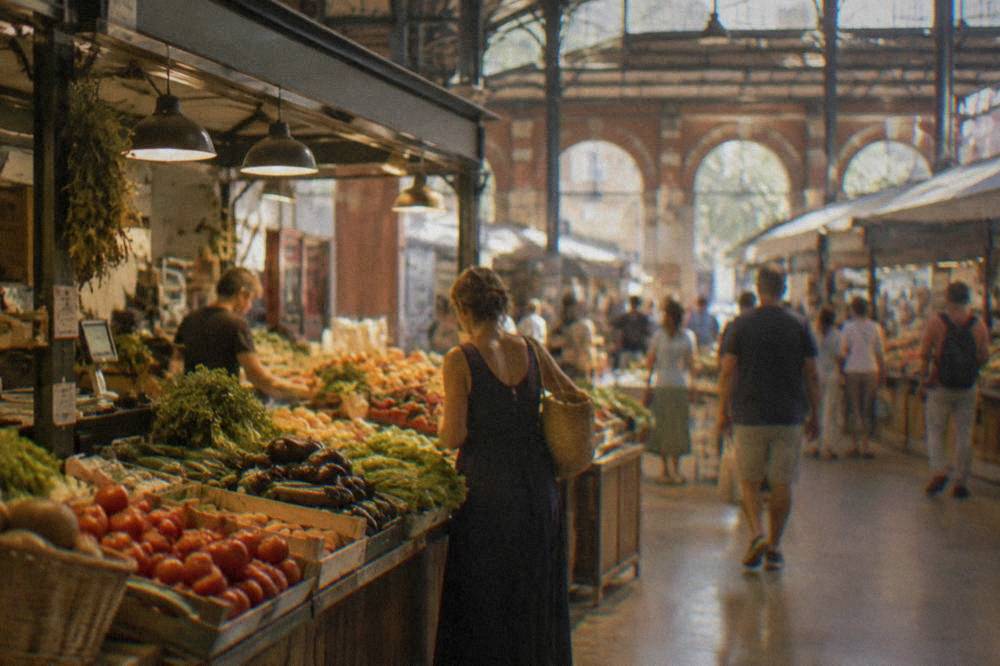
A guided food tour turns the wet walk into the point rather than the problem. The guided food tour with tastings strings indoor stops together, and the Victor Hugo market food tour keeps a large share of its route under the hall's roof. Both have their own pages with what each covers.
Does Toulouse Have Big Indoor Attractions Beyond Museums?
Yes: the Cite de l'espace is a full space-themed park with a normal adult rate of EUR 29 and tickets from EUR 22.50 on its own homepage, the Aeroscopia aviation museum charges EUR 16 for adults and is open daily 9:30-18:00 with last entry at 17:00, and the Halle de la Machine houses its mechanical creatures under a vast former assembly hall. All three swallow an entire rainy day without noticing the weather.
The Cite de l'espace, whose attraction guide covers the rockets and the planetarium, is the one that most reliably fills a wet family day, and its e-ticket can be bought in advance. The Halle de la Machine, covered in the Halle de la Machine guide, is the odder and drier of the two, with everything under one roof.
For a wet family day at the space park, book a Cité de l'espace e-ticket here.
Aeroscopia deserves the drive out to Blagnac on a grey day. The museum's practical page states the full rate card: adult EUR 16, reduced EUR 13, annual pass EUR 26, family pass EUR 80, open daily 9:30-18:00 with last entry at 17:00, closed 25 December, 1 January, and 7 May 2026. The page also warns that the exhibition hall is neither heated nor air-conditioned, which cuts both ways across the year. The Aeroscopia guide covers the aircraft on display, and the aerospace itinerary sequences it with the Airbus story.
Can You Take A Day Trip From Toulouse When It Rains?
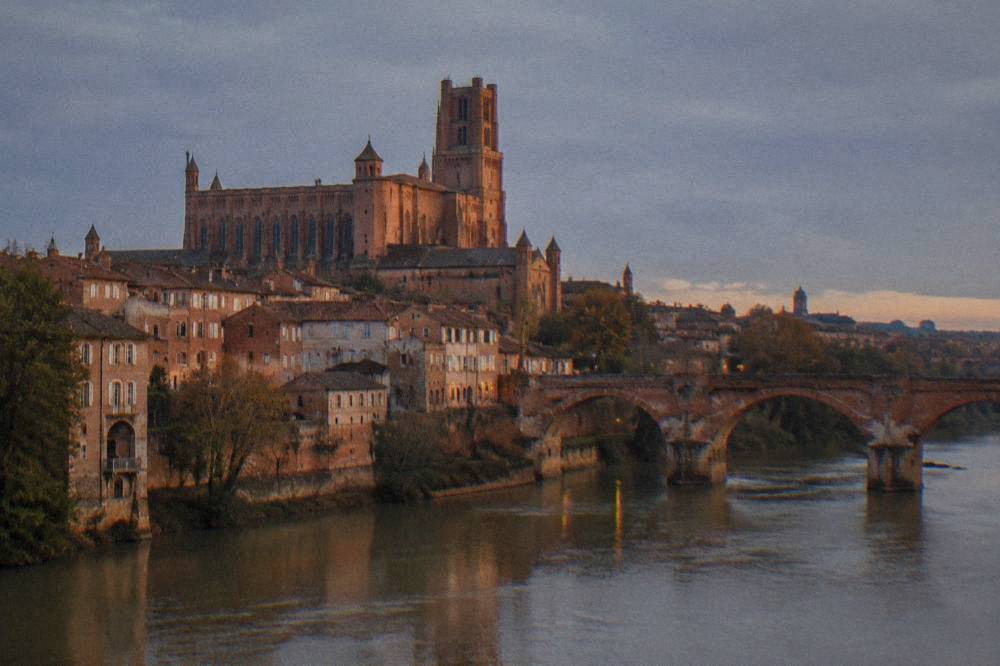
Carcassonne and Albi are the two rainy-day day trips that work, because both put the visit inside stone: Carcassonne's walled city has covered rampart walks, cafés, and interior halls, and Albi's fortress-cathedral and museums are almost entirely enclosed. The coach day trip to Carcassonne and the Albi and Cordes-sur-Ciel day trip both run from Toulouse and are bookable in advance. Cordes-sur-ciel is the one to reconsider in heavy rain, since its charm is its hilltop outdoor street.
The trade-off is simple: a coach day in the rain trades flexibility for a dry seat and a fixed plan. The Carcassonne day trip guide and the Albi day trip guide cover both destinations on their own merits, and the day trips from Toulouse guide ranks the full list, including the Cordes-sur-ciel page.
| Day trip | Rain suitability | Why it works wet |
|---|---|---|
| Carcassonne | Strong | Walled city with covered walks, interior halls, and coach transfer |
| Albi | Strong | Fortress-cathedral, museums, and enclosed old streets |
| Cordes-sur-ciel | Weak in heavy rain | Hilltop village whose main street is outdoors |
| Gaillac wine route | Strong | Cellar visits are indoors, and the Gaillac guide covers them |
The Albi and Cordes day trip pairs the two, which is a reasonable hedge when the forecast is mixed: Albi's interiors first, Cordes in the afternoon if the sky clears. Its own page lists what the day covers.
What Can You Do On A Rainy Evening In Toulouse?
A rainy evening in Toulouse runs through the churches and concert halls: the Toulouse les Orgues festival fills venues including the opening concert at Notre-Dame de la Daurade from 7 to 18 October 2026, the Piano aux Jacobins festival runs 8 to 30 September 2026 in the Jacobins cloister, and the Christmas markets at the Place du Capitole, the allees Jean-Jaures, and the square Charles-de-Gaulle run 26 November to 27 December 2026. Outside festival windows, the basilicas of Saint-Sernin and the Daurade are open into the evening and cost nothing to enter.
The Saint-Sernin basilica, a listed monument on the Santiago de Compostela routes and covered in the basilica guide, is the grandest of the dry interiors and the most rewarding in low light. The Notre-Dame de la Daurade guide covers the river-facing church that hosts the organ festival's opening concert.
| Event | Dates (official city or organiser pages) | Venue type |
|---|---|---|
| Piano aux Jacobins | 8 to 30 September 2026 | Cloister and indoor halls |
| Toulouse les Orgues, 31st edition | 7 to 18 October 2026 | Churches including Notre-Dame de la Daurade |
| Christmas markets | 26 November to 27 December 2026 | Place du Capitole, allees Jean-Jaures, square Charles-de-Gaulle |
The Christmas market deserves a note: it is an outdoor market, but the stalls are chalet-style with serving hatches, and the Capitole's arcades sit on the same square for the gaps between purchases. The Christmas market guide covers it, and the Toulouse at night itinerary sequences an evening that keeps most of its stops under roofs.
How Do You Build A Full Rainy Day Plan For Toulouse?
Start at the Musee des Augustins or the Fondation Bemberg in the late morning, lunch under the Victor Hugo market hall, cross to Les Abattoirs or the Jacobins in the afternoon by metro on a EUR 1.90 single or a EUR 7.20 day pass, and finish in a church interior or a concert hall in the evening. Buying the Pass Tourisme at EUR 26 the same morning makes the museum stops free and adds a guided tour. That single arc keeps the whole day within a few minutes of shelter at any moment.
A wet morning in Toulouse begins at the tourist office, where the pass is sold and the included guided tour departs. From there the Augustins and the Bemberg are a short walk apart, both indoors, and both on the pass. Lunch under the Victor Hugo hall needs no booking and no weather luck, and the bars around it serve the local plates.
The afternoon forks by interest. Art goes to Les Abattoirs across the river, Gothic goes to the Jacobins, and families go to the Cite de l'espace or the Halle de la Machine, both of which fill hours without an outdoor minute. The evening closes in a basilica, at a festival concert if the calendar cooperates, or at a wine bar in the Carmes quarter, whose covered streets are covered in the Carmes area guide.
The 2 days in Toulouse itinerary shows how to fold this wet-day arc into a longer stay, and the Toulouse on a budget itinerary prices the same day out at the low end, since the pass and the single tickets are the two costs that scale. This Toulouse Travel Guide page is the wet-weather companion to those routes, not a replacement for them.
Common Questions About A Rainy Day In Toulouse
Quick answers to what planners ask most about wet weather in the pink city.
Does it rain a lot in Toulouse?
Meteo-France's 1991-2020 normals for Toulouse-Blagnac record 627 mm of rain over 95.8 rain days a year. The wettest month is May at 73.6 mm, and February is the driest at 37.2 mm, so rain is frequent but rarely concentrated.
What is the best indoor attraction in Toulouse for a rainy day?
The Musee des Augustins is the strongest single choice: it is the city's fine-arts museum in a former convent, it costs EUR 5 at the counter, and it is free with the Pass Tourisme. Its Gothic halls reopen to the public from 3 October 2026 after the cloister works.
Is the Pass Tourisme worth it for one rainy day?
Often yes. The pass costs EUR 26 and the tourist office says it pays off from the third activity, and the five main indoor stops it covers each cost EUR 5 to EUR 12 at the counter, so a full museum day comes out ahead on admission alone.
Can you visit Carcassonne in the rain?
Yes. The walled city has covered rampart walks, interior halls, and cafés, and a coach day trip runs from Toulouse with an audio guide. The coach keeps the transfer dry as well as the visit.
Is the Marche Victor Hugo covered?
Yes, the market operates inside a covered hall a short walk from the Capitole, so a rainy lunch there involves no outdoor time between the stalls and the surrounding bars.
What does a metro ticket cost in Toulouse?
The Tisseo catalogue lists a single trip at EUR 1.90, a day pass at EUR 7.20, and a 3-day pass at EUR 14.30. A single bought last-minute on board costs EUR 2.50, so buy before boarding.