Does It Rain A Lot In Toulouse?
How much it really rains in Toulouse, month by month, using Meteo-France's 1991-2020 climate normals: 627 mm a year, with May the wettest month, not winter.
Toulouse, the pink-brick "La Ville Rose" on the Garonne in the Occitanie region of southwestern France, has a reputation among visitors for being a wet southwestern city, and the honest answer is more interesting than the reputation. Meteo-France's 1991-2020 climate normals for the Toulouse-Blagnac station put the city at 627 mm of rain spread over 95.8 rain days a year, alongside 2,075.1 hours of sunshine. That is a moderate total by French standards, and the pattern is not the one most people assume: the wettest month is May, not a winter month, while February is the driest of all.
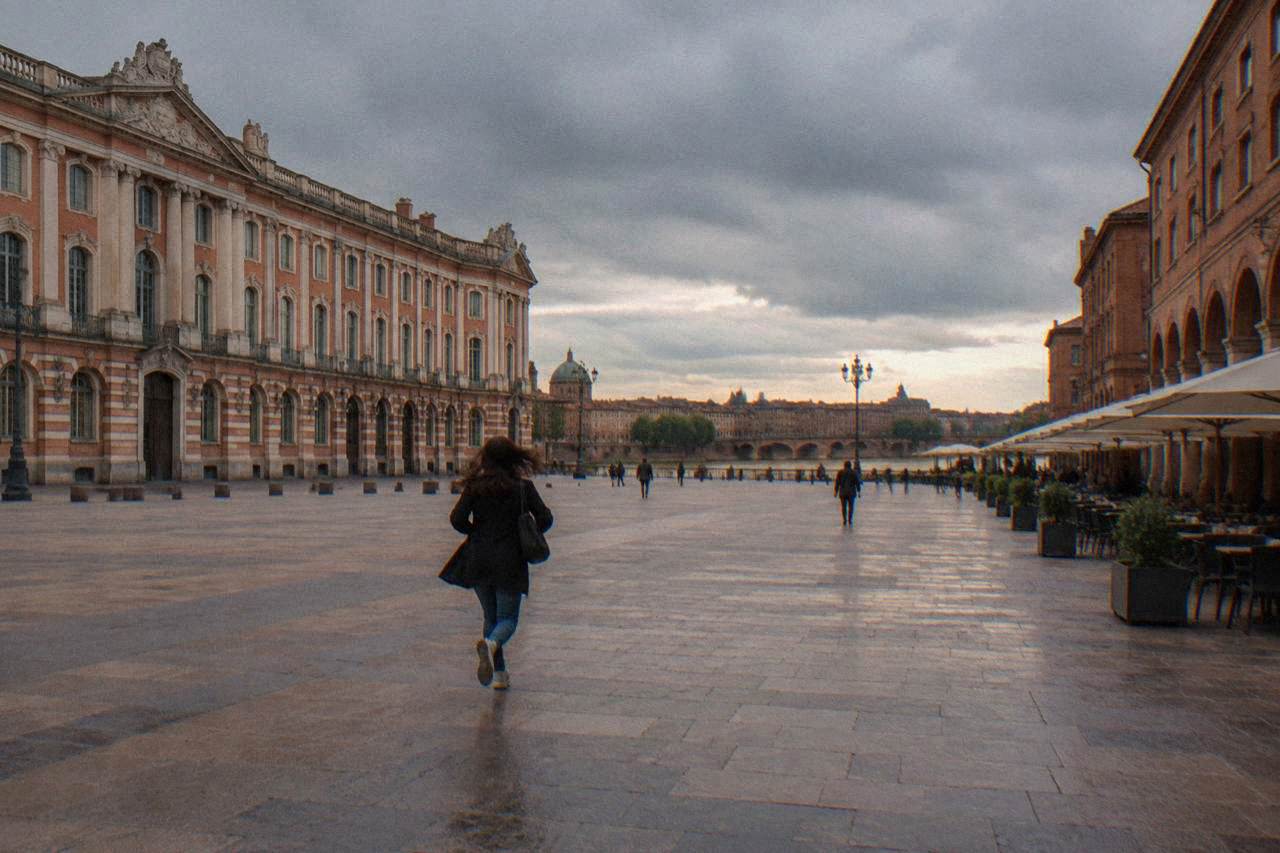
Does It Rain A Lot In Toulouse?
No, not by French standards. Meteo-France's 1991-2020 normals for Toulouse-Blagnac record 627 mm of rain a year over 95.8 rain days, with 2,075.1 hours of sunshine on top. The rain is moderate and unevenly spread: May is the wettest month at 73.6 mm, February the driest at 37.2 mm, and July gets just 40.1 mm.
The number that usually surprises planners is the shape of the year rather than the total. Spring, not winter, carries the rain. May averages 73.6 mm, April 65.2 mm and June 64.2 mm, so the three wettest months all sit between April and June. Once the calendar turns to July, the tap shuts off: July is the sunniest month at 258.6 hours of sunshine, with only 40.1 mm of rain, and August follows a similar pattern with 44.6 mm and 246.4 hours of sun.
Winter is actually the quiet season for rain. February is the driest month of the year at 37.2 mm, and December's 49.3 mm is well below the May peak. The normals also record 11.5 days a year above 30C in July and 11.3 in August, with the all-time record high at 42.4C on 23 August 2023 and the record low at -19.2C on 15 February 1956.
| Month | Rain (mm) | Rain days | Sunshine (hours) |
|---|---|---|---|
| January | 52.5 | 9.2 | 89.1 |
| February | 37.2 | 7.8 | 118.2 |
| March | 45.3 | 8.2 | 175.3 |
| April | 65.2 | 9.3 | 188.5 |
| May | 73.6 | 9.9 | 212.3 |
| June | 64.2 | 7.1 | 231.8 |
| July | 40.1 | 5.7 | 258.6 |
| August | 44.6 | 5.9 | 246.4 |
| September | 45.7 | 6.6 | 210.1 |
| October | 54.3 | 7.5 | 155.2 |
| November | 55.0 | 10.0 | 99.9 |
| December | 49.3 | 8.7 | 89.7 |
| Year | 627 | 95.8 | 2,075.1 |
All figures in the table come from Meteo-France's fiche climatologique for the Toulouse-Blagnac station, covering the 1991-2020 normals period. The station sits at Toulouse-Blagnac, the same site as the city's airport, so the numbers describe exactly the air a visitor lands into rather than a distant weather post.
When Is The Rainiest Time Of Year In Toulouse?
Late spring is the rainiest time of year in Toulouse. May leads with 73.6 mm of rain over 9.9 rain days, ahead of April at 65.2 mm and June at 64.2 mm. November has the most rain days of any month at 10.0, but its total, 55.0 mm, still falls short of May's peak.
So if you are choosing dates around weather, the numbers point away from the classic assumptions. A May visit carries the highest rain risk of the year, even though it also brings 212.3 hours of sunshine, more than any winter month by a wide margin. November, by contrast, drips rather than pours: its rain days are the most numerous, but each one delivers less on average than a May shower.
July and August are the driest stretch of the summer, with 40.1 mm and 44.6 mm respectively, and both are among the sunniest months of the year, at 258.6 hours for July and 246.4 for August. The trade-off is heat: the normals show 11.5 days a year above 30C in July and 11.3 in August, and the record high of 42.4C was set in August. For a fuller discussion of the cold end of the calendar, the sibling page on the coldest month in Toulouse covers winter in detail.
There is a second, subtler pattern worth knowing before you book. The rain days column tells you how often it rains, while the millimetre column tells you how hard. June has only 7.1 rain days, the second-lowest of the year, yet still ranks third in total rain, which means June showers tend to be short and heavy rather than the long grey drizzle of November's 10.0 rain days. A June downpour can pass in an afternoon. A November rain day can follow you from morning to evening.
What Should You Pack For Toulouse Weather?
Pack for showers in any month, with a light rain layer as your baseline and warm-weather gear for July and August, when 11.5 and 11.3 days a year respectively reach 30C or more. The normals show rain in every single month of the year, from February's 37.2 mm to May's 73.6 mm, so nothing in the calendar is reliably dry.
The practical reading of the table is that an umbrella earns its place in your bag twelve months a year, but a heavy raincoat rarely does. Rain days cluster around nine or ten a month in the wetter periods, which typically means a shower rather than a washout day. Summer demands the opposite preparation: sun protection and water matter more than waterproofs once July arrives. Everything else covered here is indexed on Toulouse Travel Guide.
If a rainy hour interrupts a visit, the city has good indoor options, from the museums covered on the Toulouse museums guide to the covered Victor Hugo market, which the Toulouse markets guide walks through in detail. An audio tour is another rain-friendly format, since you can duck under an arcade and resume when the sky clears. The in-app Toulouse secrets audio tour works exactly that way, and you can Check availability if that flexibility appeals.
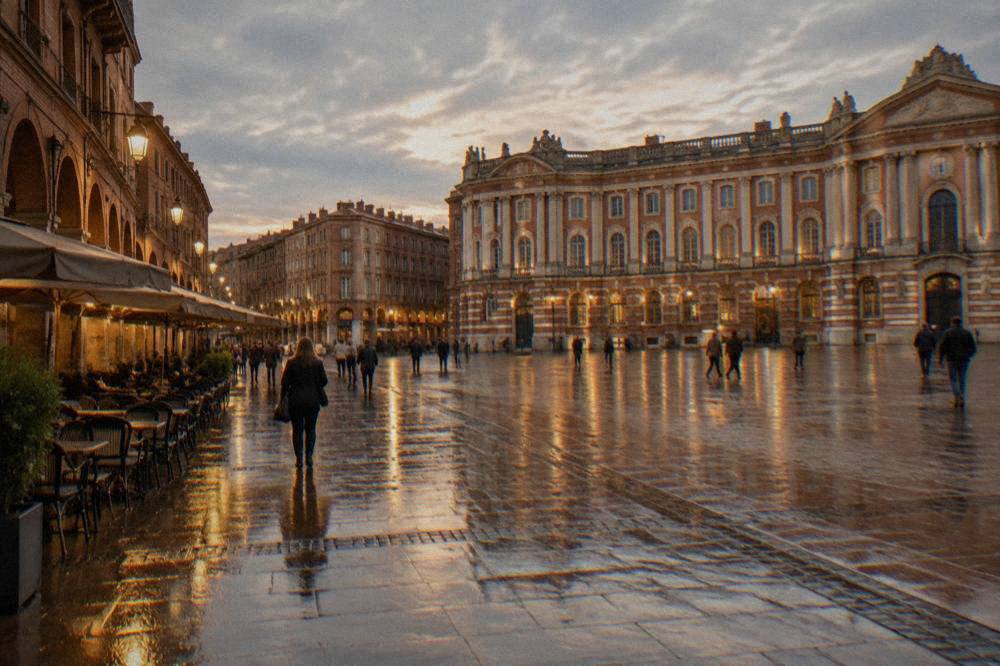
Does The Rain Affect Visiting Toulouse?
Not much, in practice. With 95.8 rain days spread across the year and the heaviest rain concentrated in April, May and June, most visits to Toulouse include some dry hours even in the wetter months, and the compact historic center shifts easily from street to covered arcade or museum when a shower passes.
The city's layout helps. The streets around the Capitole and the Saint-Etienne quarter, described on the Saint-Etienne area guide, are dense enough that a shower rarely strands you far from a cafe, a church porch or a museum entrance. The Garonne riverside and the Canal du Midi towpaths are the two places where rain genuinely changes the experience, since both are open walks without shelter, so save them for the clearer windows the climate table makes easy to find in July, August and September.
One planning note worth keeping: the rain totals say nothing about day length or light. December delivers 49.3 mm of rain but also only 89.7 hours of sunshine, the lowest of the year, so winter visits feel grey even when they stay dry. July, with 258.6 hours of sun, is the mirror image: hot, bright and nearly rain-free. Planning around how many days is enough for Toulouse is easier once you know which trade-off you prefer.
| Season | Wettest month in the season | Rain (mm) | Sunniest month in the season | Sunshine (hours) |
|---|---|---|---|---|
| Winter (Dec-Feb) | December | 49.3 | February | 118.2 |
| Spring (Mar-May) | May | 73.6 | May | 212.3 |
| Summer (Jun-Aug) | June | 64.2 | July | 258.6 |
| Autumn (Sep-Nov) | November | 55.0 | September | 210.1 |
How Does Toulouse Rain Compare Across The Year's Records?
The extremes sit far outside the averages. Meteo-France's records for Toulouse-Blagnac, covering 1947 to June 2025, put the all-time high at 42.4C on 23 August 2023 and the all-time low at -19.2C on 15 February 1956, while the 1991-2020 normals average 18.8C for the daily maximum and 9.6C for the daily minimum across the year.
Averages hide the tails, and the tails are what travelers remember. A July or August day can climb past 30C, with 11.5 and 11.3 such days a year respectively in those months, yet the same summer can still deliver a 40.1 mm July. The winter record low of -19.2C belongs to 1956, and nothing in the modern normals suggests a visitor should plan for it: January, the coldest month, averages a mean of 6.3C.
The daily minimum figures also shape what "rain" feels like here. January's mean minimum is 2.9C and February's is 3.1C, so winter rain in Toulouse almost always falls as liquid rather than snow. That matters for packing: waterproof shoes matter more than thermal layers for a winter visit, and the rain that does fall is rarely accompanied by the freezing conditions the record low implies.
| Measure | Value | Period |
|---|---|---|
| Annual mean daily maximum | 18.8C | 1991-2020 normals |
| Annual mean daily minimum | 9.6C | 1991-2020 normals |
| Annual rainfall | 627 mm | 1991-2020 normals |
| Annual rain days | 95.8 | 1991-2020 normals |
| Annual sunshine | 2,075.1 hours | 1991-2020 normals |
| Record high | 42.4C, 23 August 2023 | 1947 to June 2025 |
| Record low | -19.2C, 15 February 1956 | 1947 to June 2025 |
Common Questions About Rain In Toulouse
Quick answers to what planners ask most about rain in Toulouse.
Does it rain a lot in Toulouse?
Toulouse records 627 mm of rain a year over 95.8 rain days, per Meteo-France's 1991-2020 normals for Toulouse-Blagnac. That is a moderate total, and the rain is concentrated in late spring: May is the wettest month at 73.6 mm, while February is the driest at 37.2 mm.
What is the wettest month in Toulouse?
May is the wettest month, averaging 73.6 mm of rain over 9.9 rain days. April and June follow at 65.2 mm and 64.2 mm. No winter month comes close: February averages just 37.2 mm.
What is the driest month in Toulouse?
February is the driest month at 37.2 mm of rain over 7.8 rain days. July is the driest of the warm season, with 40.1 mm, and it is also the sunniest month of the year at 258.6 hours of sunshine.
Does it rain more in Toulouse in winter or summer?
Neither: late spring is the wettest period. May, April and June are the three wettest months, while July and August are among the driest. Winter is comparatively quiet for rain, with February the driest month of the whole year.
How many hours of sunshine does Toulouse get a year?
Meteo-France's 1991-2020 normals record 2,075.1 hours of sunshine a year in Toulouse. July is the sunniest month at 258.6 hours, and December the least sunny at 89.7 hours.
Does it snow in Toulouse?
The normals give January a mean daily minimum of 2.9C and February 3.1C, so winter precipitation in Toulouse falls mostly as rain. The record low of -19.2C was set on 15 February 1956, but nothing in the modern averages points to snow as a normal feature of a Toulouse winter.