Narbonne
Narbonne sits in the Aude, a direct train ride south of Toulouse, and packs an archbishops' palace, Roman underground galleries and a canal-side old town into a space you can walk across in a morning.
Short answer
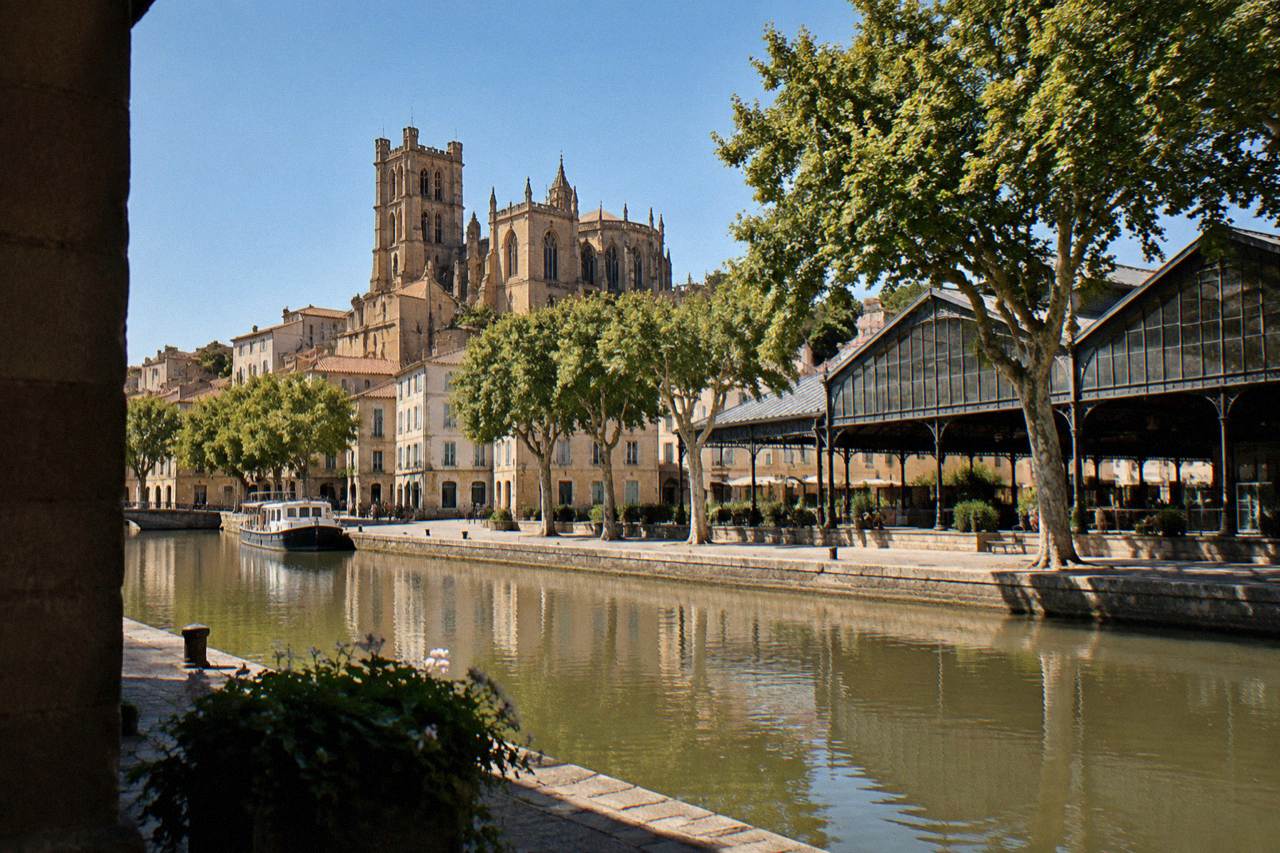
Narbonne is a direct train ride from Toulouse-Matabiau and works as a full-day trip: Roman remains, the archbishops' palace complex, the unfinished cathedral and the covered market all sit within a short walk of each other, and the Canal de la Robine runs through the middle of town.
Toulouse, the pink-brick "La Ville Rose" on the Garonne in the Occitanie region of southwestern France, makes an easy base for day trips in every direction, and Narbonne is one of the most rewarding of them. The city lies in the neighboring Aude department, a direct train ride from Toulouse-Matabiau station, and it condenses a lot into a walkable center: Roman underground galleries, a palace complex built by archbishops, a cathedral that was never finished, and a covered food market that anchors local life. The Canal de la Robine, linked to the Canal du Midi system, runs right through town and gives the southern edge a slow, waterside character. This guide lays out what to expect, how to plan the journey, and how Narbonne fits alongside the region's other day trips.
Where Is Narbonne And How Far Is It From Toulouse?
Narbonne lies in the Aude department, southeast of Toulouse toward the Mediterranean coast, and it is reached by a direct train from Toulouse-Matabiau station. The city sits on the Canal de la Robine, part of the Canal du Midi's heritage landscape, and it sits inland of the coastal resorts, so a day trip pairs a historic old town with an easy onward hop to the shore.
The exact journey time and fare depend on the train operator and the day, and this site does not quote figures the official sources have not confirmed, so check the operator's own site for current timetables. What is stable is the shape of the trip: you leave from Matabiau, Toulouse's main rail station, and you arrive in the center of Narbonne, a short walk from the main sights. That makes it one of the simpler day trips to run without a car. No transfers, no parking, no navigation: the train does the corridor and you do the town.
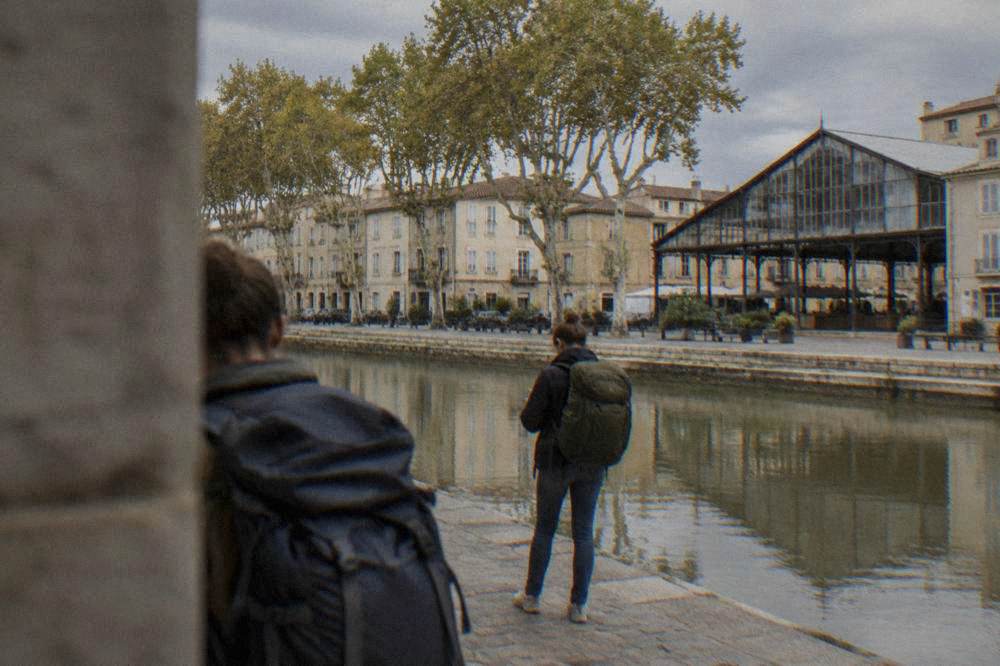
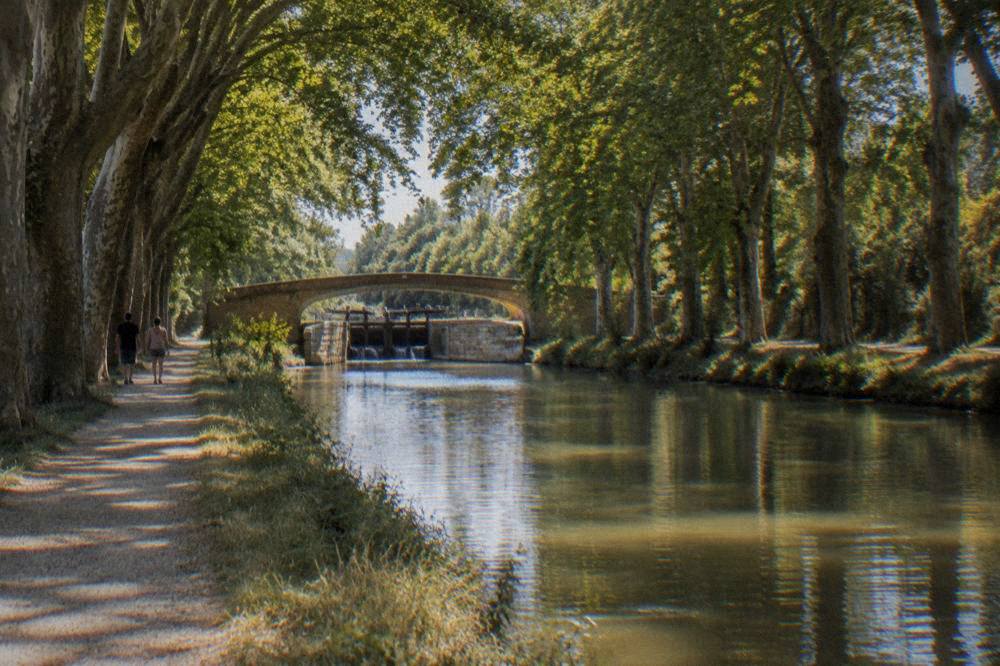
Narbonne's geography explains why it rewards a visit at all. The city was a major Roman center, and its medieval importance came from being a seat of archbishops, which is why the palace complex and the cathedral dominate the center rather than a castle or a fortress. The Canal de la Robine, which threads the town, belongs to the same waterway family as the Canal du Midi, the 1996 UNESCO inscription that begins in Toulouse. Travelers who know the canal from the Toulouse end will recognize the plane trees and the towpath immediately.
Getting to Matabiau in the first place is a Tisseo question, and those fares are fixed and published. The table below covers the tickets that matter for a day trip.
| Tisseo ticket | Price | Notes |
|---|---|---|
| Single trip | EUR 1.90 | One journey on metro, bus or tram |
| Single bought on board | EUR 2.50 | Last-minute purchase penalty |
| 10 trips | EUR 16.00 | Shareable, useful for a group |
| Day pass | EUR 7.20 | Unlimited travel for 24 hours |
| 3-day pass | EUR 14.30 | No 2-day pass exists |
If you are staying several days and moving between the station, the center and the museums, the tourist office's Pass Tourisme adds attraction entry to the mix. The office's Pass Tourisme page lists it at EUR 26 for stays of one to three days, with a free guided tour from the office included, and an optional EUR 10 add-on for ten public-transport trips. The pass pays off from the third activity, so a single Narbonne day does not justify it on its own, but a week of museum-going in Toulouse does.
What Are The Best Things To See In Narbonne?
The core of a Narbonne visit is the archbishops' palace complex, the Horreum Roman underground galleries, the unfinished cathedral and the covered market, all within a few minutes' walk of each other. The palace houses the archaeology and art collections, the Horreum is the city's most direct link to its Roman past, and the market is where the city eats, shops and argues, which makes it the best single stop for understanding the place.
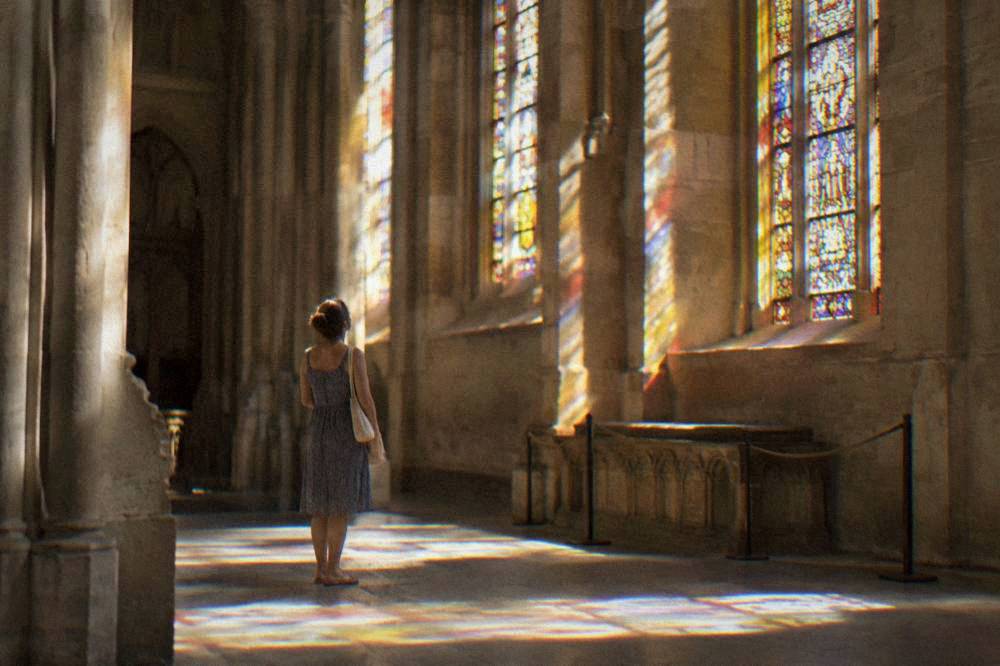
The archbishops' palace dominates the main square and holds the city's main museums inside its walls. The Horreum, a network of underground Roman storage galleries, is the sight people come specifically to see: narrow, cool corridors beneath the modern street level, the kind of space that makes the Roman city feel physically present rather than labeled on a plaque. The cathedral next door is famous for what never happened: work stopped centuries ago and the building stands as a monumental choir without its intended nave, which leaves the interior surprisingly luminous and the exterior oddly abrupt. That incompleteness is not a defect to apologize for, it is the reason the interior works: the choir was built to a single ambitious plan and finished as designed, so the proportions inside are coherent in a way that patched-together cathedrals rarely are.
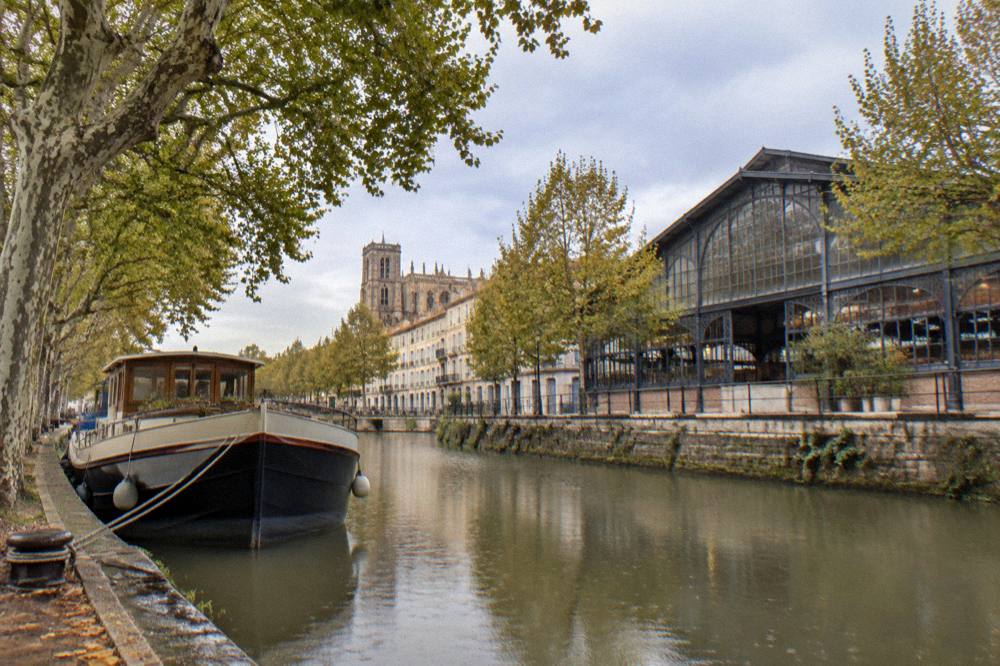
The Canal de la Robine cuts along the edge of the old town, and the banks are the natural place for a slow hour between sights. The canal belongs to the same family of waterways as the Canal du Midi, which was inscribed by UNESCO in 1996, and travelers who want more of that landscape can read our Canal du Midi guide for the Toulouse end of the system, or take a look at the Canal du Midi boat trips page for water-level options.
For a water-level experience without leaving Toulouse, a short cruise on the canal is an easy add-on to any itinerary:
How Do You Plan The Train Journey From Toulouse To Narbonne?
You travel from Toulouse-Matabiau station on a direct train toward the coast and get off at Narbonne's station, which sits a short walk from the old town, so the whole trip is a station-to-station affair with no transfers to worry about. Book on the operator's site for the day's exact times and fares, travel early to claim a full day, and check return times before you commit to a late dinner.
The practical rhythm matters more than any single number. Trains toward Narbonne continue on toward the coast, so the route doubles as the region's seaside corridor, and the same line is the one you would use for Carcassonne-bound connections in the other planning direction. Because this site only prints figures the official sources confirm, the journey time and ticket price are things to read on the rail operator's own booking page rather than in a guide; what a guide can tell you is that the trip is short enough that Narbonne works as a spontaneous decision, not just a planned excursion.
Allow a comfortable margin at Matabiau. The station is on the Tisseo network, so a single trip ticket at EUR 1.90, or a day pass at EUR 7.20 if you are using transport all day, gets you there. If you are flying in and out, the airport connection has its own quirks: the tram line T2 to Toulouse-Blagnac airport has been closed since 5 June 2023 and stays closed until the end of 2026 because of the metro Line C works, so the Navette aeroport bus is the public-transport link, running one departure every 15 minutes and taking 20 to 40 minutes to the center. The airport's own press figures record 7,621,409 commercial passengers in 2025, down 2.8% on 2024, so the airport is busy but not overwhelming by big-city standards.
The Line C metro itself, the project causing all that airport disruption, is a 27 km line with 21 stations running from Colomiers through Blagnac, Toulouse and out to Labege, and it opens at the end of 2028. None of that affects a Narbonne day trip directly, but it explains why the airport end of the network feels like a construction site, and why the bus is the honest answer for a morning flight connection.
How Much Time Do You Need In Narbonne?
A single full day is enough to see Narbonne's core at a relaxed pace: the palace museums, the Horreum, the cathedral and a long lunch at the covered market fill a day without rushing. Travelers who want to add the coast or a second town should plan either an early start and a late return, or an overnight, because the worthwhile additions lie beyond walking distance of the station.
The morning belongs to the palace and the Horreum, when the galleries are quiet. Lunch belongs to the market: the covered halls are the city's stomach, and the stalls around them do the region's charcuterie, cheese and shellfish justice. The afternoon is for the cathedral, the canal banks and, if the season is right, a wander out toward the coast. The 3 days in Toulouse itinerary shows how a Narbonne day slots into a longer stay in the region.
A useful way to think about pacing is to treat Narbonne as three zones. The palace-and-cathedral zone takes a morning. The market zone takes an unhurried lunch plus a browsing half hour. The canal zone takes whatever you have left, and it is the zone that absorbs overflow gracefully, because a towpath walk has no opening hours and no ticket. Travelers who try to compress all three into half a day end up skipping the market, which is the wrong thing to skip. Other pages covering the same trip are gathered on Toulouse Travel Guide.
For travelers who prefer a guided structure over self-direction, a guided walk of Toulouse's own highlights is a good complement on a different day of the trip:
A private version of the same idea exists for groups who want a dedicated guide, and the listing for the private walking tour with a local explains what it covers.
Where To Eat In Narbonne And What To Taste?
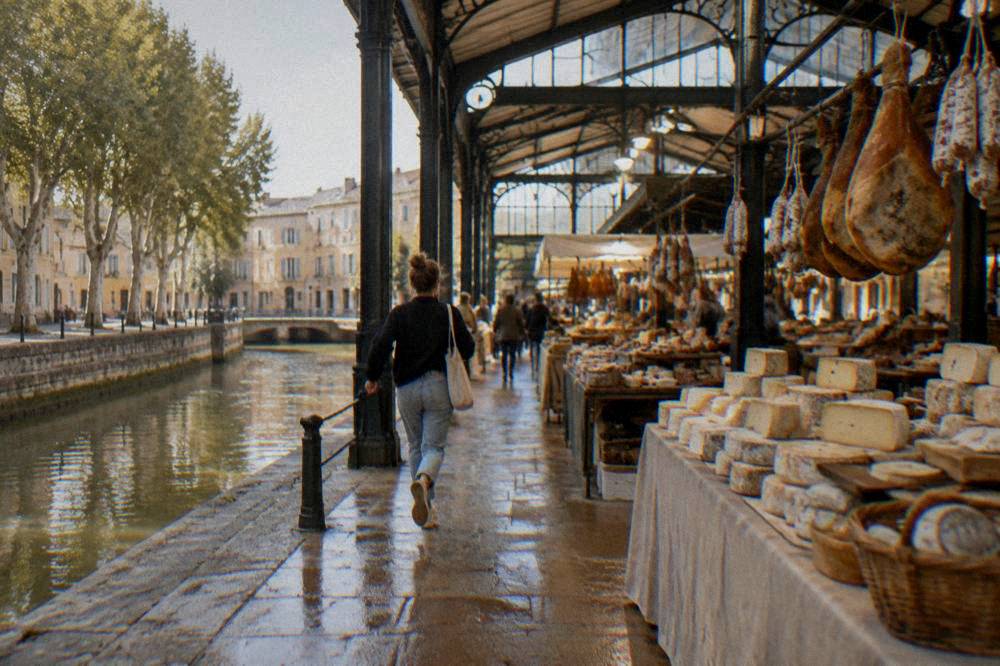
The covered market is the center of eating in Narbonne: stalls sell the Aude's charcuterie, cheeses, oysters and seasonal produce, and the surrounding counters serve them ready to eat, so the market works as both a sight and a lunch plan. Beyond the market, the old town's restaurants lean on the same regional larder, and the honest advice is to follow the market's lead rather than a ranking.
This site does not rank restaurants or quote their prices, because those figures change and none were confirmed on an official page. What travels well is the shopping logic: buy what the region is known for. The Aude is wine country, and the coast is close enough that shellfish and oysters reach the market quickly. Cassoulet, the region's signature slow-cooked bean dish, appears on menus across the Aude, and our cassoulet guide covers what it is and how to read a menu for a serious version of it. The Toulouse food page does the same for the home city.
A wine-focused alternative exists for travelers who want the region's vineyards handled for them. The Fronton small group wine tour from Toulouse heads to a local appellation with a winemaker visit, and the operator's live listing carries the current dates and prices.
When Is The Best Time Of Year To Visit Narbonne From Toulouse?
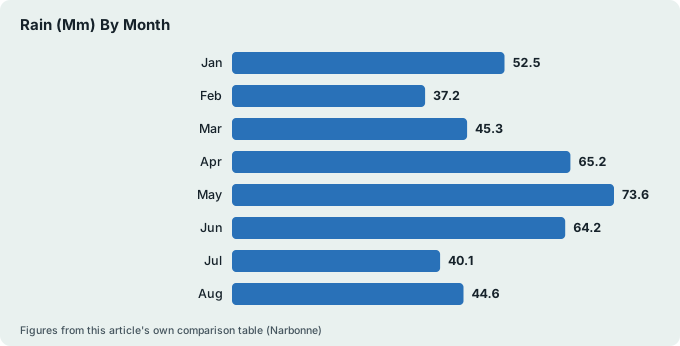
Late spring through early autumn is the comfortable window for a Narbonne day trip: Meteo-France's 1991-2020 normals for Toulouse-Blagnac show July as the sunniest month at 258.6 hours of sunshine, and the hot months are manageable because the trip is a train ride rather than a drive. The wettest month in Toulouse is May at 73.6 mm, so spring travelers should carry a light rain layer even though the day usually delivers.
The climate data below is measured at Toulouse-Blagnac, the departure point, and it is the best planning baseline available for the whole corridor.
| Month | Mean temperature (C) | Rain (mm) |
|---|---|---|
| Jan | 6.3 | 52.5 |
| Feb | 7.1 | 37.2 |
| Mar | 10.3 | 45.3 |
| Apr | 12.7 | 65.2 |
| May | 16.4 | 73.6 |
| Jun | 20.3 | 64.2 |
| Jul | 22.6 | 40.1 |
| Aug | 22.8 | 44.6 |
| Sep | 19.3 | 45.7 |
| Oct | 15.3 | 54.3 |
| Nov | 9.9 | 55.0 |
| Dec | 7.0 | 49.3 |
The surprise in that table is where the rain falls. May is the wettest month at 73.6 mm, nearly double February's 37.2 mm, and April and June follow close behind. Then the tap turns off: July gets just 40.1 mm of rain and the sunniest weather of the year. Hot-day frequency tells the same story.
| Month | Days at or above 30 C in Toulouse |
|---|---|
| May | 0.6 |
| Jun | 6.0 |
| Jul | 11.5 |
| Aug | 11.3 |
| Sep | 3.5 |
For the record extremes, Meteo-France's data for Toulouse-Blagnac shows a high of 42.4C on 23 August 2023 and a low of -19.2C on 15 February 1956, both far outside the normal range. For season planning in general, our best time to visit Toulouse guide works through the whole year.
If your trip lands in autumn, Toulouse's own festival calendar gives the departure city an evening program before or after the day trip.
| Event | Dates |
|---|---|
| Piano aux Jacobins | 8 to 30 September 2026 |
| Toulouse les Orgues (31st edition) | 7 to 18 October 2026 |
| Christmas markets (Capitole, Jean-Jaures, Charles-de-Gaulle) | 26 November to 27 December 2026 |
| Rio Loco | 9 to 13 June 2027 |
What Can You Combine With Narbonne On The Same Trip?
Carcassonne is the natural pairing with Narbonne, because the two cities lie on the same southbound corridor from Toulouse and a guided day trip covers the medieval citadel without the logistics of a second train day. The coast is the other pairing: Narbonne sits inland, and the beaches beyond it are a short onward hop, which is why travelers sometimes split a week between the historic inland cities and the shore.
Carcassonne deserves more than a rushed stop. Our Carcassonne day trip guide covers the walled citadel in detail, and the Cathar castles page extends the same story into the hilltop fortresses scattered across the region. For travelers who want the citadel explained rather than just walked, a private guided day trip from Toulouse handles the whole circuit:
The listing for the Carcassonne Castle of Kings and Crusades day trip explains the route and what the guide covers, with live dates and pricing on the operator's page: Check availability.
Coastal alternatives sit further along the same corridor. The Collioure guide covers the most photographed of the seaside villages, and the Pyrenees page opens the mountain option, roughly 100 km south of Toulouse, for travelers whose appetite runs to heights rather than harbors. Closer to home, the Albi and Montauban trips round out the inland set, and the day trips from Toulouse hub collects every option on one page.
For a final evening back in Toulouse, an aperitif cruise on the Garonne or the canal is a low-effort way to close out a day trip, and the trio below collects the options that pair best with a Narbonne itinerary.
Common Questions About A Narbonne Day Trip
Quick answers to what planners ask most about a Narbonne day trip from Toulouse.
Is Narbonne worth a day trip from Toulouse?
Yes, for travelers interested in Roman remains, a major market town's food culture and canal-side walking. The sights cluster within a compact center a short walk from the station, so a single day delivers the core without a car.
How do I get from Toulouse to Narbonne without a car?
A direct train from Toulouse-Matabiau station runs toward the coast and stops at Narbonne. Check the rail operator's own site for the day's times and fares, since this site only prints figures confirmed on official pages.
Is Narbonne on the coast?
No. Narbonne is an inland city on the Canal de la Robine, though the Mediterranean shore lies beyond it on the same corridor, which is why the city often appears in coastal itineraries.
What food is Narbonne known for?
The covered market defines the city's food scene: regional charcuterie, cheese, oysters and seasonal produce from the Aude. The area is also wine country, and cassoulet appears widely across the region's menus.
Can you combine Narbonne and Carcassonne in one day?
Doing both properly is tight on public transport. A guided day trip from Toulouse that covers Carcassonne is the more relaxed structure, or split them across two days and read the Carcassonne guide first.
Do I need to book the Horreum in advance?
Check the monument's own page for current opening arrangements before you travel, since hours and ticketing can change with the season. The site sits in the center, so it is easy to fit around the market and the palace.
Whatever the final shape of the itinerary, the pairing that consistently works is a Narbonne day for the market and the Roman underground, a Carcassonne day for the walls, and an evening cruise back in Toulouse to finish.