Montauban
Montauban, a pink-brick town on the Tarn north of Toulouse in southwestern France, makes an easy day trip by direct train from Toulouse-Matabiau. This guide covers the journey, the old town's arcaded square, the art museum, food, costs and timing.
Short answer
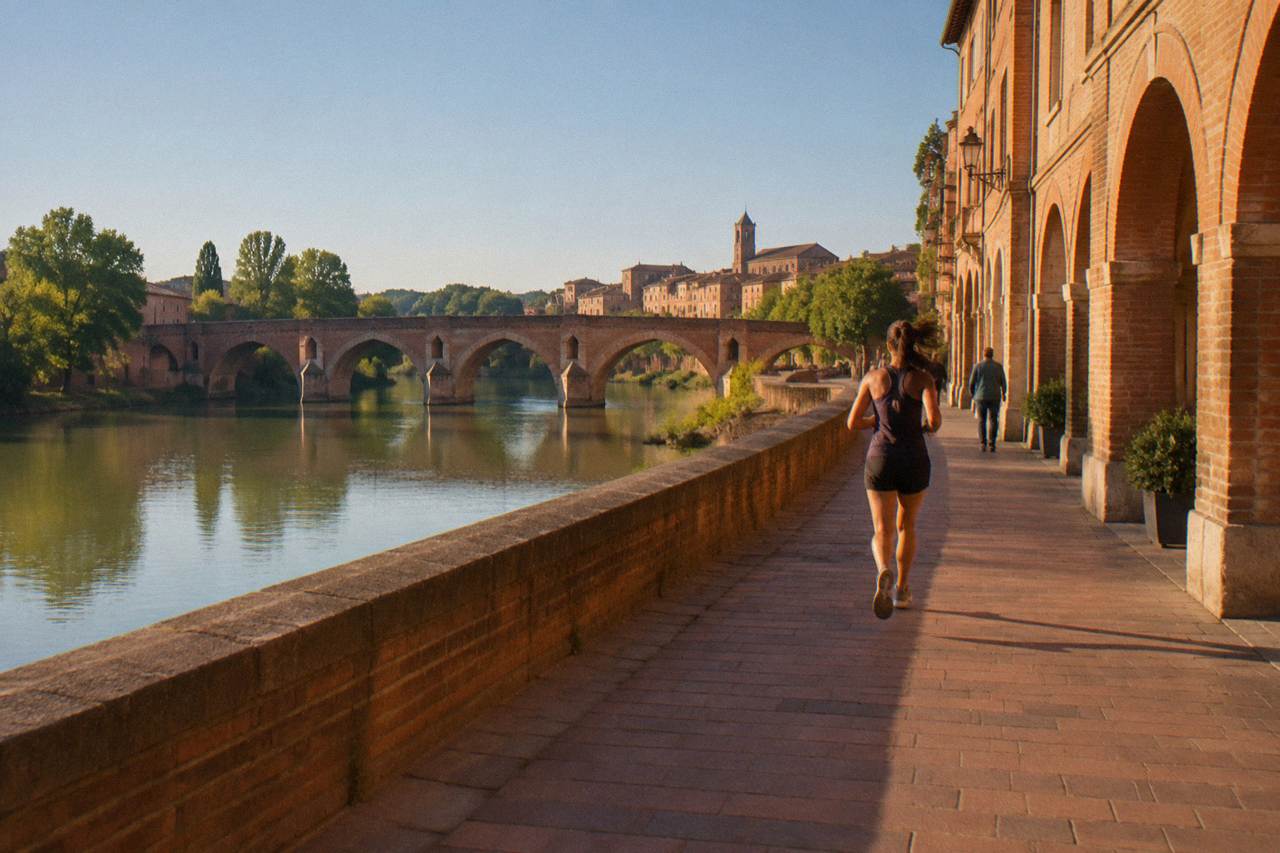
Montauban sits north of Toulouse in southwestern France and is reached by a direct train from Toulouse-Matabiau station. The town is known for its pink brick architecture, its great arcaded central square and its principal art museum. A single day is enough for the old town, the riverside walk and a long lunch.
Montauban, a pink-brick town on the Tarn river in southwestern France, is one of the easiest day trips you can make from Toulouse. A direct train from Toulouse-Matabiau connects the two cities, and the reward for the ride is a compact old town of warm brick, a huge arcaded square at its heart, and an art museum that holds one of the more remarkable collections in the region. Where Toulouse is known as La Ville Rose, Montauban belongs to the same family of southern brick towns, and the resemblance is the first thing that strikes you when you step out of the station.
This guide, from the Toulouse Travel Guide editorial desk, walks through the practical side of the trip: how to get there and back, what to do with a day, where the food is worth stopping for, and what the whole outing should cost. Every figure quoted comes from an official source, and where something could not be confirmed, the page says so or stays silent.
Where Is Montauban And Why Does It Make An Easy Day Trip?
Montauban lies north of Toulouse in the Occitanie region of southwestern France, on the Tarn river, and it is the administrative center of the Tarn-et-Garonne department. A direct train links it to Toulouse-Matabiau station, which puts the old town within reach for a morning-to-evening outing. Its pink brick core, its arcaded central square and its principal art museum are the three reasons day-trippers go.
The town shares its building material with Toulouse. The brick here is the same warm terracotta that gives Toulouse its nickname, La Ville Rose, and on a sunny afternoon the facades glow in exactly the same way. That makes Montauban a natural companion piece to the capital: you see the architecture of the region concentrated in a smaller, quieter setting that you can cross on foot in an afternoon.
The scale is the real argument for the trip. Everything a visitor wants sits inside a walkable center. The station, the main square, the museum and the riverbank are close together, so there is no metro, no bus network and no timetable to master once you arrive. You walk out of the station, and the day unfolds from there.
It is also a genuinely working French town rather than a museum piece. Markets, shops, cafés and schools all operate around the monuments, which gives the place a lived-in feel that some more heavily visited destinations in the region have traded away. Come on a weekday morning and you will share the square with locals doing their errands.
How Do You Get From Toulouse To Montauban?
You take a direct train from Toulouse-Matabiau station, the city's main rail terminal, and the journey is short enough that no other planning is really needed. Montauban's station sits within walking distance of the old town, so there is no transfer at the far end. Trains run regularly through the day, so no timetable needs to be checked in advance.
Getting to Matabiau in the first place is the part you can price precisely. Toulouse's public transport network, Tisseo, serves the station, and its official e-boutique catalogue lists the fares. A single trip costs EUR 1.90, or EUR 2.50 if you buy it last-minute on board. A day pass is EUR 7.20, a 3-day pass is EUR 14.30, and a carnet of 10 trips is EUR 16.00. There is no 2-day pass in the catalogue.
| Tisseo ticket | Price | Notes |
|---|---|---|
| Single trip | EUR 1.90 | Bought before boarding |
| Single, last minute on board | EUR 2.50 | The catalogue's premium for buying on the vehicle |
| 10 trips | EUR 16.00 | Works out cheaper per trip |
| Day pass | EUR 7.20 | Unlimited travel for one day |
| 3-day pass | EUR 14.30 | No 2-day pass exists |
| Airport single | EUR 9.50 | Tisseo network plus the Navette aeroport |
If you are flying in and out, note that the airport connection is in flux. Tram T2 to Toulouse-Blagnac airport has been closed since 5 June 2023 and stays closed until the end of 2026 because of the Line C metro works. The Navette aeroport bus runs one departure every 15 minutes and takes 20 to 40 minutes to the center. The airport handled 7,621,409 commercial passengers in 2025, down 2.8% on 2024, so the shuttle is a busy link; allow time for it if a flight and a train are chained together on the same morning.
Driving is an alternative, and car hire is covered on this site, but the train is the simpler choice for a single day. Montauban's center is compact and pedestrian-friendly, and arriving without a car removes any question about where to park. The train also lets you time your return with a glass of wine at dinner rather than a drive.
If you would rather leave the logistics to someone else, guided coach day trips from Toulouse are an option, though Montauban itself is not a standard coached destination. The operators listed below run to the region's headline sights instead, and they suit travelers who want the transport, the commentary and the schedule handled in one booking.
What Should You See In Montauban In One Day?
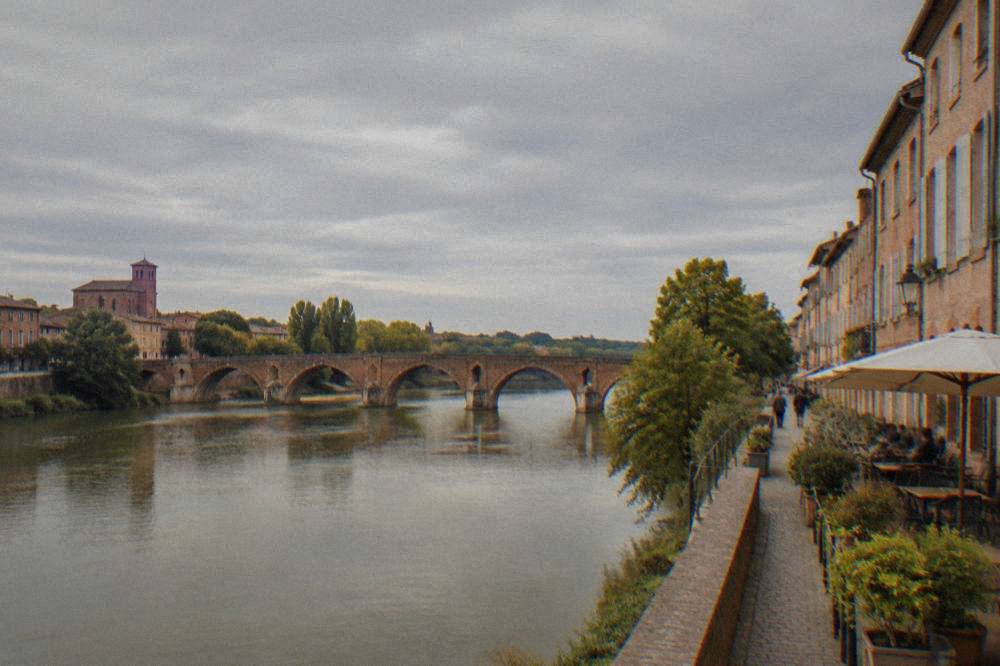
The core of a Montauban day is the Place Nationale, the great arcaded square at the center of the old town, followed by the town's principal art museum and a walk along the Tarn riverbank to the old bridge. All three sit within a few minutes' walk of each other, so the whole circuit is comfortably done on foot between lunch and the return train.
Start on the square. The Place Nationale is one of the great arcaded squares of southwest France, a wide expanse framed by buildings supported on brick pillars, with cafés set into the arches around the edges. The space is the town's living room: markets and events happen here, and on an ordinary morning it belongs to people reading newspapers over coffee. Give it an unhurried loop before anything else, because it sets the tone for the brick architecture you will see everywhere else.
The art museum is the indoor anchor. The museum's own name commemorates two figures of French art, and its collection is housed in a historic building facing the square's approach; it is the single biggest cultural draw the town has. Check the museum's own page for current hours and admission before you go, because this site does not publish figures it has not confirmed.
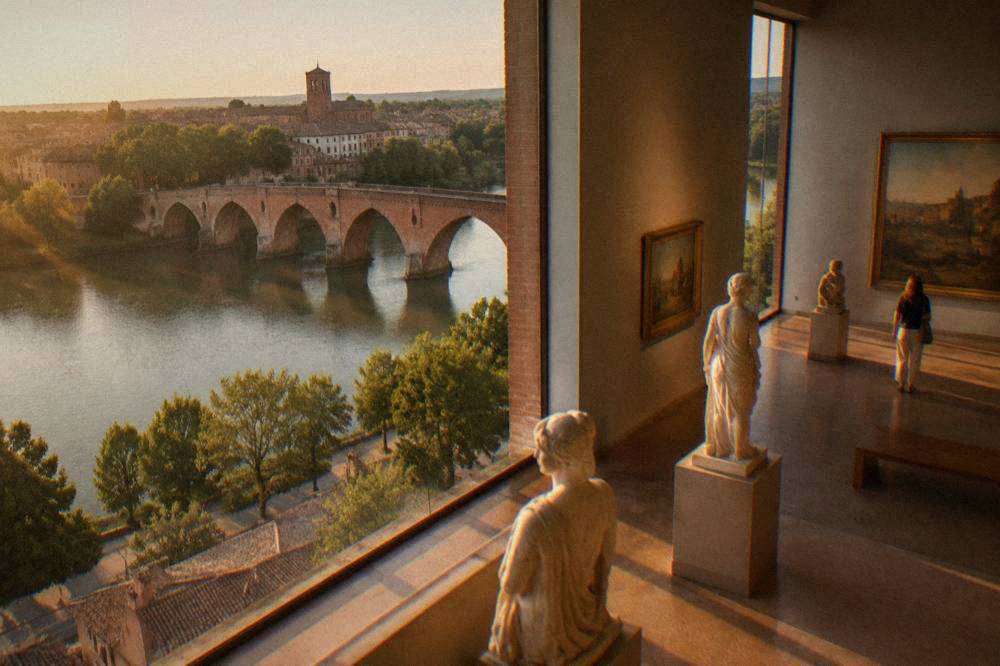
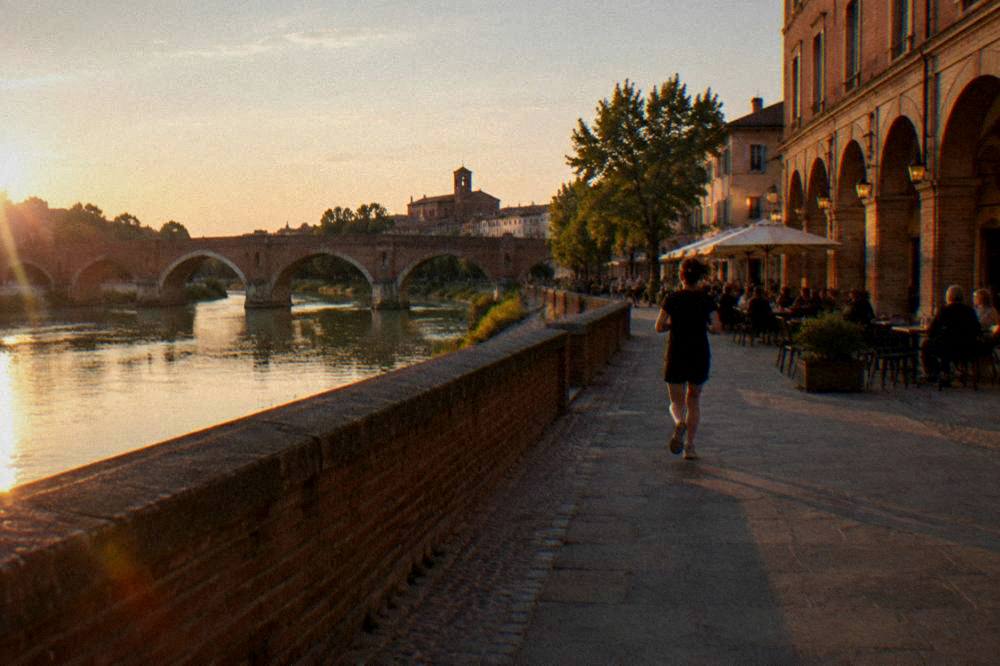
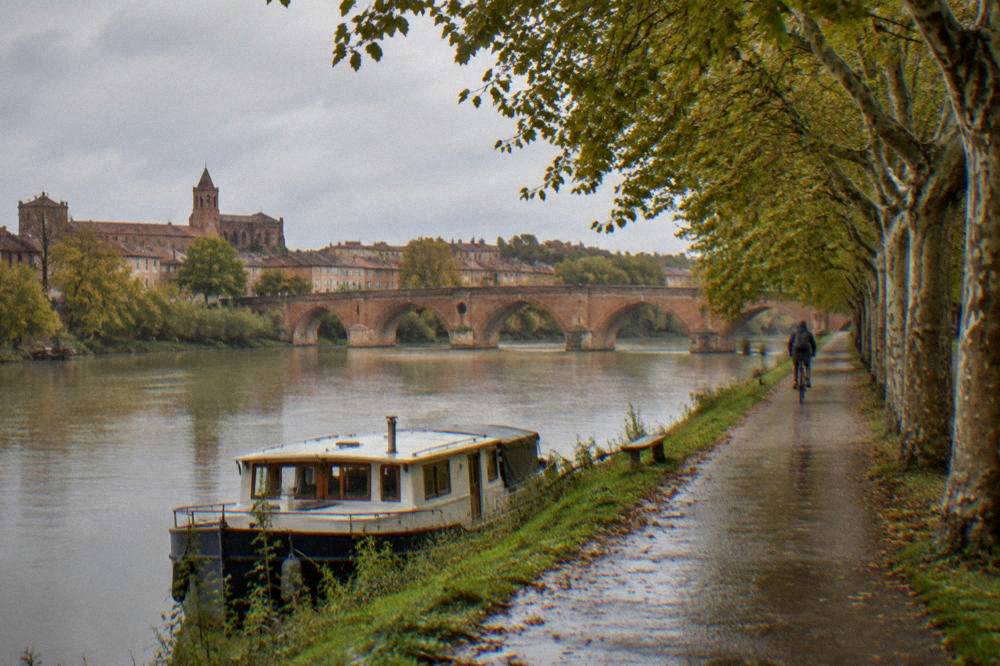
From the museum, walk downhill toward the river. The old bridge crosses the Tarn and gives the classic view back over the town's rooftops, with the brick of the churches and houses stacked above the water. The riverbank path on either side is a pleasant stretch for a final hour, and in summer the shade along the water is the coolest place in town.
Churches fill the gaps. Montauban's main church and its bell tower are visible from across the river, and the interior is worth a short visit if the museum has left time in the day. As with the museum, this site does not print opening hours it has not verified, so treat the church as a probable stop rather than a scheduled one.
A realistic shape for the day looks like this: arrive mid-morning, coffee on the square, the museum before lunch, a long southwestern lunch, then the riverbank and the bridge in the afternoon, with a final drink under the arcades before walking back to the station. Nothing in that plan requires a booking, a ticket bought in advance or a timetable beyond the return train.
Where Should You Eat In Montauban?
Montauban eats like the rest of the southwest: duck in every form, cassoulet, local cheeses and the produce of the surrounding farmland, served in restaurants around the arcaded square and the streets running off it. This site has not verified any individual restaurant's prices, hours or ranking, so this section names the dishes to look for rather than the addresses, and lets the square's own chalkboards do the choosing.
The starting point is the same one that governs eating in Toulouse. Duck breast, confit and foie gras are the region's signature products, and cassoulet, the baked bean and meat casserole, is the dish the southwest is most famous for. Our guide to the cassoulet of Toulouse covers what goes into the dish and why arguments about it run so hot; in Montauban you will meet the same debates on the plate.
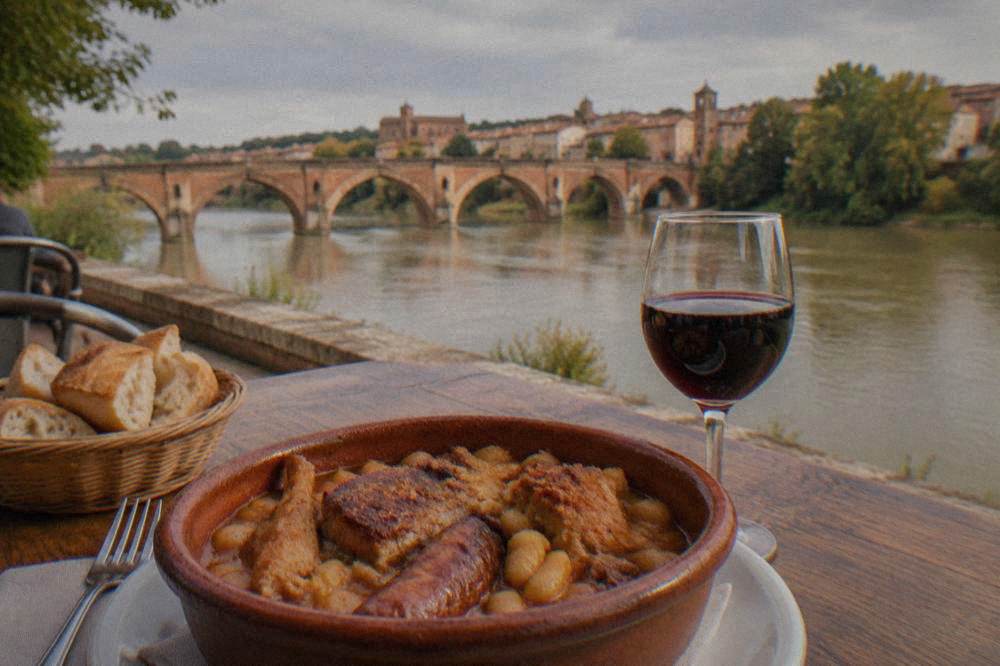
Markets are the other food experience, and the town's market tradition is the practical way to assemble a picnic. Ask at the tourist office for the current market days, because this site has not confirmed the schedule, and treat the stalls as your source for cheese, fruit and bread to eat on the riverbank. A market picnic and a restaurant dinner is a good division of a day's eating.
Wine is local in a way that surprises people who expect Bordeaux on every list. The vineyards of the Gaillac region lie in the same part of the world, and Fronton, whose reds are made just north of Toulouse, is another nearby appellation. Our Gaillac wine route guide covers that area in depth if the day trip turns into a wine plan. In a Montauban restaurant, asking what is poured by the glass from the neighborhood is usually the right move.
For dessert, the region's repertoire of pastries and sweets holds up anywhere. If the day ends with a coffee and something sweet under the arcades, you have eaten Montauban correctly.
Should You Combine Montauban With Another Stop?
Yes, if you have a full day and your own transport, because Montauban's old town is compact enough to fill a morning and leave an afternoon free. The most natural pairings are Moissac, the riverside town with its famous cloister to the west, and Auch, the historic cathedral city to the south. By train on a day trip, Montauban alone is the realistic plan, and it is a full enough one.
Moissac is the strongest pairing for travelers with a car. The town sits on the Tarn and the Garonne canal system, and its cloister and church portal are the reasons visitors make the detour. Our Moissac day trip guide lays out the details. Auch, with its cathedral and its stepped old center, is the other direction; the Auch guide covers it.
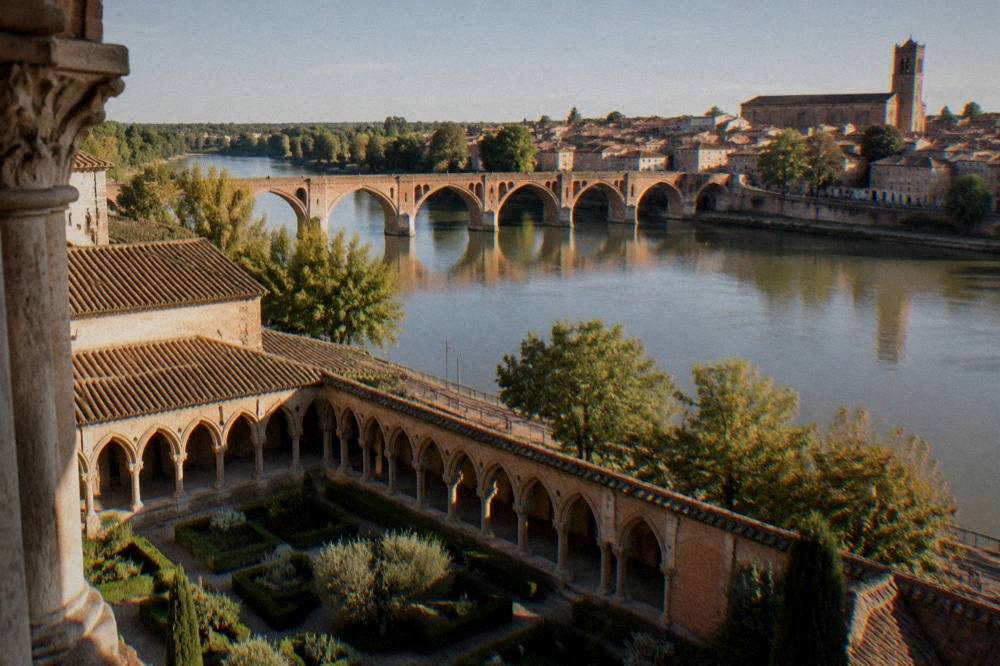
Travelers who fall for the pink-brick towns of this region often end up planning a second day trip before the first is over. Albi, with its fortress cathedral and its museum dedicated to Toulouse-Lautrec, is the biggest of them, and Cordes-sur-Ciel is the hilltop village that photographers love. Both are covered in depth on this site, and a guided coach option exists for travelers who would rather not drive.
If Montauban is your taste rather than an outlier, the honest advice is to keep the day simple. One town, one museum, one long lunch and one river walk is a complete day out, and bolting on a second stop by train usually means spending the afternoon watching departure boards instead of sitting under the arcades.
When Is The Best Time Of Year To Visit?
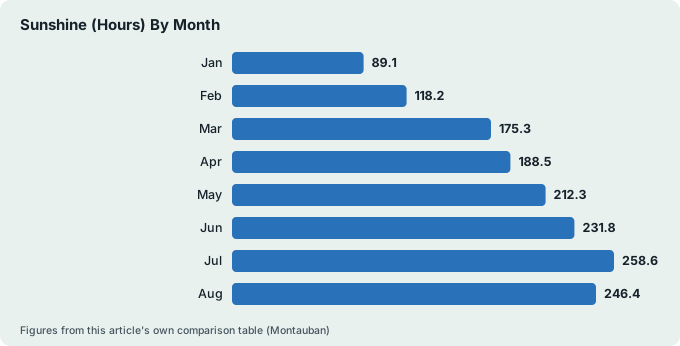
Late spring through early autumn is the comfortable window, and within it the official climate data favors the shoulder months, because May is the wettest month of the year in this region while July is the sunniest and among the driest. The nearest station with published Meteo-France 1991-2020 normals is Toulouse-Blagnac, and its figures describe the climate Montauban shares.
The numbers overturn a common assumption. Rain here peaks in late spring, not winter: May averages 73.6 mm, April 65.2 mm and June 64.2 mm, while February is the driest month at 37.2 mm. July, the sunniest month with 258.6 hours of sunshine, gets just 40.1 mm of rain. If a day trip's success depends on the weather, the data says to aim for high summer or early autumn rather than the green weeks of May.
| Month | Mean temperature (C) | Rain (mm) | Sunshine (hours) |
|---|---|---|---|
| Jan | 6.3 | 52.5 | 89.1 |
| Feb | 7.1 | 37.2 | 118.2 |
| Mar | 10.3 | 45.3 | 175.3 |
| Apr | 12.7 | 65.2 | 188.5 |
| May | 16.4 | 73.6 | 212.3 |
| Jun | 20.3 | 64.2 | 231.8 |
| Jul | 22.6 | 40.1 | 258.6 |
| Aug | 22.8 | 44.6 | 246.4 |
| Sep | 19.3 | 45.7 | 210.1 |
| Oct | 15.3 | 54.3 | 155.2 |
| Nov | 9.9 | 55.0 | 99.9 |
| Dec | 7.0 | 49.3 | 89.7 |
Source: Meteo-France 1991-2020 normals, Toulouse-Blagnac station. Over the year the station records 627 mm of rain across 95.8 rain days and 2,075.1 hours of sun. The records for the site run from 1947 to June 2025, with an all-time high of 42.4C on 23 August 2023 and an all-time low of -19.2C on 15 February 1956, so heat is the more realistic extreme to plan around.
Events can tilt the timing too. If your day trip is anchored to a stay in Toulouse, the autumn festival calendar is rich: Piano aux Jacobins runs 8 to 30 September 2026, and Toulouse les Orgues, the international organ festival's 31st edition, runs 7 to 18 October 2026 with its opening concert at Notre-Dame de la Daurade on 7 October. The Christmas markets on Place du Capitole, the allees Jean-Jaures and square Charles-de-Gaulle run 26 November to 27 December 2026, which pairs a Montauban day with a festive evening back in Toulouse.
| Event | 2026-2027 dates | Location |
|---|---|---|
| Piano aux Jacobins | 8 to 30 September 2026 | Couvent des Jacobins, Toulouse |
| Toulouse les Orgues (31st edition) | 7 to 18 October 2026 | Multiple venues, opening at Notre-Dame de la Daurade |
| Christmas markets | 26 November to 27 December 2026 | Place du Capitole, allees Jean-Jaures, square Charles-de-Gaulle |
| Rio Loco | 9 to 13 June 2027 | Prairie des Filtres, Toulouse, theme "Noctiluca" |
How Much Does A Day Trip To Montauban Cost?
The transport is the only fixed cost, and it is small: a Tisseo single to Matabiau station is EUR 1.90, and the train fare to Montauban is set by SNCF, whose prices this site does not quote because they could not be verified. Food and museum admission are the variables, and the tourist office's Pass Tourisme, at EUR 26 for stays of one to three days, is the benchmark to measure any sightseeing spending against.
The Pass Tourisme is a Toulouse product, not a Montauban one, but it frames the value question for anyone using Toulouse as a base. The tourist office's Pass Tourisme page lists the pass at EUR 26 for stays of one to three days, says it pays off from the third activity, and includes a free guided tour from the tourist office. Adding EUR 10 buys ten public-transport trips on top.
| Pass Tourisme detail | Figure |
|---|---|
| Pass price | EUR 26, valid 1 to 3 days |
| Transport add-on | +EUR 10 for 10 trips |
| Free guided tour | Included, from the tourist office |
| Pays off from | The 3rd activity |
The museums the pass covers, with their normal rates as the tourist office lists them, show what admission costs in the region: Fondation Bemberg EUR 12, the Museum EUR 12, Les Abattoirs EUR 12, Musee des Augustins EUR 5 and Couvent des Jacobins EUR 5, all free with the pass. Cite de l'espace, at a normal rate of EUR 29, is discounted rather than free. Montauban's museum sits outside this scheme, so budget its admission separately and check its own page for the current figure.
Two caveats keep the budget honest. First, the Toulouse Metropole tourist tax applies to non-classified lodging, including most platform rentals, at 5% of the pre-tax nightly price per person, so it touches where you sleep in Toulouse, not your day in Montauban. Second, restaurant prices in the town are not something this site can quote, since no individual establishment's figures were verified; the honest budget line is that a market picnic costs less than a restaurant lunch, and both are good.
For anyone weighing the day trip against a guided excursion, the comparison is between a cheap train ticket plus your own timekeeping and a booked seat on a coach with a fixed itinerary. The coach option below covers Carcassonne with transfer and free time, and it suits travelers who prefer the second model.
Is Montauban Worth It Compared To The Region's Headliners?
Montauban is the quieter, cheaper, lower-effort choice, and it rewards travelers who want a working French town rather than a spectacle. Carcassonne and Albi are the region's headliners and they justify their reputations, but a Montauban day costs less, moves slower and never feels crowded. The honest ranking depends on what you want from a day out, not on any objective scale.
Carcassonne's restored medieval city is the biggest draw in the southwest, and our Carcassonne guide treats it as the full-day commitment it is. Albi's brick cathedral and its Toulouse-Lautrec collection are covered in the Albi guide. Both deserve their fame, and both absorb a whole day. Montauban asks for less and gives less, and that is exactly its value.
The canal is a different kind of comparison. The Canal du Midi, inscribed by UNESCO in 1996 under criteria i, ii, iv and vi, begins its run from Toulouse toward the Mediterranean, and a cruise on it is an afternoon rather than a day. Montauban's riverbank walk is a smaller pleasure of the same family: water, shade, brick above the bank. Travelers who enjoy one tend to enjoy the other.
The decision rule is simple. If this is your only day trip from Toulouse and you want the maximum, take Carcassonne or Albi. If you have already seen a headliner, or you want a day with no schedule at all, take the train to Montauban and give the square the time it deserves.
Common Questions About Montauban
Quick answers to what planners ask most about a Montauban day trip.
How do I get from Toulouse to Montauban?
Take a direct train from Toulouse-Matabiau station. The journey is short, and Montauban's station is within walking distance of the old town. To reach Matabiau, a Tisseo single costs EUR 1.90, or EUR 2.50 bought last-minute on board.
Is one day enough for Montauban?
Yes. The arcaded Place Nationale, the town's principal art museum and the riverbank walk are all within a compact center, and a morning-to-evening visit covers the town comfortably without rushing.
What is Montauban famous for?
Pink brick architecture in the same family as Toulouse's, one of the great arcaded squares of southwest France, and a fine art museum in the center of town.
What should I eat in Montauban?
The same southwestern repertoire as Toulouse: duck breast, confit, foie gras and cassoulet, plus local cheeses and wines from nearby appellations such as Gaillac and Fronton. This site names no individual restaurant.
When is the best time to visit Montauban?
High summer or early autumn. The Meteo-France 1991-2020 normals for Toulouse-Blagnac show May as the wettest month at 73.6 mm, while July is the sunniest at 258.6 hours with only 40.1 mm of rain.
Can I combine Montauban with another town?
With a car, Moissac to the west or Auch to the south make natural pairings. By train on a day trip, Montauban alone is the realistic plan, and it fills a day on its own.