Toulouse Violet: The Flower, The Sweets And The February Festival
The Toulouse violet is the small purple flower that the city adopted as its own emblem, flavoring its sweets, scenting its perfumes and giving it a festival each February. This guide explains what the flower means to the city, where to look for violet products and how to plan a visit around them.
Short answer
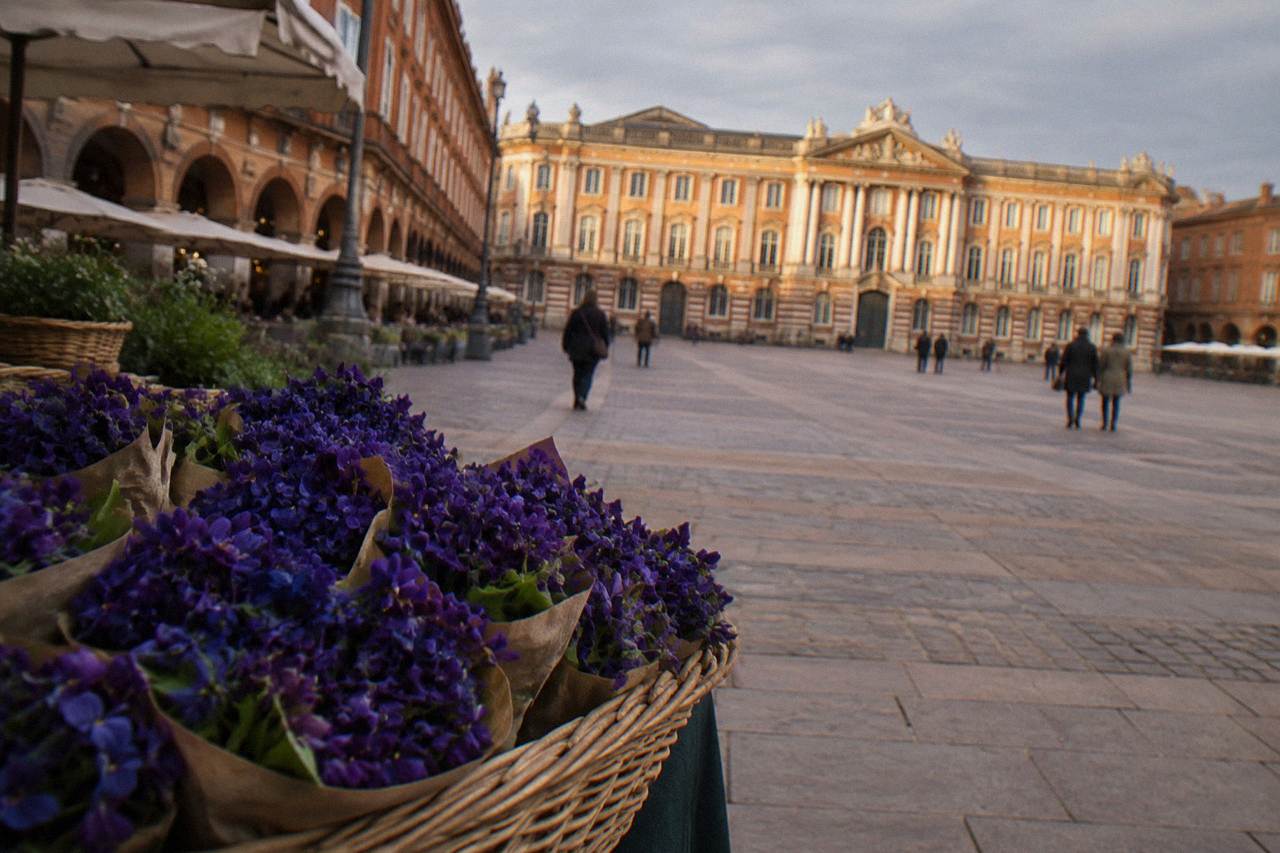
The Toulouse violet is a small, fragrant purple flower the city adopted as an emblem, celebrated with a festival that typically falls in February. Violet sweets, syrups and perfumes are sold in the city's markets and confectioners, and the flower is one of the things the city lists among its signature local products.
Toulouse, the pink-brick "La Ville Rose" on the Garonne in southwestern France, has a second color in its wardrobe besides the rose of its walls: the deep purple of the violet. The city's tourist office and metropole listings treat the violet as a signature local product, alongside cassoulet and the aerospace industry, and the flower shows up in sweets, syrups, liqueurs and perfumes sold across the city. This guide covers what the Toulouse violet actually is, where to find it in edible and scented form, when the city celebrates it, and how to fold a violet theme into a wider trip. For the broader canvas of the city's famous foods and symbols, see the companion guide to what Toulouse is famous for.
What Is The Toulouse Violet?
The Toulouse violet is a small, intensely fragrant purple flower that the city adopted as a local emblem, cultivated around Toulouse for its perfume and its edible petals. It is not a separate botanical oddity so much as a local tradition: the flower is grown, candied, distilled and celebrated here in ways few other French cities match, and it shares emblem status with cassoulet and the pink brick itself. The violet belongs to Toulouse the way lavender belongs to Provence. The flower appears in the city's confectioners' windows as crystallized violets, in bottles of violet syrup and liqueur, and in perfumes whose scent is built around the flower. The city's own listings and tourism material treat the violet as one of the products that define local identity, and the February festival dedicated to it draws the flower lovers of the region into the center. None of the city's other emblems, not the brick, not the sausage, not the rugby club, comes in a form you can eat, drink and smell at once.
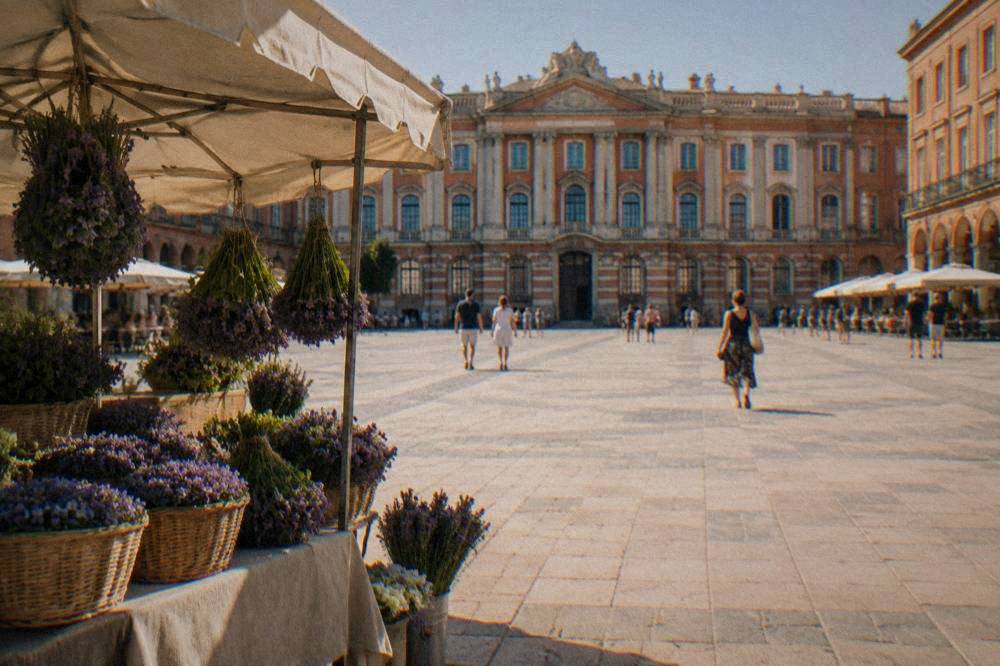
The connection runs deep enough that the violet has its own annual celebration, the Fete de la Violette, which the city's agenda has typically scheduled in February in recent editions. The metropole's event pages carry the festival when it runs, and the tourist office's material on local products gives the flower a place of its own. For a visitor, the practical takeaway is simple: violet products are a genuine local specialty, not a tourist trap invented yesterday, and they make a compact, packable souvenir. The tradition also explains why the flower survives in the city's shops long after the growing season ends: preserving violets in sugar was the original way to keep a February flower on the shelf until the following winter, and the confectioners' jars on display today are the direct descendants of that practice.
Where To Buy Violet Sweets, Syrups And Perfumes In Toulouse?
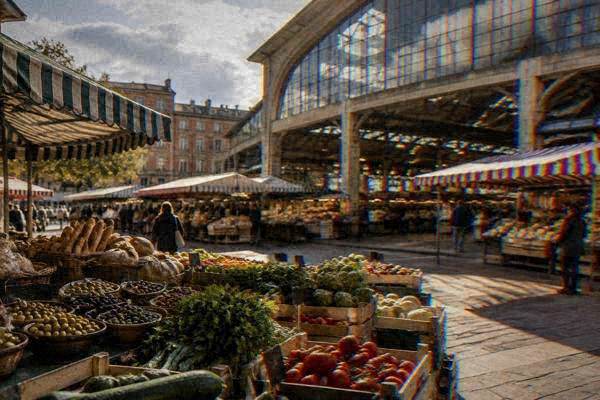
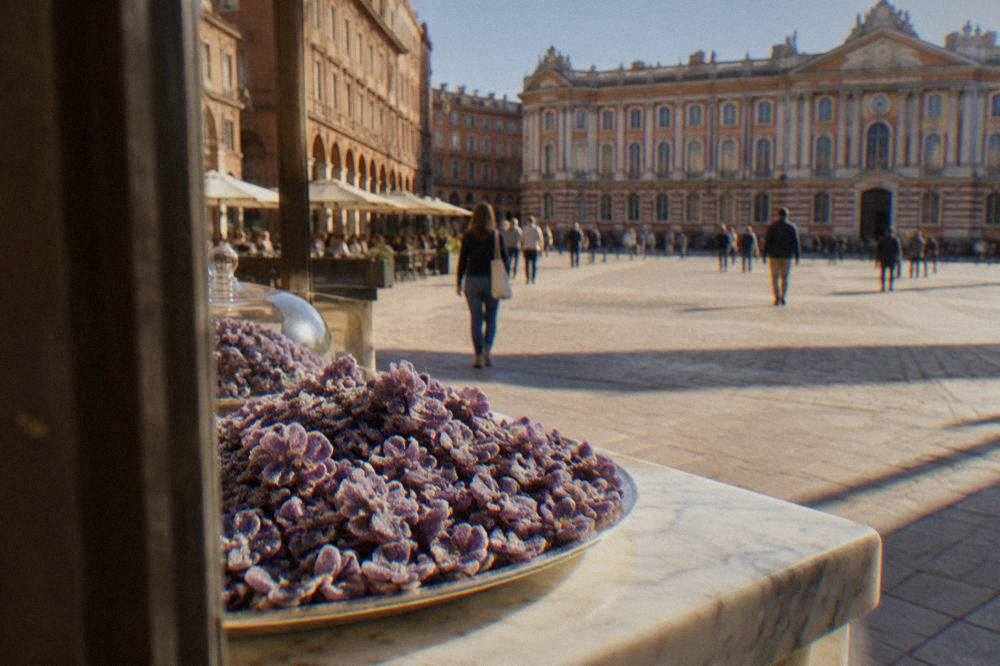
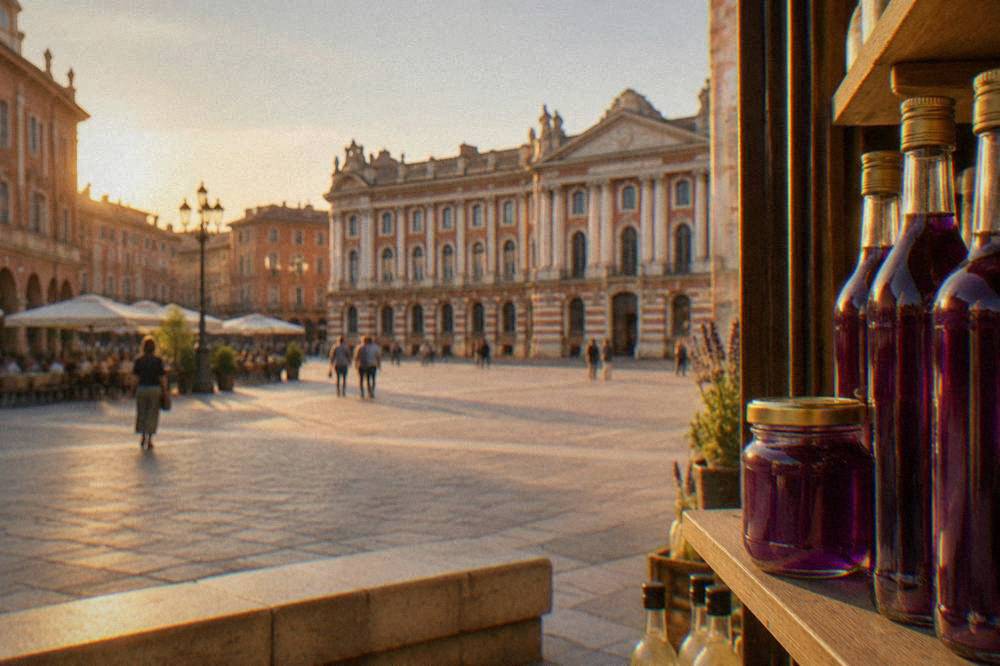
The main places to find violet products in Toulouse are the covered food markets, above all the Victor Hugo market near the Capitole, and the traditional confectioners and sweet shops of the city center, which sell crystallized violets, violet syrup and violet-flavored pastries. Perfume shops carrying violet scents cluster in the same central streets. No single shop was verified as "the" address, so treat the market and the old center as the hunting ground rather than one named stop. The Victor Hugo market is the city's flagship food market, the same hall where restaurateurs shop for the ingredients of Toulouse food and where the stalls of cassoulet ingredients sit a few steps from the flowers and confectionery. Look for the flower in three forms: candied, as a crystallized violet on a pastry or in a jar; liquid, as a syrup or liqueur; and scented, in soaps and perfumes. The market hall sits close to the Capitole, which makes it an easy pairing with a morning walk through the old center.
Beyond the market, the streets around the Capitole and Saint-Sernin hold the city's traditional sweet shops, the kind of confiserie that keeps violet specialties alongside the other classics of the southwest. Because no specific shop's prices, hours or ranking were sourced for this guide, the honest advice is to browse rather than to chase one address: the violet products are visible in the windows, and the restaurants and markets guide covers the same streets for eating. If the trip falls outside February, the sweets and syrups are sold year-round, which is the whole point of candying a perishable flower in the first place. A useful rhythm for a shopping morning is to start at the market when the stalls are fullest, then work outward through the shopping streets as the day warms up, finishing near the Garonne before lunch.
When Is Violet Season In Toulouse?
Violets bloom in the late-winter and early-spring window, and Toulouse's violet festival, the Fete de la Violette, has typically been held in February in recent editions, timed to the flower's natural season. The city's climate supports this: Meteo-France's 1991-2020 normals for Toulouse-Blagnac show February as the driest month of the year at 37.2 mm of rain, with 118.2 hours of sunshine, mild for winter and workable for an outdoor flower festival. The flower's calendar and the city's calendar line up neatly. February is the month the violet wakes, and it is also the month Toulouse is at its driest, which matters for a festival built around outdoor stalls and displays. The metropole's agenda pages list the Fete de la Violette when it runs, and recent editions have fallen in February; a 2027 edition had no confirmed dates, so check the city's agenda before locking a trip around it. The table below shows the flower-season months from the official climate normals, the same Meteo-France fiche climatologique for the Toulouse-Blagnac station that underpins the site's weather guide.
| Month | Mean temperature (C) | Rain (mm) | Sunshine (hours) |
|---|---|---|---|
| February | 7.1 | 37.2 | 118.2 |
| March | 10.3 | 45.3 | 175.3 |
| April | 12.7 | 65.2 | 188.5 |
| May | 16.4 | 73.6 | 212.3 |
One caution from the same source: May, not any winter month, is Toulouse's wettest month at 73.6 mm of rain. Late spring visitors who come for the gardens and the best time to visit guide should pack for showers, while February visitors hunting violets get the driest small month of the year. The flower season and the festival season are the same season, and it is early.

How Do You Plan A Trip Around The Fete De La Violette?
Plan a February trip, book central lodging early because festival weekends fill the old center, and build the days around the festival stalls plus the indoor comfort stops: the Victor Hugo market, the city's museums and the confectioners. The festival itself is free to wander in the spirit of a street market, and the city's climate data says February is the driest month of the year, so the odds of a walkable weekend are better than the calendar suggests. The practical spine of the trip is the same as any Toulouse weekend, with the festival layered on top. Arrive through Toulouse-Blagnac airport, which handled 7,621,409 commercial passengers in 2025, and reach the center on the airport Navette, which runs one departure every 15 minutes and takes 20 to 40 minutes to the center; a single airport ticket on the Tisseo network costs EUR 9.50. Note that the airport tram, T2, has been closed since 5 June 2023 and stays closed until the end of 2026, so the bus is the public-transport link. The full mechanics are in the airport to city center guide.
For lodging, the where to stay in Toulouse guide maps the central neighborhoods; a festival trip argues for staying within walking distance of the Capitole, since the festival activity clusters in the central streets and the market. Once in place, a good first move is an orientation loop of the city. The Toulouse Sightseeing Bus Tour circles the main monuments in about an hour, and it can be booked at Check availability for the first morning, before the festival crowds build.
What Else Is On In Toulouse In The Colder Months?
The months around violet season carry a dense verified events calendar: Piano aux Jacobins ran 8 to 30 September 2026, Toulouse les Orgues runs 7 to 18 October 2026, and the Christmas markets run 26 November to 27 December 2026 on the Place du Capitole, the allees Jean-Jaures and the square Charles-de-Gaulle. A visitor combining the violet theme with the city's cultural calendar has real, dated options from autumn straight through to the New Year. The table below collects the events whose dates were confirmed on official city or organizer pages, which makes it a reliable skeleton for an off-season trip.
| Event | Confirmed dates | Venue |
|---|---|---|
| Piano aux Jacobins | 8 to 30 September 2026 | Couvent des Jacobins and other venues |
| Toulouse les Orgues (31st edition) | 7 to 18 October 2026 | Multiple venues, opening concert at Notre-Dame de la Daurade |
| Christmas markets | 26 November to 27 December 2026 | Place du Capitole, allees Jean-Jaures, square Charles-de-Gaulle |
| Rio Loco | 9 to 13 June 2027 | Prairie des Filtres |
The Christmas market matters to a violet trip in a direct way: the Marche de Noel on the Place du Capitole is the same square where festival stalls appear, and the confectioners who sell crystallized violets do their biggest business of the year in December. The Jacobins, whose cloister hosts the piano festival, is also one of the monuments where the city's history is most visible; the convent is free on the first Sunday of the month except when a temporary exhibition is on, and its church roof is under restoration with the site open to visitors. The details of the monument are covered in the site's guide to the Couvent des Jacobins.

How Do You Get Around Toulouse On A Violet-Themed Day?
A violet-themed day in Toulouse needs almost no transport at all: the Victor Hugo market, the Capitole, the confectioners of the old center and the Garonne riverside are all within a short walk of each other. For longer hops, the Tisseo network's official catalogue prices a single trip at EUR 1.90, a day pass at EUR 7.20 and a 3-day pass at EUR 14.30, and the tourist office's Pass Tourisme at EUR 26 adds museum entries plus, for EUR 10 more, ten transport trips. The city center is compact enough that the flower trail is a walking trail. Start at the Capitole, walk to the Victor Hugo market, loop back through the shopping streets where the sweet shops sit, and finish on the Garonne, which the riverside guide covers in full. When legs give out, the metro and bus fares are modest, and the full fare table with the airport options sits in the getting around Toulouse guide.
| Tisseo ticket | Price (EUR) |
|---|---|
| Single trip | 1.90 |
| Single trip bought on board | 2.50 |
| 10 trips | 16.00 |
| Day pass | 7.20 |
| 3-day pass | 14.30 |
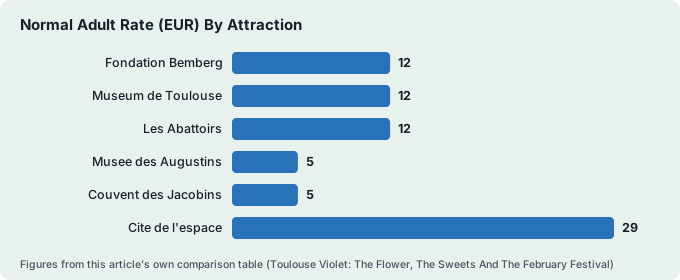
The Pass Tourisme deserves a look for a museum-heavy violet weekend. The tourist office's own page prices it at EUR 26 for stays of 1 to 3 days, says it pays off from the third activity, and includes a free guided tour from the tourist office; the museums it lists as free with the pass include the Fondation Bemberg at a normal rate of EUR 12, the Museum at EUR 12, Les Abattoirs at EUR 12, the Musee des Augustins at EUR 5 and the Couvent des Jacobins at EUR 5. The Pass Tourisme guide runs the arithmetic in detail.
| Attraction | Normal adult rate (EUR) | With Pass Tourisme |
|---|---|---|
| Fondation Bemberg | 12 | Free |
| Museum de Toulouse | 12 | Free |
| Les Abattoirs | 12 | Free |
| Musee des Augustins | 5 | Free |
| Couvent des Jacobins | 5 | Free |
| Cite de l'espace | 29 | Discounted |
One timing note from the museums' own pages: the Musee des Augustins is temporarily closed 21 September to 2 October 2026 for great-cloister works, with its Gothic halls reopening on 3 October 2026 from 10:00. A late-September visitor planning a museum day alongside the flower stalls should check the museum's own site first.
Can You Combine Violets With Day Trips From Toulouse?
Yes, and the natural pairing is the Albi and Cordes-sur-Ciel day trip, which the site's roster offers as a coach tour with audio guides, plus the Canal du Midi, whose UNESCO-listed banks make a flower-and-water day out of the city. The Albi trip visits the UNESCO-listed cathedral city and the hilltop village of Cordes-sur-ciel in one day, and the canal cruise runs on the waterway inscribed by UNESCO in 1996. The Albi and Cordes day trip suits the violet theme better than it first appears: the medieval hill towns of the region hold artisan food traditions of their own, and the drive north crosses the same southwest countryside that produces the flower farms. Albi itself is covered in the site's Albi guide, and Cordes-sur-ciel in its own page. The tour can be reserved through the operator's live listing.
The canal is the second pairing. The Canal du Midi was inscribed by UNESCO in 1996 under criteria (i), (ii), (iv) and (vi), and a narrated cruise on it is one of the cheapest structured experiences in the roster. The narrated canal cruise runs on the listed waterway with commentary, and the site's Canal du Midi guide explains why the canal matters. For the wider menu of escapes, from Carcassonne to the Pyrenees roughly 100 km south, the day trips from Toulouse guide is the full index.

What Should You Bring Home From A Toulouse Violet Trip?
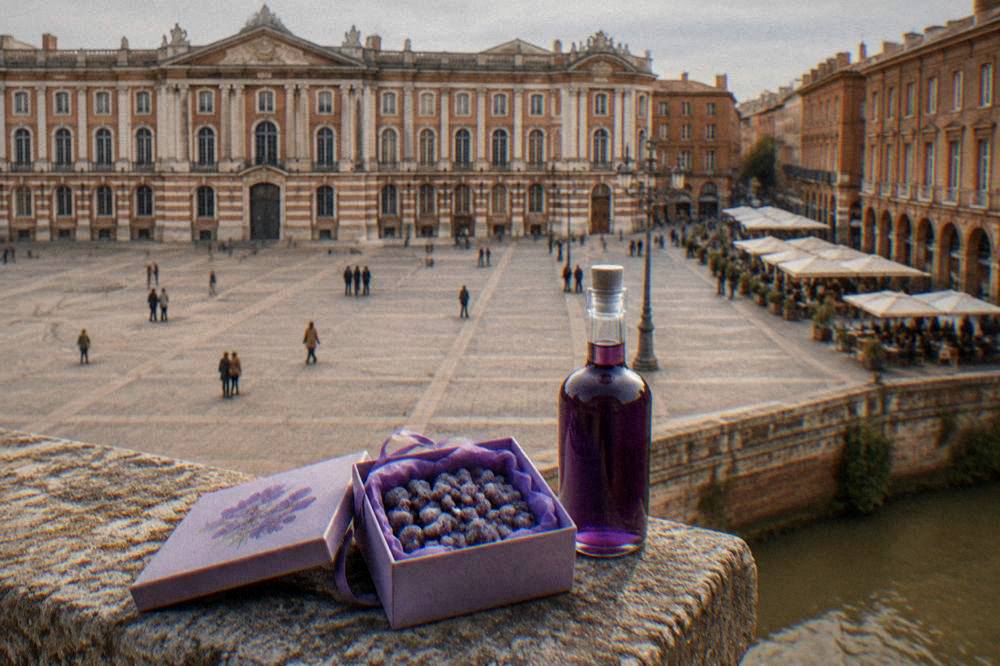
The honest souvenir list from a violet trip is short and packable: crystallized violets in a jar, a bottle of violet syrup or liqueur, a violet-scented soap or perfume, and, if the trip hits the February festival, a fresh bunch bought on the day. All of them except the fresh flowers survive a suitcase, and all of them are sold year-round in the city's markets and confectioners, so a missed festival is not a missed souvenir. Crystallized violets are the classic: the flower preserved in sugar, the form that made the Toulouse violet travelable a century before mass tourism. Syrup and liqueur carry the flavor into drinks, and the perfume shops carry the scent. The one thing not to over-plan is the fresh flower: violets are fragile, and a bunch bought at a February stall is for the hotel windowsill, not the flight home. For the edible side of the city more broadly, the cassoulet guide and the food guide cover the dishes that share the violet's emblem status, and Toulouse Travel Guide rounds up the whole city.
Common Questions About The Toulouse Violet
Quick answers to what planners ask most about the Toulouse violet.
What is the Toulouse violet?
A small, fragrant purple flower that the city adopted as a local emblem, grown around Toulouse and sold as crystallized sweets, syrup, liqueur and perfume. The city's tourism material lists it among the signature local products, alongside cassoulet and the pink brick.
When is the Fete de la Violette in Toulouse?
The festival has typically been held in February in recent editions, timed to the flower's natural blooming season. Dates for future editions were not confirmed, so check the metropole's agenda pages before booking a trip around it.
Where can I buy violet products in Toulouse?
The Victor Hugo market near the Capitole and the confectioners of the city center are the main hunting grounds. No specific shop's prices or hours were sourced for this guide, so browse the market hall and the central streets rather than chasing one address.
Can you eat Toulouse violets?
Yes, in preserved form. Crystallized violets, violet syrup and violet liqueur are the traditional edible products, and they are sold year-round, which is the point of candying a perishable flower.
Is February a good time to visit Toulouse?
For the violet theme, yes. Meteo-France's 1991-2020 normals for Toulouse-Blagnac show February as the driest month of the year at 37.2 mm of rain, with 118.2 hours of sunshine, and the flower season and the festival season both fall in that window. The trade-off is that it is winter, with a mean temperature of 7.1 C.
How do I get from Toulouse airport to the violet festival?
Take the airport Navette, which runs one departure every 15 minutes and takes 20 to 40 minutes to the center; a single airport ticket on the Tisseo network costs EUR 9.50. The airport tram has been closed since 5 June 2023 and stays closed until the end of 2026, so the bus is the public-transport link.
The violet is the smallest of Toulouse's emblems and the easiest to carry home, and a February trip built around it lands in the city's driest, quietest month, with the sweets, the syrup and the festival stalls all within a walk of the Capitole.