Is Toulouse Safe
Toulouse, the pink-brick city on the Garonne in southwestern France, is a city travelers ask about constantly: is it safe? This guide answers with honest, hedged planning advice, no invented statistics, and the practical details that actually shape how a visit feels.
Short answer
Toulouse is generally a relaxed, low-stress city for visitors who take the same basic precautions they would in any European city of 514,819 people. The honest answer is about neighborhoods, transport habits and evening planning, not numbers.
Toulouse, the pink-brick "La Ville Rose" on the Garonne in the Occitanie region of southwestern France, is a city of 514,819 inhabitants (INSEE, population in 2023), a major aerospace hub and a university town whose streets fill with students and families late into the evening. The question "is Toulouse safe" deserves a straight answer, and the straight answer is that no crime statistic, safety ranking or pickpocket figure was sourced for this page, so none is invented here. What follows instead is the practical, hedged planning advice that actually determines how a visit feels: which neighborhoods reward walking, how the airport transfer works, what to think about after dark, and how to keep a day trip to Carcassonne or Albi as calm as the city itself.
Is Toulouse Safe For Tourists?
Toulouse is generally a relaxed, low-stress city for visitors who take the same ordinary precautions they would in any large French city. No crime statistic, safety ranking or pickpocketing figure was verified for this guide, so none is printed. The honest planning answer is about where you walk, when, and how you carry your things, not about numbers.
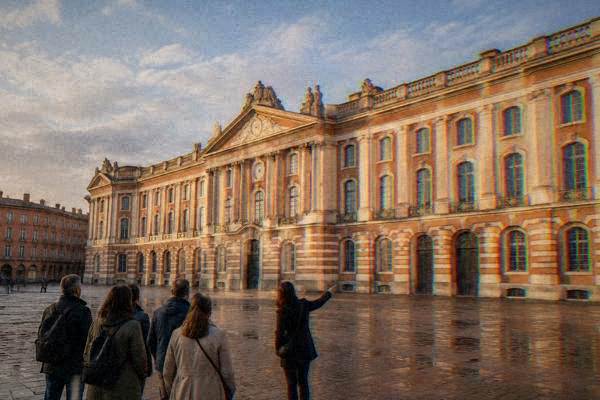
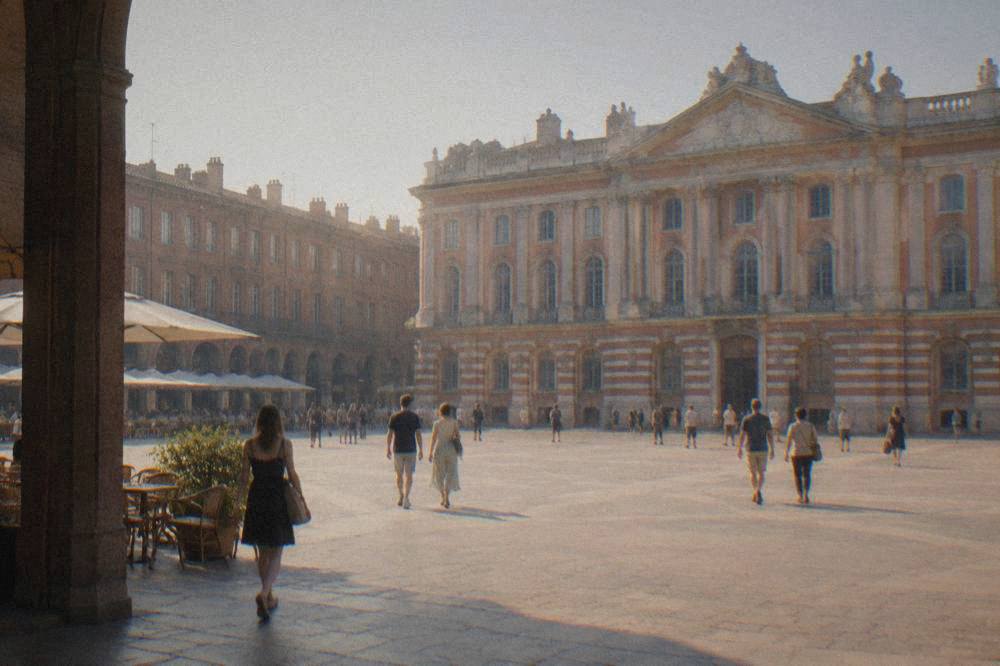
The city's core, from the Capitole to Saint-Sernin and along the Garonne, is a compact area where the normal rules of European city travel apply. Keep bags closed and in front of you in crowds, watch phones on café terraces, and treat any approach that feels staged, a petition, a friendship bracelet, a sudden spill on your jacket, as a reason to move on rather than engage. These are habits, not Toulouse-specific warnings.
What genuinely shapes the visitor experience here is scale and rhythm. Toulouse is an inland city, a university town where the streets stay lively in the warm months, and its center is walkable in a way that removes a whole category of stress: late-night transit transfers, unfamiliar peripheral neighborhoods, long rides home. The more of your day you spend on foot between the Capitole, the Jacobins and the riverbank, the fewer the situations that require judgment calls.
For a first orientation, a guided circuit removes the awkwardness of reading a map on a corner at night. The electric tuk-tuk tour with photo stops and audio commentary covers the highlights with a live driver, and it pairs naturally with a first-day walk: Check availability. Our introduction to what Toulouse is famous for gives the fuller picture of why the center is so compact.
Which Areas Of Toulouse Should You Know Before You Walk?
The central districts around the Capitole, Saint-Etienne and Saint-Sernin are where nearly every visitor spends their time, and they are ordinary, lively European city streets. The Carmes and Saint-Cyprian neighborhoods sit just across or beside the center and reward walking. No area of Toulouse was assessed as dangerous or safe by any sourced ranking, because none exists for this page.
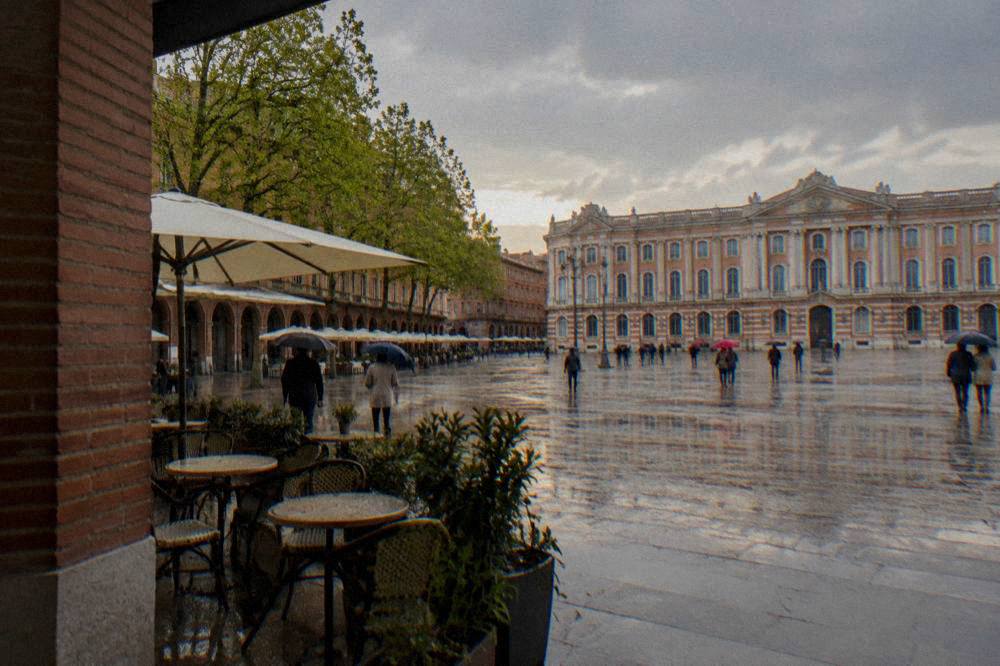
Practical geography matters more than reputation. The visitor city sits between the Garonne and the canal-side streets: the Capitole and its square, the Basilique Saint-Sernin to the north, the Jacobins to the south, and the riverbank linking them. Saint-Cyprian, on the left bank, holds the Abattoirs museum and the river atmosphere; the Carmes district, on the right bank, is a dense, pleasant quarter of small streets. Both are covered in our guide to the nicest parts of Toulouse, which approaches the question from where to sleep rather than where to avoid.
The honest advice on "areas to avoid" is that no sourced list exists, and any confident one you read elsewhere is someone's impression dressed up as fact. What you can plan around is ordinary city logic: streets that are empty at 2 a.m. feel less comfortable than streets with people on them, and the way to avoid that is timing, not geography. Late evening, the areas around the Capitole and the Victor Hugo market stay animated; a quiet residential street ten minutes out may not.
| Neighborhood | Position | What Draws Visitors | Evening Character |
|---|---|---|---|
| Capitole and Saint-Georges | Center | Square, city hall, cafes | Busy, lit, central |
| Saint-Etienne | Center | Cathedral, boutique streets | Lively, restaurant-heavy |
| Saint-Sernin | North of center | UNESCO-listed basilica | Calmer, residential edge |
| Carmes | Right bank | Small streets, food shops | Popular for evenings out |
| Saint-Cyprian | Left bank | Abattoirs, Prairie des Filtres, riverbank | Quieter, pleasant walks |
| Compans-Caffarelli | North-west of center | Modern district, Japanese garden | Business-hours bustle |
Is Public Transport In Toulouse Safe And Easy To Use?
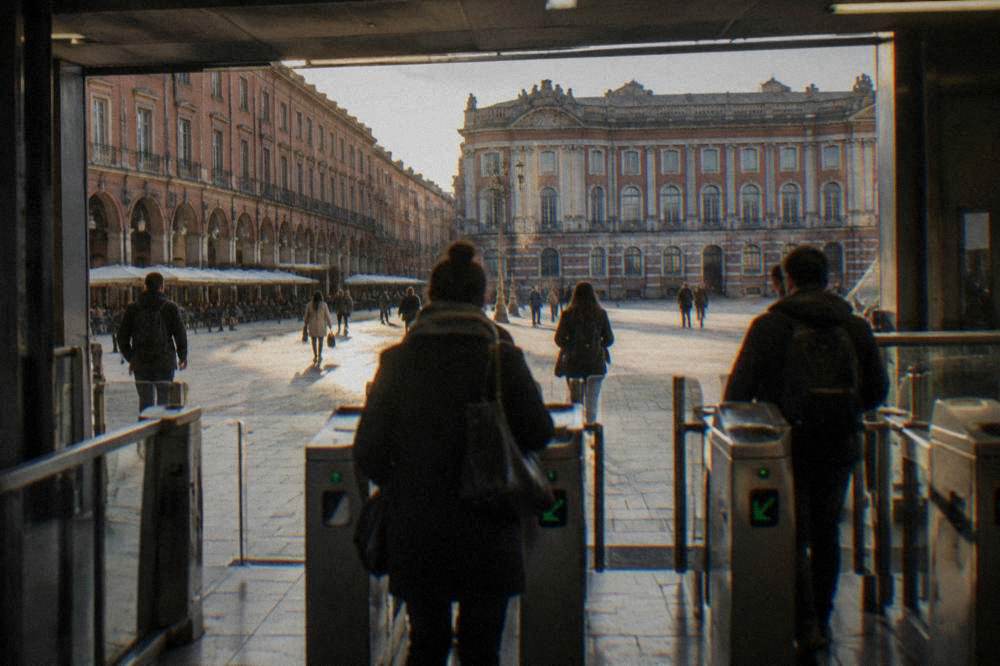
The Tisseo network of metro, tram and bus is the standard way to move around Toulouse, and using it is a matter of normal city habits: buy a ticket before boarding, keep bags closed, and prefer the metro for late returns. A single trip costs EUR 1.90, a day pass EUR 7.20 and a 3-day pass EUR 14.30, per the official Tisseo catalogue.
The fares matter for planning because a day pass at EUR 7.20 removes the temptation to walk long distances late at night to save a fare. A single trip bought at a machine is EUR 1.90, while buying it last-minute on board costs EUR 2.50, so pre-purchase is both cheaper and quicker. Ten trips cost EUR 16.00, which suits a longer stay. There is no 2-day pass in the catalogue, so plan around the day pass or the 3-day pass.
| Tisseo Ticket | Price | Notes |
|---|---|---|
| Single trip | EUR 1.90 | Bought before boarding |
| Single trip, on board | EUR 2.50 | Last-minute purchase |
| 10 trips | EUR 16.00 | Shared or solo use |
| Day pass | EUR 7.20 | Unlimited same-day travel |
| 3-day pass | EUR 14.30 | No 2-day pass exists |
| Airport single | EUR 9.50 | Tisseo network plus Navette aeroport |
The one transport fact every visitor should hold onto is the airport tram situation. Tram T2 to Toulouse-Blagnac airport has been closed since 5 June 2023 and stays closed until the end of 2026 because of the Line C metro works; it does not reopen with your travel dates in between. The airport is served by the Navette aeroport bus, one departure every 15 minutes, taking 20 to 40 minutes to the center, or about 25 minutes to the Matabiau bus station. Buses 30 and 31 take about 45 minutes to the Capitole with changes. Our airport-to-city-center guide covers the transfer in detail, and the wider getting-around guide explains the metro lines.
One forward-looking note: Metro Line C, 27 km with 21 stations running from Colomiers through Blagnac, Toulouse and Labege, opens at the end of 2028. Until then, nothing about the airport link changes.
Is Toulouse Safe At Night?
Evenings in Toulouse are a normal part of the city's rhythm, especially in the warm months, and the sensible approach is the one that works anywhere: stay on lit, busy streets, use the metro rather than long walks for late returns, and keep your phone off the café table. No sourced statistic describes Toulouse nightlife as safe or unsafe, and none is invented here.
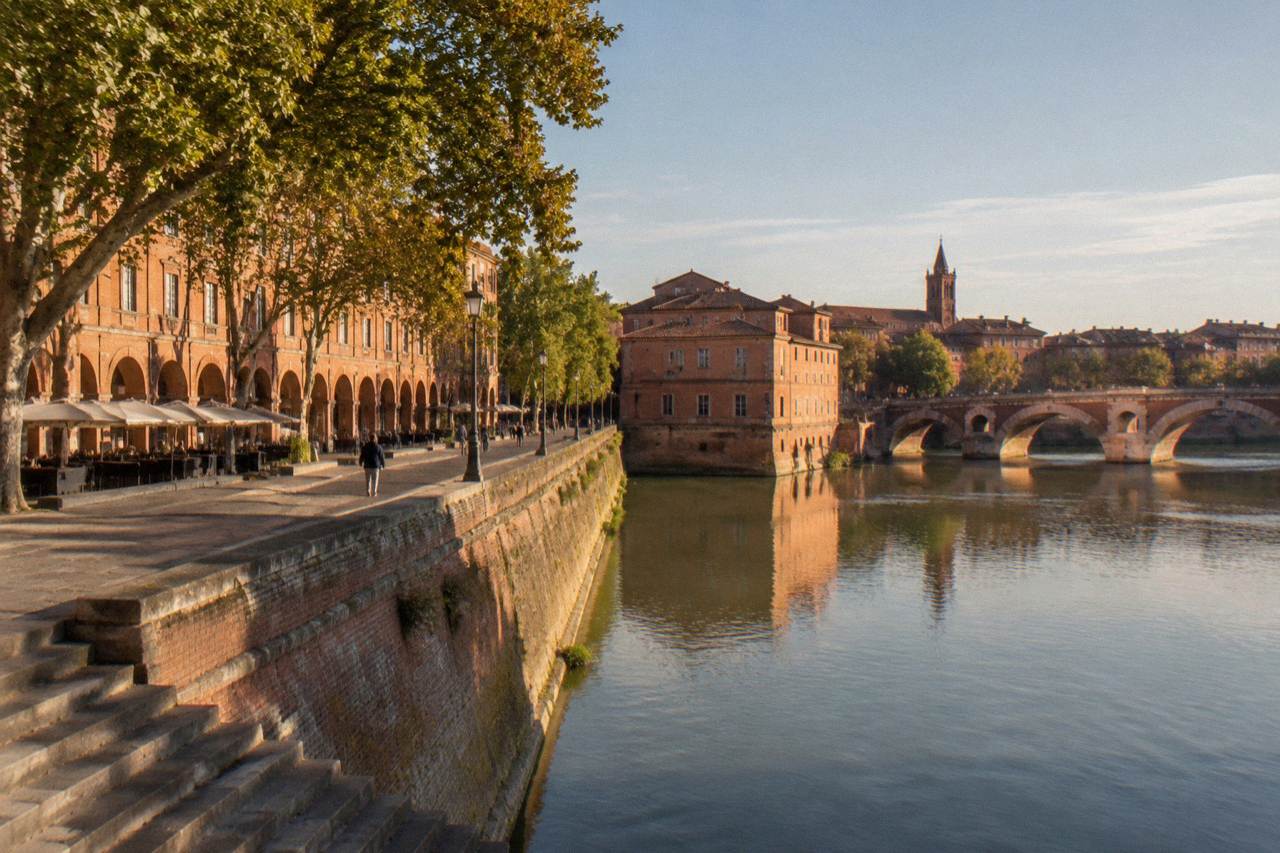
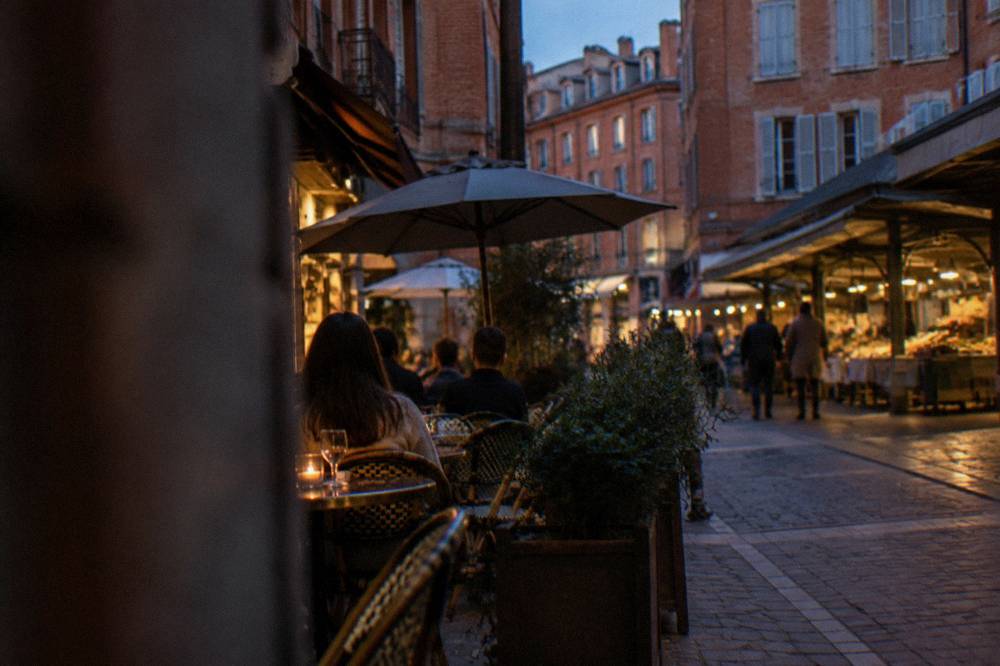
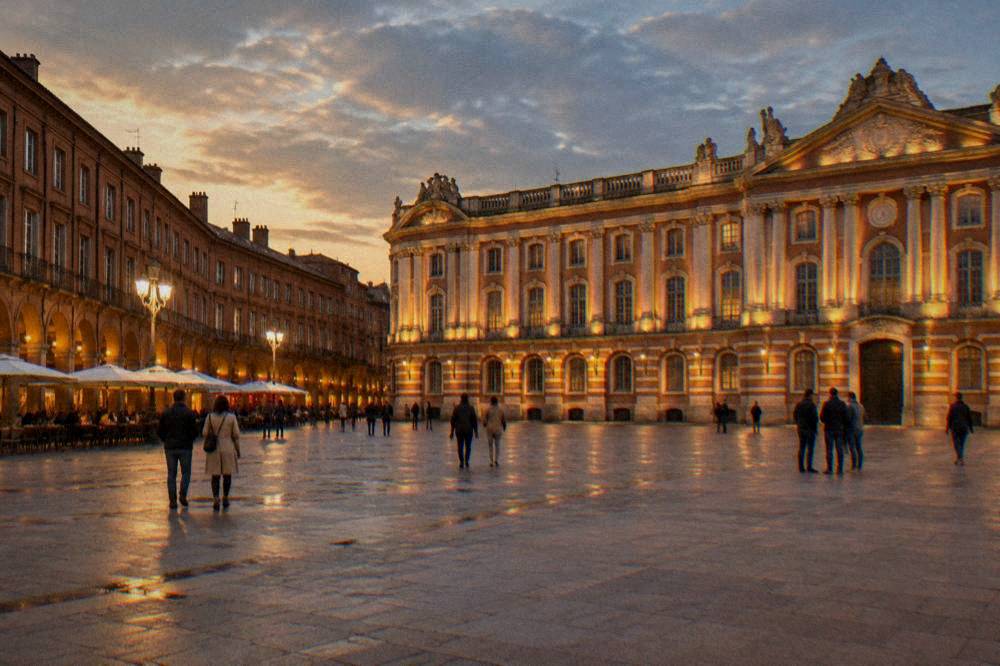
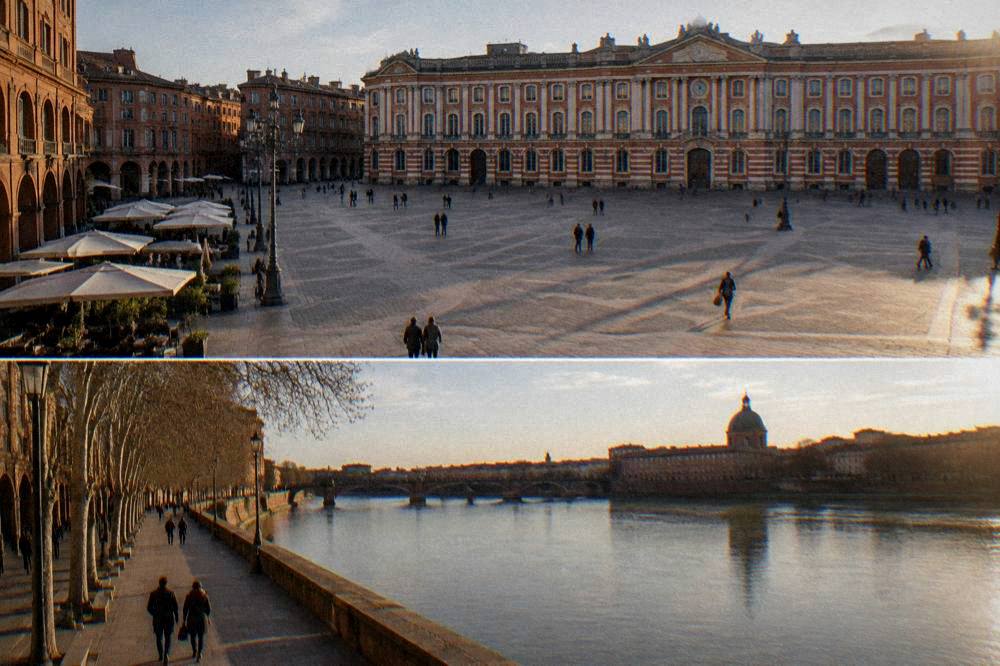
The city's evening geography is generous. The square around the Capitole, the streets of Saint-Georges and the terraces of the Carmes hold people well past dinner, and the riverbank between the Pont Neuf and the Bazacle is a classic warm-evening walk. Dinner habits matter for planning: the question of what time people eat dinner in Toulouse has its own answer, but the short version is that French dining runs later than visitors expect, so the streets stay populated correspondingly later.
Rugby evenings deserve a mention because they are a signature of the city rather than a risk. Match days around the Stadium de Toulouse change the mood of whole neighborhoods, in a festive, crowded way; our Toulouse rugby guide explains the fixture calendar. Crowds of any kind, festive or otherwise, are when ordinary pickpocket precautions earn their keep.
For an evening that ends far from your bed, the day pass logic applies in reverse: check the last metro time for your line before you commit to a distant bar, not after. This is the single most common avoidable late-night problem in any French city with a metro, and Toulouse is no exception.
Is Toulouse Safe For Solo Travelers And Women?
Toulouse is a university city with a steady flow of solo visitors, and the planning advice is the same as for any French city of its size: the same street habits, the same transport logic, and the same evening judgment calls. No sourced safety ranking for solo travelers or women exists for this page, so this section gives hedged practical advice rather than numbers.
The honest framing matters here. Anyone who tells you a city is "completely safe" or definitively "unsafe" for women traveling alone is offering an opinion, not a fact, and this page will not dress one up as a statistic. What can be said is concrete: the metro and the airport Navette both run frequently enough that solo visitors rarely need to improvise late-night transport, and the visitor center is compact enough that most evening plans involve a short, well-lit walk rather than a crossing of unfamiliar districts.
Solo travelers often find that a guided activity on day one solves the orientation problem that makes evenings feel uncertain later. A walking tour with a live guide is one option, covered in the Toulouse walking tours guide. Our dedicated solo female travelers answer page takes this question further, and the is Toulouse worth visiting guide frames the wider case for the city.
Is Toulouse Safe For Families And Children?
Toulouse works well as a family city, and the safety planning is mostly logistics: the center is walkable, the metro handles strollers, and the big family attractions, Cite de l'espace and Aeroscopia, are reached by short, simple rides. Cite de l'espace's normal adult rate is EUR 29 with tickets from EUR 22.50, and Aeroscopia charges adults EUR 16.
The family attractions are where the practical safety questions actually live, and they are answerable with sourced figures. Aeroscopia, the aviation museum beside the Airbus sites, is open daily 9:30-18:00 with last entry at 17:00, closed 25 December, 1 January and 7 May 2026; one detail families should know in advance is that the exhibition hall is not heated or air-conditioned, so dress for the season. The Airbus factory tours run by Manatour require an original passport or ID card for every participant, no photocopies or phone images, with arrival 30 minutes early, and cameras are not allowed on the tour. Other pages covering the same trip are gathered on Toulouse Travel Guide.
| Family Attraction | Admission | Practical Rule |
|---|---|---|
| Aeroscopia | Adult EUR 16, reduced EUR 13 | Original ID for factory tours, no cameras |
| Cite de l'espace | From EUR 22.50, adult EUR 29 | Book ahead in high season |
| Halle de la Machine | Entry ticket available | Check the listing for current hours |
| Japanese Garden | Free public park | Daylight hours |
| Jardin des Plantes | Free public park | Daylight hours |
The Toulouse with kids guide builds a full family itinerary, and the Aeroscopia guide covers the museum visit in depth.
Are Day Trips From Toulouse Safe And Straightforward?
Day trips are the low-stress end of a Toulouse stay: Carcassonne, Albi and Cordes-sur-Ciel are reached by coach tours or a short train ride, and the planning questions are about tickets and timing rather than safety. No incident statistic exists for any of these routes, and none is invented.
Coach-based day trips remove the questions entirely, because the operator handles the road. The Carcassonne coach day trip with audio guide is the classic first choice, and the Albi and Cordes-sur-Ciel day trip with audio guides pairs two of the region's most striking towns in one circuit. For travelers who prefer the rails, Carcassonne, Montauban and Bordeaux all sit on direct lines from Toulouse-Matabiau, though no verified journey time is printed on this page.
| Day Trip | How It Works | Best For |
|---|---|---|
| Carcassonne | Coach tour or direct train | First-time visitors |
| Albi and Cordes-sur-Ciel | Coach tour with audio guides | Architecture and views |
| Gaillac wine route | Small-group wine tour | Wine-focused travelers |
| Lourdes | Coach or train | Pilgrimage visitors |
| Pyrenees | Roughly 100 km south, day trip only | Mountain scenery |
The full day trips from Toulouse guide lists every option with the logistics, and our Carcassonne guide takes the region's most famous walled city in depth.
What Scams And Common Problems Should You Watch For In Toulouse?
The problems visitors actually encounter in Toulouse are the ordinary ones of any French city: distraction approaches in crowds, unattended bags on terraces, and phone snatching on quiet streets, and none has a sourced frequency figure. The countermeasures are boring and effective: closed bags, front pockets, and a flat refusal to engage with staged approaches.
Distraction approaches follow scripts you can recognize in advance. A petition clipboard thrust at you while an accomplice works your bag, a bracelet looped onto your wrist before you agree, a "spill" on your shoulder that appears from nowhere: none of these are Toulouse inventions, and none require a local countermeasure. A firm no, keeping walking, and moving your valuables out of reach handles all of them.
Two practical French specifics are worth knowing. First, the tourist tax: non-classified or pending-classification lodging, which includes most platform rentals, pays 5% of the pre-tax nightly price per person in Toulouse Metropole, so a rental's final price can differ from the headline. Second, emergencies: France uses the single European emergency number, which reaches police, fire and medical services from any phone, including one without a SIM.
| Problem | Where It Typically Happens | Countermeasure |
|---|---|---|
| Distraction approaches | Crowded squares, transit hubs | Decline and keep walking |
| Terrace thefts | Café and restaurant terraces | Bag between feet, phone off the table |
| Phone snatching | Quiet streets, riverbanks | Phone away while walking |
| Ticket confusion | Metro stations | Buy before boarding, EUR 1.90 not EUR 2.50 |
| Rental price surprises | Platform bookings | Expect the 5% tourist tax on non-classed stays |
Does Weather Or Season Change The Safety Picture?
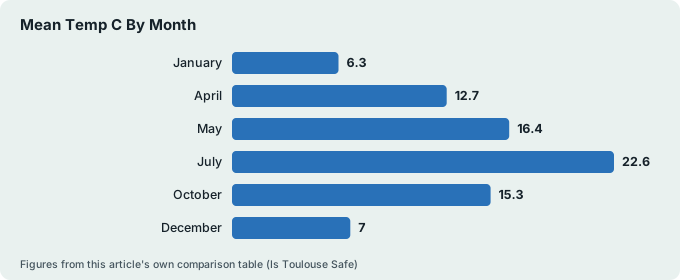
Weather in Toulouse does not create safety problems so much as discomfort, and the Meteo-France 1991-2020 normals for Toulouse-Blagnac give the honest numbers: 627 mm of rain a year, a wettest month of May at 73.6 mm, and a sunniest July at 258.6 hours. The planning point is that spring rain, not summer heat, is the thing to pack for.
The counterintuitive fact about Toulouse weather is worth internalizing: May, at 73.6 mm, is the wettest month, ahead of April at 65.2 mm and June at 64.2 mm, while February is the driest at 37.2 mm. Summer heat is real but bounded: July averages 11.5 days a year above 30C, and the all-time record high at the Toulouse-Blagnac station is 42.4C, set on 23 August 2023. The all-time low is -19.2C from 15 February 1956, a figure that tells you winter nights can bite but says nothing about a normal visit.
| Month | Mean Temp C | Rain mm | Sunshine Hours |
|---|---|---|---|
| January | 6.3 | 52.5 | 89.1 |
| April | 12.7 | 65.2 | 188.5 |
| May | 16.4 | 73.6 | 212.3 |
| July | 22.6 | 40.1 | 258.6 |
| October | 15.3 | 54.3 | 155.2 |
| December | 7.0 | 49.3 | 89.7 |
The Toulouse weather guide and the best time to visit guide turn the climate table into a month-by-month plan.
How Do Money, Museums And Passes Fit Into A Safe, Simple Trip?
The euro (EUR) is the currency, France is in the EU and the Schengen area, and the tourist office's Pass Tourisme at EUR 26 for stays of one to three days simplifies both budgeting and movement: it includes a free guided tour from the tourist office, pays off from the third activity, and adding EUR 10 buys ten public-transport trips.
The Pass Tourisme is a safety-adjacent tool because it reduces the number of late-evening decisions: with transport trips bundled in, the walk-versus-metro calculation at 11 p.m. is already paid for. The tourist office lists the normal rates the pass covers free: Fondation Bemberg at EUR 12, the Museum at EUR 12, Les Abattoirs at EUR 12, the Musee des Augustins at EUR 5 and the Couvent des Jacobins at EUR 5, with Cite de l'espace discounted rather than free against its EUR 29 normal rate.
Two museum status notes matter for 2026 planning. The Musee des Augustins is temporarily closed from 21 September to 2 October 2026 for great-cloister works, and its Gothic halls, the sacristy, the Notre-Dame de Pitie hall and the chapter house, reopen on 3 October 2026 from 10:00. The Couvent des Jacobins is free on the first Sunday of the month except when a temporary exhibition is on, a rule stated for the Jacobins and not generalized here to other museums.
| Pass Or Ticket | Price | What It Includes |
|---|---|---|
| Pass Tourisme | EUR 26 | Municipal museums, free guided tour, 1-3 days |
| Transport add-on | +EUR 10 | 10 Tisseo trips |
| Couvent des Jacobins | EUR 5 normal | Free first Sunday, except exhibitions |
| Musee des Augustins | EUR 5 normal | Reopens Gothic halls 3 October 2026 |
| Cite de l'espace | EUR 29 adult | Discounted, not free, with the Pass |
The Pass Tourisme guide does the full math on when the pass pays off, and the Toulouse museums guide tracks what is open when.
What Should You Do If Something Goes Wrong In Toulouse?
Call the single European emergency number, which works across France and the whole Schengen area, for police, fire or medical emergencies; it reaches help from any phone. For non-emergencies, go in person to the central police station near the Capitole, and for lost travel documents contact your consulate, because France's Schengen membership means many European travelers can cross with an ID card while others need a passport.
The practical sequence for a theft is the same everywhere in France: cancel cards first, from your banking app or a call, then report the loss for the insurance record, then replace documents. Reporting quickly matters less than canceling cards quickly, and knowing that order before you travel removes the worst of the panic if it ever happens.
Prevention beats process. Photograph your passport and ID before you leave, keep a spare card separate from your wallet, and store your hotel's address offline. None of this is Toulouse-specific, and that is the point: the city does not demand special measures, only the ordinary ones.
For travelers who want the reassurance of a guide rather than a self-guided first day, a bike circuit is a calm way to cover ground, and the Toulouse walking tours guide lists the guided options in full. For the deeper question behind this one, whether the city deserves your time at all, the is Toulouse worth visiting guide makes the case.
Common Questions About Safety In Toulouse
Quick answers to what planners ask most about safety in Toulouse.
Is Toulouse safe at night?
Evenings in central Toulouse are a normal part of city life, especially around the Capitole and Saint-Georges. The ordinary precautions apply: lit streets, the metro for late returns, and phones off café tables. No sourced statistic describes the city's nightlife as safe or unsafe.
Is Toulouse safe for solo female travelers?
No sourced safety ranking exists for solo female travelers in Toulouse, so this page gives hedged advice rather than numbers. The city is compact, the metro runs frequently, and the standard European city habits apply. The dedicated solo female travelers answer page takes the question further.
Are there areas of Toulouse to avoid?
No sourced list of dangerous areas exists for Toulouse, and any confident one is an opinion. The practical rule is timing over geography: busy, lit streets feel and behave better than empty ones late at night, and the visitor center offers plenty of the former.
Is public transport in Toulouse safe?
The Tisseo metro, tram and bus network is the standard way to move around, with a single trip at EUR 1.90 and a day pass at EUR 7.20. Ordinary transit habits apply. Remember that the airport tram T2 is closed until the end of 2026; the Navette aeroport bus runs every 15 minutes instead.
Is Toulouse safe compared to other French cities?
No comparative crime statistic or safety ranking was sourced for this page, so no comparison is made. The honest answer is that Toulouse rewards the same ordinary precautions as any large French city, and its compact, walkable center removes many of the situations that require judgment calls.
What is the emergency number in Toulouse?
The single European emergency number reaches police, fire and medical services from any phone across France and the Schengen area. For thefts, cancel cards first, then report the loss for insurance, then replace documents.
The bottom line for Toulouse is that the city asks for ordinary city habits, not special measures: a pre-bought metro ticket, a closed bag, a late-evening route that stays on lit streets, and a day-trip plan that lets the coach or the train do the work. Plan the boring parts well and the pink-brick streets take care of the rest.