Dome De La Grave
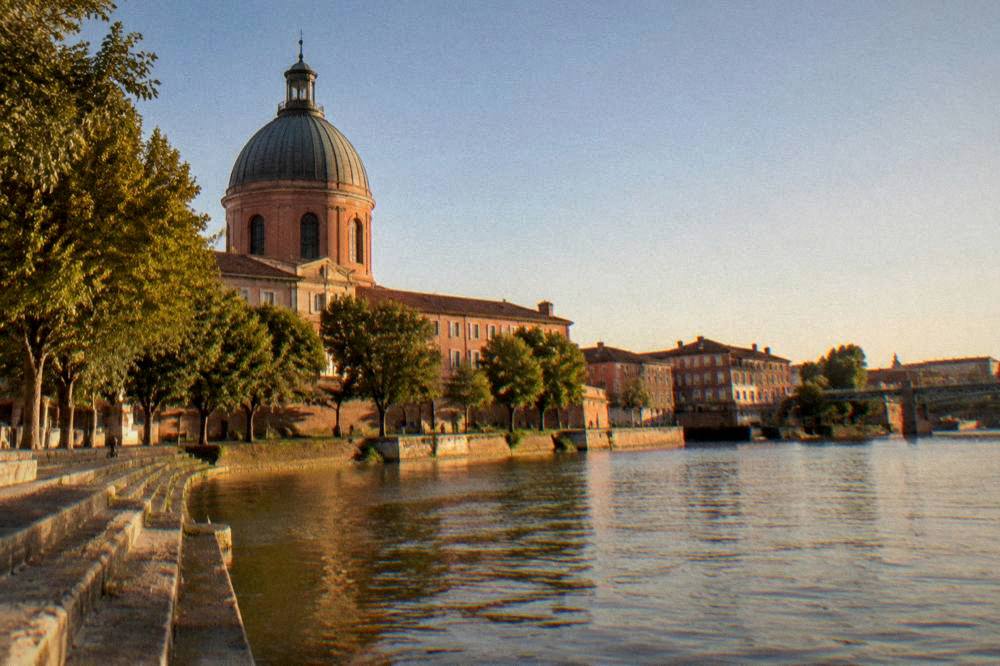
The Dome de la Grave is the pink-brick dome that crowns the chapel of the Hopital de La Grave on the left bank of the Garonne in Toulouse, one of the most recognizable silhouettes on the riverfront.
Short answer
The Dome de la Grave is the dome of the chapel of the Hopital de La Grave on the left bank of the Garonne in Toulouse, in southwestern France. It is best seen from the opposite bank, from the Pont-Neuf and from the Garonne riverside walk, and it costs nothing to look at from outside.
Toulouse, the pink-brick "La Ville Rose" on the Garonne in the Occitanie region of southwestern France, has a handful of silhouettes that define its skyline, and the Dome de la Grave is one of them. It is the dome of the chapel of the Hopital de La Grave, which stands on the left bank of the river just downstream of the Pont-Neuf. From the opposite bank, the dome floats above the water in a way that makes it one of the most photographed riverfront landmarks in the city, and unlike a museum or a tower with a ticket desk, it costs nothing at all to stand on the quay and look at it.
This guide covers what the dome is, where to see it from, how to reach the area by public transport, what else sits within a short walk of it, and how to plan the practical side of a visit, with verified fare and climate tables for the decisions that actually matter. The site's editorial desk has not visited Toulouse, so every figure below comes from an official source or from the tour listings themselves, and where something is not verified, this page says so rather than guessing.
What Is The Dome De La Grave In Toulouse?
The Dome de la Grave is the dome of the chapel of the Hopital de La Grave, which stands on the left bank of the Garonne in Toulouse, in southwestern France. It is not a standalone monument with its own ticket desk: it is the crowning feature of a large hospital complex, and its pink-brick silhouette is one of the most recognizable views on the riverfront.
The building takes its name from the La Grave quarter of the left bank, the riverside neighborhood around the Place Saint-Pierre and the streets leading down to the water. The dome sits above the hospital's chapel and acts as a visual anchor for the whole complex: from many points along the river, it is the first thing the eye picks out among the rooftops.
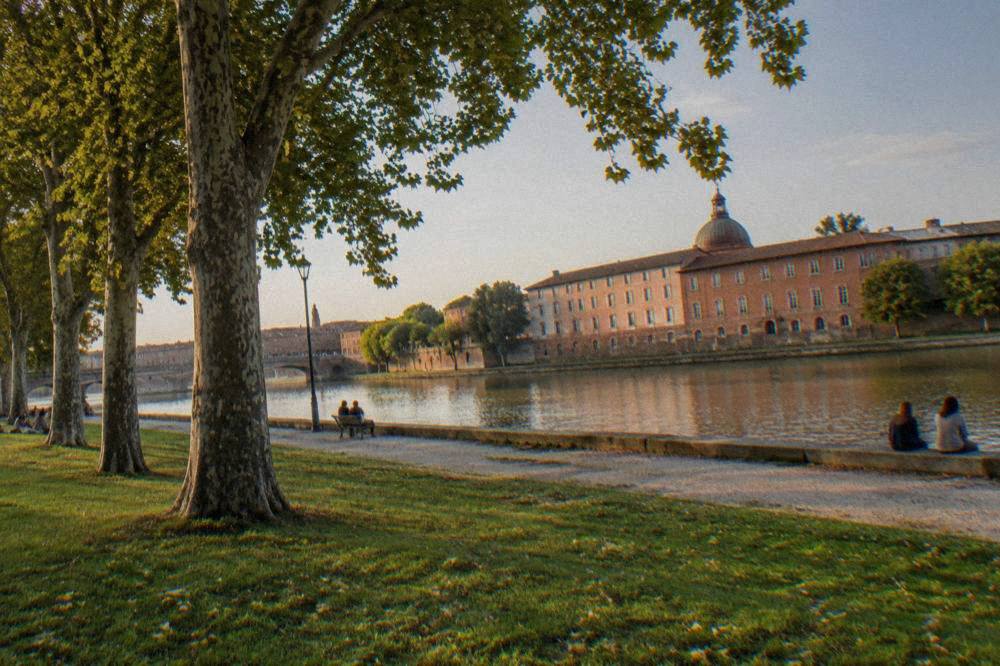
What makes the dome so prominent in photographs of Toulouse is geometry and color together. The Garonne at this point runs fairly straight, so the dome reads cleanly from the opposite bank, and the warm pink brick of the hospital walls catches the light of late afternoon in a way that has made the view a fixture of the city's image. The brick is the same local material that gives Toulouse its "La Ville Rose" nickname, though this site does not attach a date or a quarry story to it, because none of that was verified in the sources used here.
It helps to set expectations honestly. The dome is primarily an exterior landmark. If interior access matters to your visit, the Toulouse tourist office is the place to ask before you go; for everyone else, the dome delivers its full effect from outside, from the water, and from the bridges, which is exactly how the city presents it.
That exterior-first character is also why the dome pairs so well with a riverfront walk. The stretch of the Garonne between the Pont-Neuf and the upstream bridges is covered in detail on the Garonne Riverside In Toulouse page, and the dome is one of the fixed points of any route along it. If your idea of a good city visit is architecture seen from the water rather than queueing for a tower, this is your landmark.
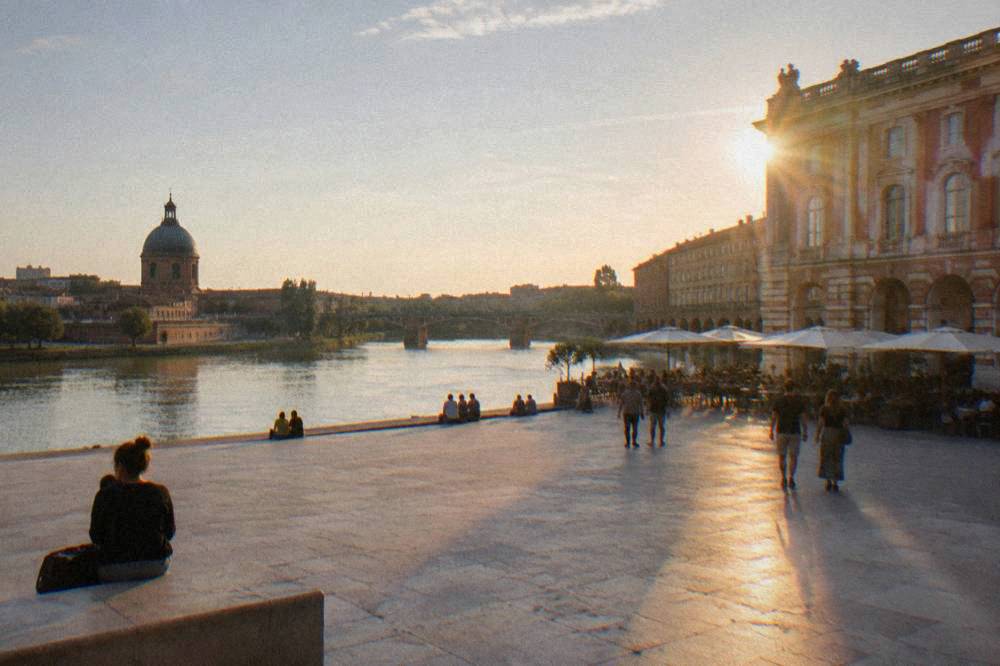
Where Are The Best Views Of The Dome De La Grave?
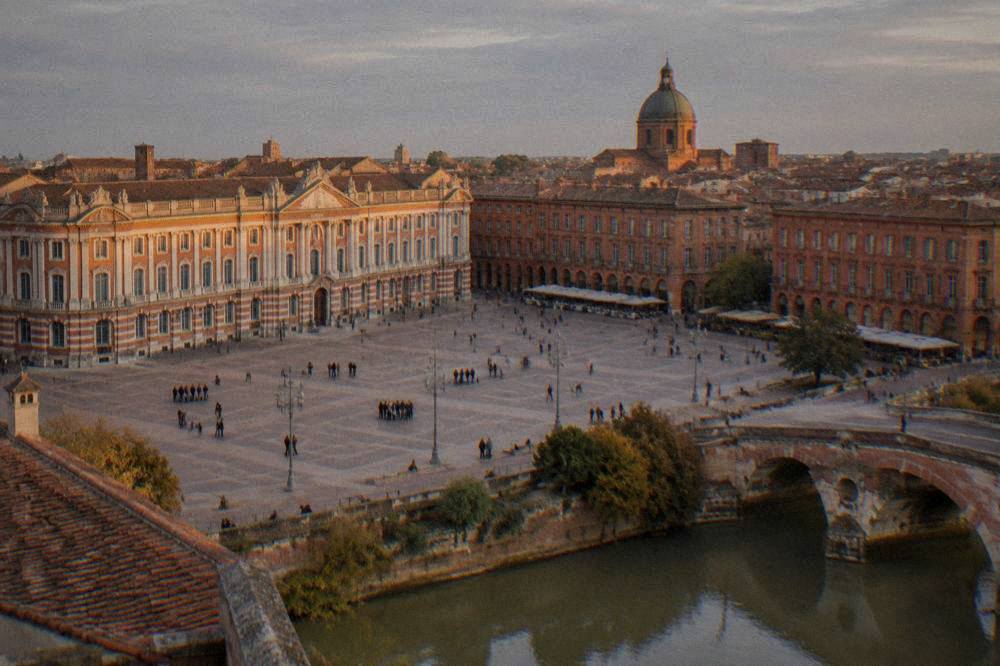
The clearest views of the Dome de la Grave are from the right bank of the Garonne, from the quays around the Port de la Daurade, and from the Pont-Neuf, which sits immediately upstream of the hospital complex. From across the river the dome rises above the hospital's brick facade with the water in the foreground, which is the classic Toulouse riverfront composition.
Start at the Port de la Daurade, the open quay on the right bank roughly opposite the hospital. From there the dome is framed by the plane trees and the water, and the light is best in the later part of the day when the sun comes around onto the left-bank facade. Walk a few minutes upstream and you reach the Pont-Neuf, Toulouse's oldest bridge, whose arches give a second, closer angle on the complex; the Pont Neuf In Toulouse page covers the bridge itself. From the middle of the bridge you look straight down onto the hospital roofs with the dome behind them.
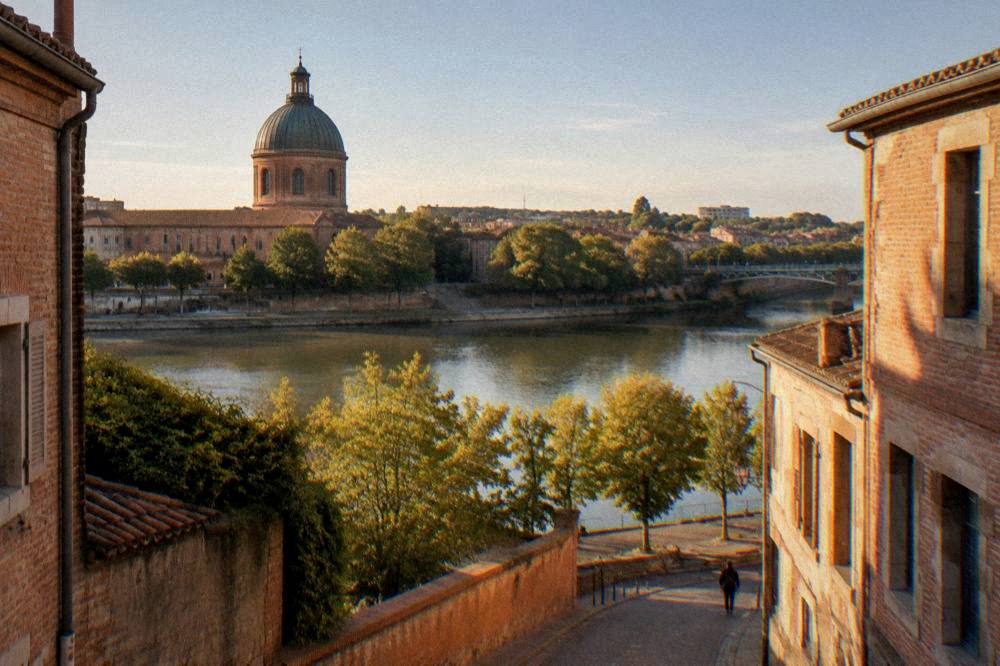
Two more angles are worth knowing about. From the water itself, the river cruise tours that run on the Garonne and out onto the Canal du Midi pass the hospital frontage, and the dome is one of the features the commentary points out on the UNESCO-listed canal itineraries; the Canal Du Midi guide covers the water options in depth. And from the left-bank side, the Place Saint-Pierre and the streets of the La Grave quarter put you directly under the dome, which is the better angle if you want to photograph the brickwork and the lantern close up rather than the skyline view.
Fancy seeing the dome and the riverside from the water itself? Book a historic center cruise ticket here.
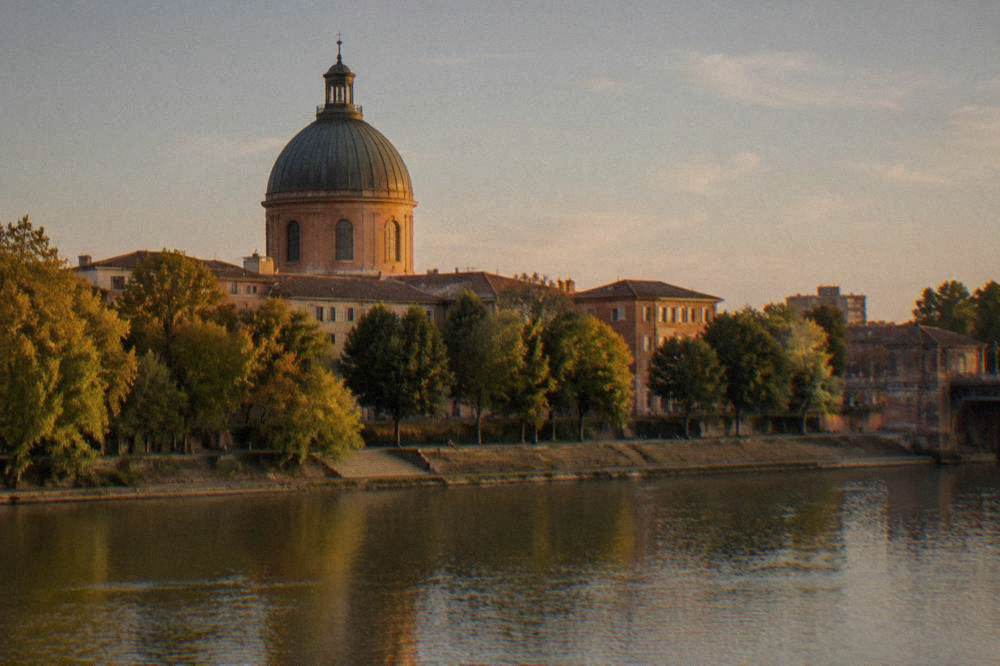
Photographers should think about season as much as angle. Meteo-France's 1991-2020 normals for Toulouse-Blagnac show July as the sunniest month of the year, with 258.6 hours of sunshine and only 40.1 mm of rain, so summer evenings give the most reliable light on the brick. May, by contrast, is the wettest month in the whole table, at 73.6 mm, which surprises visitors who assume the Mediterranean side of France rains mainly in winter. The climate table further down this page gives the month-by-month numbers so you can pick your window.
How Do You Get To The Dome De La Grave In Toulouse?
The Dome de la Grave sits on the left bank of the Garonne just downstream of the Pont-Neuf, in the heart of central Toulouse, so the honest answer is that you walk to it: from the Place du Capitole the hospital frontage is a short stroll through the old streets. For longer hops across the city, the Tisseo network sells a single trip at EUR 1.90 and a day pass at EUR 7.20, per the official Tisseo e-boutique catalogue.
The area around the dome is one of the most walkable corners of an already compact center. The Capitole, the Basilique Saint-Sernin and the Couvent des Jacobins are all linked by streets that take minutes rather than hours, and the riverside walk along the Garonne connects the whole set without any transport at all. This site's Getting Around Toulouse guide covers the network in detail; the table below is the short version of the fares you might actually use on a visit that includes the dome.
| Tisseo ticket | Price | What it covers |
|---|---|---|
| Single trip | EUR 1.90 | One journey on the network |
| Single bought on board | EUR 2.50 | One journey, bought last-minute |
| 10 trips | EUR 16.00 | Ten journeys, shared or solo |
| Day pass | EUR 7.20 | Unlimited travel for one day |
| 3-day pass | EUR 14.30 | Three days of travel; no 2-day pass exists |
| Airport single | EUR 9.50 | Tisseo network plus the Navette aeroport |
One transport fact matters if you are flying in. Tram T2 to Toulouse-Blagnac airport has been closed since 5 June 2023 and stays closed until the end of 2026 because of the metro Line C works, so no guide should tell you to take the tram to the airport. The Navette aeroport bus runs one departure every 15 minutes and takes 20 to 40 minutes to the center, per the airport's own access page. Metro Line C, the new 27 km line with 21 stations running from Colomiers through Blagnac, Toulouse and Labege, opens at the end of 2028, which is worth knowing if you read older guides that describe it as imminent.
If you would rather see the riverside landmarks with a guide than navigate them alone, Toulouse has a strong supply of walking and vehicle tours, and the trio above is a representative sample: a ticket for the Halle de la Machine, a food-tasting bike tour that covers the city's gourmand side, and an immersive walk built around the city's 18th-century past. Each has its own page on this site with the full listing details.
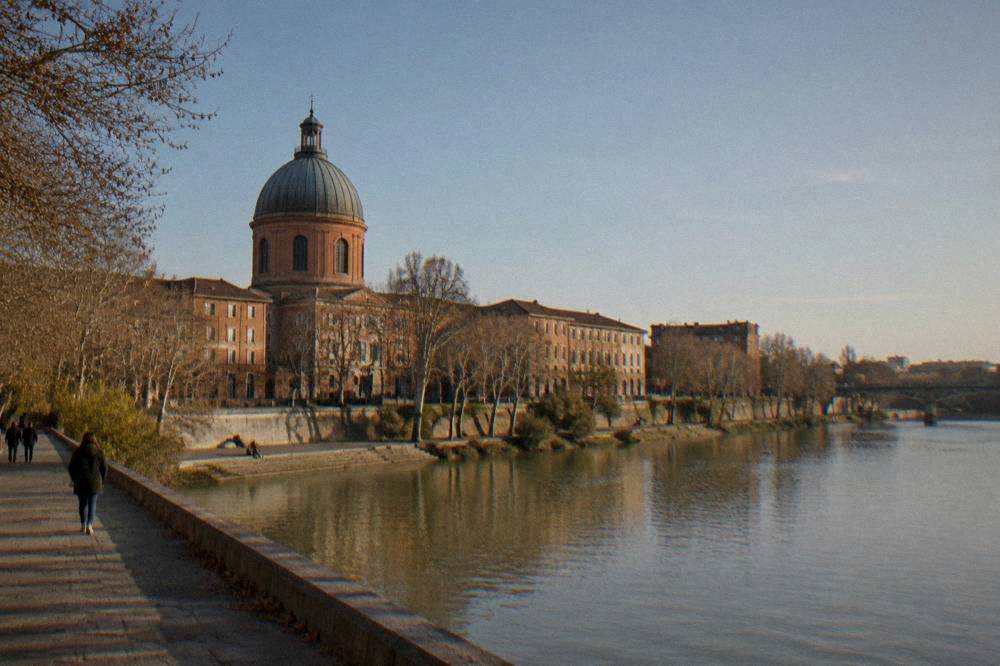
What Else Can You See Near The Dome De La Grave?
The area around the Dome de la Grave holds some of the densest sightseeing in Toulouse: the Pont-Neuf immediately upstream, the Notre-Dame de la Daurade basilica directly across the river, the Place Saint-Pierre at the foot of the quarter, and the Capitole and the old-city museums within a short walk. A visitor could spend a full day in this one stretch of riverbank without repeating a street.
Cross the Pont-Neuf and you are at the Notre-Dame De La Daurade, the riverside basilica whose plain facade hides one of the most atmospheric interiors in the city; it is also the venue named for the opening concert of the Toulouse les Orgues festival on 7 October 2026. From there the quay leads toward the center and the Capitole De Toulouse, the city's grand municipal building and the square that anchors the Christmas market each winter, which the Metropole lists from 26 November to 27 December 2026.
Upstream and inland, the museum cluster is close. The Musee Des Augustins, the fine-arts museum in the former Augustin convent, is worth a planning note: it is fully closed from 21 September to 2 October 2026 for great-cloister works, and its Gothic halls, the sacristy, the Notre-Dame de Pitie hall and the chapter house, reopen on 3 October 2026 from 10:00. The Basilica Of Saint-Sernin, the largest Romanesque church on the Santiago routes and a UNESCO-listed component of the "Routes of Santiago de Compostela in France" inscribed in 1998, is a few streets further. The Couvent Des Jacobins charges EUR 5 normally and is free on the first Sunday of the month, except when a temporary exhibition is on, per the Metropole's page for the convent.
| Sight near the dome | What it is | Verified planning detail |
|---|---|---|
| Pont-Neuf | The city's oldest bridge | Directly upstream of the hospital |
| Notre-Dame de la Daurade | Riverside basilica | Opening concert of Toulouse les Orgues, 7 October 2026 |
| Musee des Augustins | Fine-arts museum | Closed 21 Sep to 2 Oct 2026; Gothic halls reopen 3 Oct 2026 from 10:00 |
| Couvent des Jacobins | Gothic convent | EUR 5 normal rate; free first Sunday except during exhibitions |
| Capitole | City hall and square | Christmas market 26 Nov to 27 Dec 2026 |
For something completely different, the Halle de la Machine is the city's temple to mechanical theater, a hall where giant walking machines perform; it is one of the most family-friendly visits in the Toulouse area and a natural pairing with a morning on the riverbank. The hall's entry ticket is the featured product on this page, and you can check the live listing for current dates and availability.
Does The Pass Tourisme Help Around The Dome De La Grave?
The Pass Tourisme does not apply to the dome itself, which is a landmark seen from outside, but it covers the paid sights you will walk to from it: the tourist office's Pass Tourisme page lists it at EUR 26 for stays of one to three days, including a free guided tour from the office, with an add-on of EUR 10 for ten public-transport trips. The office's own numbers show the pass pays off from the third activity.
The tourist office's page lists the normal rates the pass waives: Fondation Bemberg at EUR 12, the Museum at EUR 12, Les Abattoirs at EUR 12, the Musee des Augustins at EUR 5 and the Couvent des Jacobins at EUR 5. Cite de l'espace, the space park, is not free with the pass: its normal adult rate is EUR 29 and the pass brings a discount instead. If your day around the dome includes three or more of the paid museums, the arithmetic favors the pass; if it includes one, it does not. This site's Toulouse Pass Tourisme guide works through the break-even cases in detail.
| Pass Tourisme detail | Figure | Source note |
|---|---|---|
| Pass price, 1 to 3 days | EUR 26 | Tourist office Pass Tourisme page |
| Transport add-on | EUR 10 for 10 trips | Metro, bus and tram |
| Free guided tour | Included | Departs from the tourist office |
| Break-even point | From the 3rd activity | Stated by the tourist office |
| Fondation Bemberg | EUR 12 normal, free with pass | Tourist office rate table |
| Musee des Augustins | EUR 5 normal, free with pass | Tourist office rate table |
| Couvent des Jacobins | EUR 5 normal, free with pass | Tourist office rate table |
| Cite de l'espace | EUR 29 normal, discounted with pass | Not free with the pass |
One note on museums: the Musee Saint-Raymond, the archaeology museum near Saint-Sernin, closed on 3 November 2025 for renovation and modernisation works and reopened on 3 April 2026. Treat it as "check before you go" rather than assuming it is open.
When Is The Best Time Of Year To See The Dome De La Grave?
The best months to see the Dome de la Grave are late spring and early autumn for comfortable walking weather, and July for the most reliable light, since Meteo-France's 1991-2020 normals for Toulouse-Blagnac show July as the sunniest month at 258.6 hours with only 40.1 mm of rain. The surprise in the data is that May, not any winter month, is the wettest month of the year at 73.6 mm.
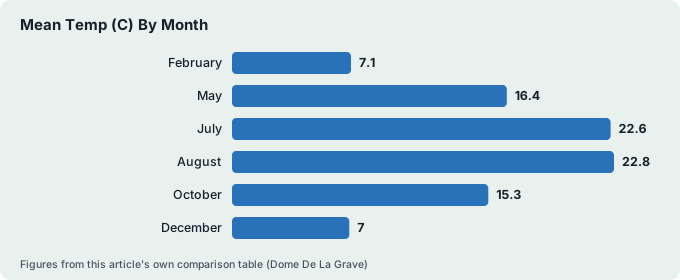
The full picture matters because the dome is an outdoor landmark: your experience of it is basically the weather on the quay. The normals show annual totals of 627 mm of rain across 95.8 rain days and 2,075.1 hours of sun, with mean daily maxima of 18.8C across the year. Records since 1947 run from a high of 42.4C on 23 August 2023 to a low of -19.2C on 15 February 1956, which frames the range without saying anything about a normal year. The table below pulls the months that matter most for planning.
| Month | Mean temp (C) | Rain (mm) | Sunshine (hours) |
|---|---|---|---|
| February | 7.1 | 37.2 | 118.2 |
| May | 16.4 | 73.6 | 212.3 |
| July | 22.6 | 40.1 | 258.6 |
| August | 22.8 | 44.6 | 246.4 |
| October | 15.3 | 54.3 | 155.2 |
| December | 7.0 | 49.3 | 89.7 |
Two seasonal reads follow from the data. August is the warmest month at a 22.8C mean, with 11.3 days a year at 30C or more, so late-summer evenings on the quay are warm but the light is strong for photography. December is the darkest month at 89.7 hours of sun, yet it carries the Christmas market on the Place du Capitole from 26 November to 27 December 2026, which pairs a gray-sky river walk with one of the city's liveliest scenes. If rain threatens, this site's Rainy Day In Toulouse guide lists the indoor options, and the Best Time To Visit Toulouse guide works through the whole year.
Festival dates can anchor a visit too. Piano aux Jacobins runs 8 to 30 September 2026 in the Jacobins cloister, and Toulouse les Orgues holds its 31st edition from 7 to 18 October 2026, with the opening concert on 7 October at Notre-Dame de la Daurade, directly across the river from the dome. Looking further ahead, Rio Loco, the riverside music festival on the Prairie des Filtres, runs 9 to 13 June 2027 with the theme "Noctiluca".
| Event | Dates | Location note |
|---|---|---|
| Piano aux Jacobins | 8 to 30 September 2026 | Couvent des Jacobins |
| Toulouse les Orgues, 31st edition | 7 to 18 October 2026 | Opening concert 7 October at Notre-Dame de la Daurade |
| Christmas markets | 26 November to 27 December 2026 | Place du Capitole, allees Jean-Jaures, square Charles-de-Gaulle |
| Rio Loco | 9 to 13 June 2027 | Prairie des Filtres, theme "Noctiluca" |
How Do You Build A Day Around The Dome De La Grave?
A full day around the Dome de la Grave works best as a loop: the quays and the Pont-Neuf in the morning light, the museums and the Capitole through the middle of the day, and the left bank and the Place Saint-Pierre in the evening, when the sun comes around onto the hospital facade. The whole route is walkable, and no leg of it needs a ticket unless you choose to enter a museum.
Morning is the quiet time on the river. Start on the right bank at the Port de la Daurade, cross the Pont-Neuf while the light is still low, and work the left-bank streets of the La Grave quarter, ending at the Place Saint-Pierre. From there the walk into the center passes within reach of the Jacobins and the Augustins, so the middle of the day can be a museum block; the Augustins closure window of 21 September to 2 October 2026 is the one date trap to remember. Afternoon belongs to the Capitole and the shopping streets, and the evening returns to the water for the dome at its best, warm brick against the dusk.
Tours can slot into this loop at several points. A guided food tour is the most efficient way to eat well in a city whose markets and cassoulet carry a serious reputation; the Toulouse Food guide covers the background, and the tasting tours in this site's roster handle the table.
If you prefer your history delivered with atmosphere rather than dates, the immersive 18th-century walk is built exactly for visitors who want the old city brought to life around them, and it covers the same central streets you will walk between the dome and the Capitole.
For a second day, the dome's riverside position makes it a natural jumping-off point for the water itineraries: the Garonne cruise tours and the UNESCO-listed Canal du Midi trips both put the city's architecture in a different frame. Beyond the city, the Day Trips From Toulouse guide covers Carcassonne, Albi and the Pyrenees, all reachable by coach tours or, for Carcassonne, a short train ride, though this site publishes no verified train times or fares and will not invent them.
Whichever way you build the itinerary, the dome asks nothing of you: no ticket, no queue, no schedule. It rewards the visitor who simply ends the day on the quay with the river between them and the brick, which is what the editors of Toulouse Travel Guide recommend as the closing move of any first visit to the city.
Common Questions About The Dome De La Grave
What is the Dome de la Grave?
It is the dome of the chapel of the Hopital de La Grave on the left bank of the Garonne in Toulouse, and one of the city's most recognizable riverfront silhouettes.
Can you go inside the Dome de la Grave?
The dome is primarily an exterior landmark. This site has no verified information on regular public access to the chapel interior, so ask at the Toulouse tourist office before planning an interior visit; the exterior views from the quays and the Pont-Neuf need no ticket at all.
How much does it cost to see the Dome de la Grave?
Nothing. The dome is seen from public streets, quays and bridges, and no admission figure exists because there is no ticket desk. The paid sights nearby, such as the Musee des Augustins at EUR 5 and the Couvent des Jacobins at EUR 5, are the costs to plan around.
Where is the best place to photograph the dome?
From the right bank around the Port de la Daurade, and from the Pont-Neuf immediately upstream of the hospital complex. Late afternoon and evening give the strongest light on the pink brick.
How do I get to the Dome de la Grave by public transport?
The area is in the walkable center, minutes from the Capitole. For longer hops, the Tisseo catalogue lists a single trip at EUR 1.90 and a day pass at EUR 7.20, and the tourist office's Pass Tourisme offers an add-on of EUR 10 for ten transport trips.
When is the best time of year to visit?
July is the sunniest month at 258.6 hours of sunshine with 40.1 mm of rain, per Meteo-France's 1991-2020 normals, while May is the wettest month at 73.6 mm. October pairs comfortable walking weather with the Toulouse les Orgues festival, whose opening concert is on 7 October 2026 at Notre-Dame de la Daurade, across the river.