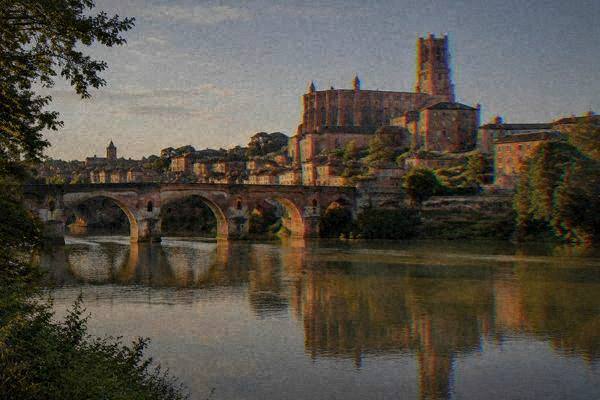
Lautrec: A Medieval Hill Village Day Trip From Toulouse
Lautrec is a small medieval hill village in the Tarn, east of Toulouse, built of the same warm brick that earned Toulouse its La Ville Rose nickname, and it makes one of the quietest and most photogenic day trips from the pink city.
Short answer
Lautrec is a medieval hill village in the Tarn, east of Toulouse in southwestern France, reached as a day trip by car or as part of an organized excursion. Its brick lanes, covered market square, windmill and views over the surrounding plain reward a half day, and it pairs naturally with Albi or Cordes-sur-Ciel.
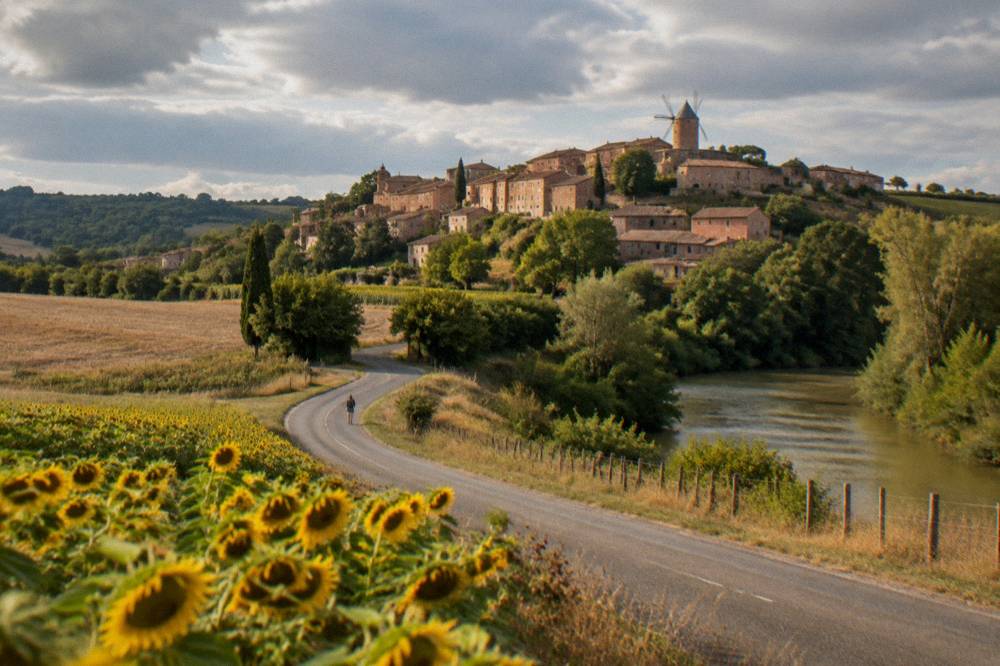
Lautrec is a small medieval hill village in the Tarn, the department just east of Toulouse in the Occitanie region of southwestern France, and it makes an easy, unhurried day trip from the pink city. Where Toulouse spreads flat along the Garonne, Lautrec does the opposite: it climbs a hill, crowns it with brick walls and a windmill, and looks out over a green plain of fields and sunflowers. The village is built from the same warm brick that gave Toulouse its famous La Ville Rose nickname, so a visit feels like seeing the city's material distilled into a single, walkable hilltop. This guide from Toulouse Travel Guide covers what to see in Lautrec, how to get there, what to eat, and how to fold it into a bigger day out with Albi or Cordes-sur-Ciel.
Where Is Lautrec, And Why Day-Trip There From Toulouse?
Lautrec sits on a hill in the Tarn, the rural department east of Toulouse, and it works as a day trip because it is small, quiet and completely different in feel from the city. The village is built of brick, ringed by farmland, and crowned by a windmill, and a visit is really about walking its lanes slowly rather than ticking off monuments. It pairs naturally with Albi and Cordes-sur-Ciel, which sit in the same department.
Toulouse is a big working city, the prefecture of Haute-Garonne, with 514,819 inhabitants in the commune according to INSEE's 2023 population data. Lautrec is the counterweight to that: a village where the loudest sound on a weekday morning is likely to be church bells or a delivery van on cobblestones. Day-trippers from Toulouse come here precisely because the scale flips, from a regional capital to a hill you can walk around in a morning.
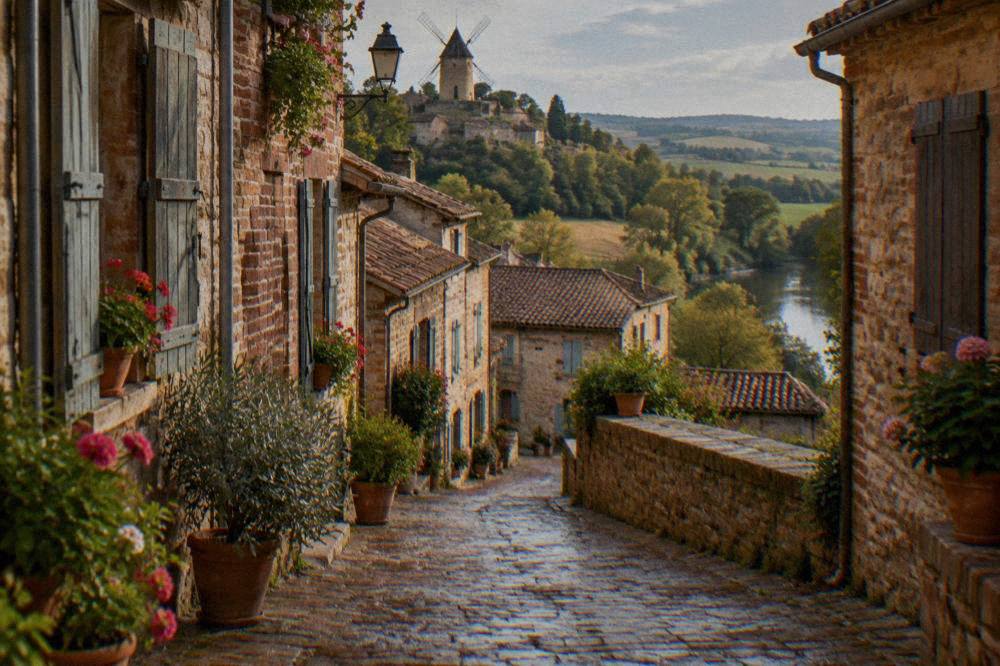
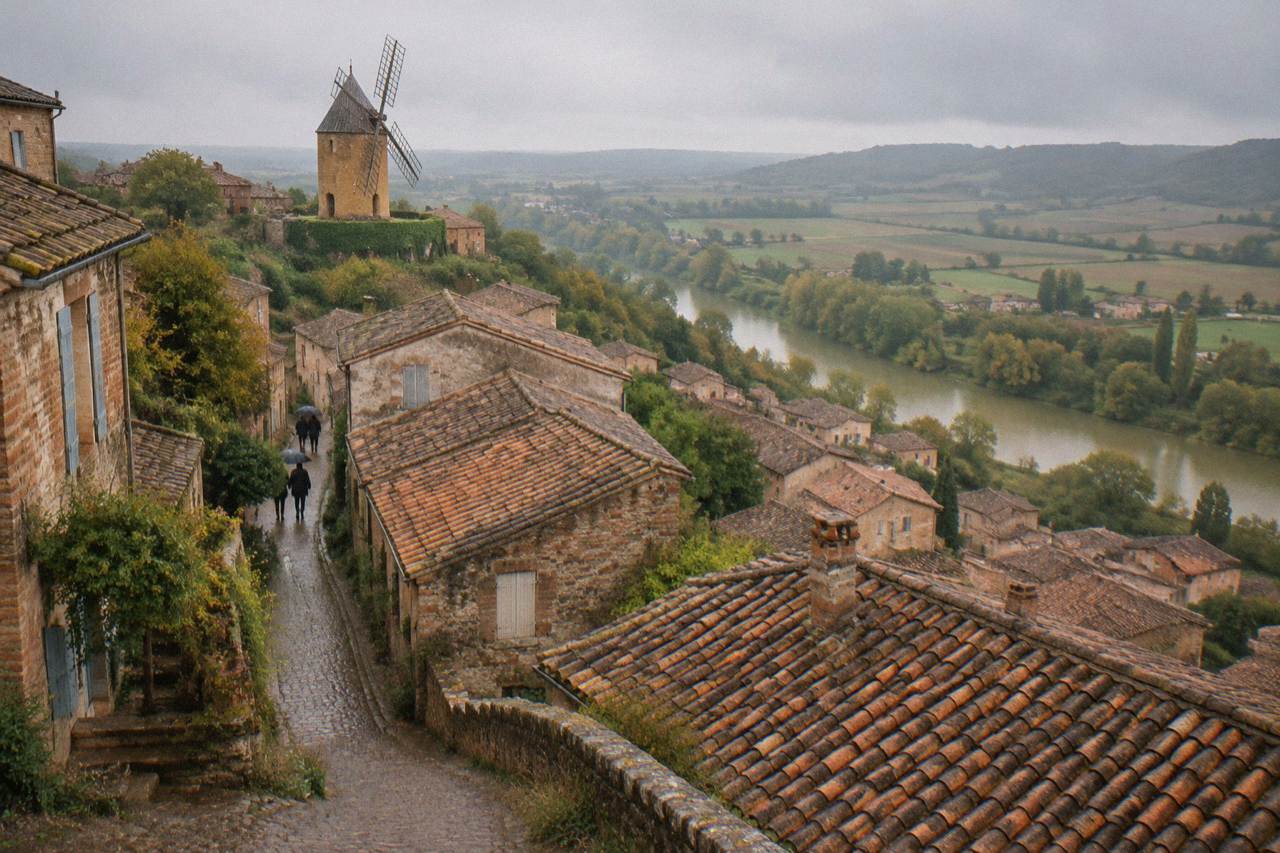
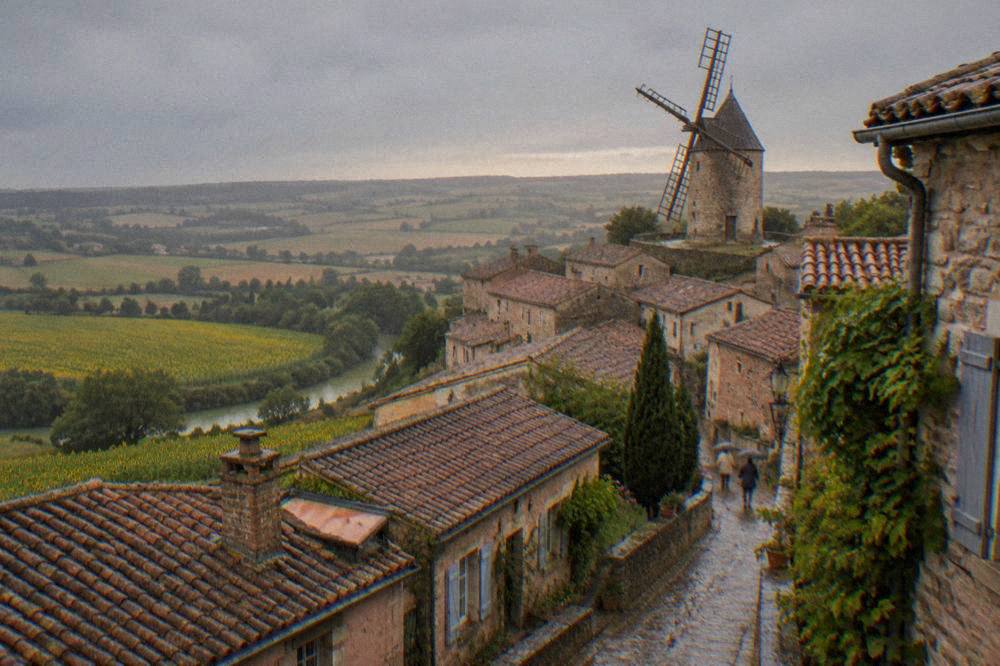
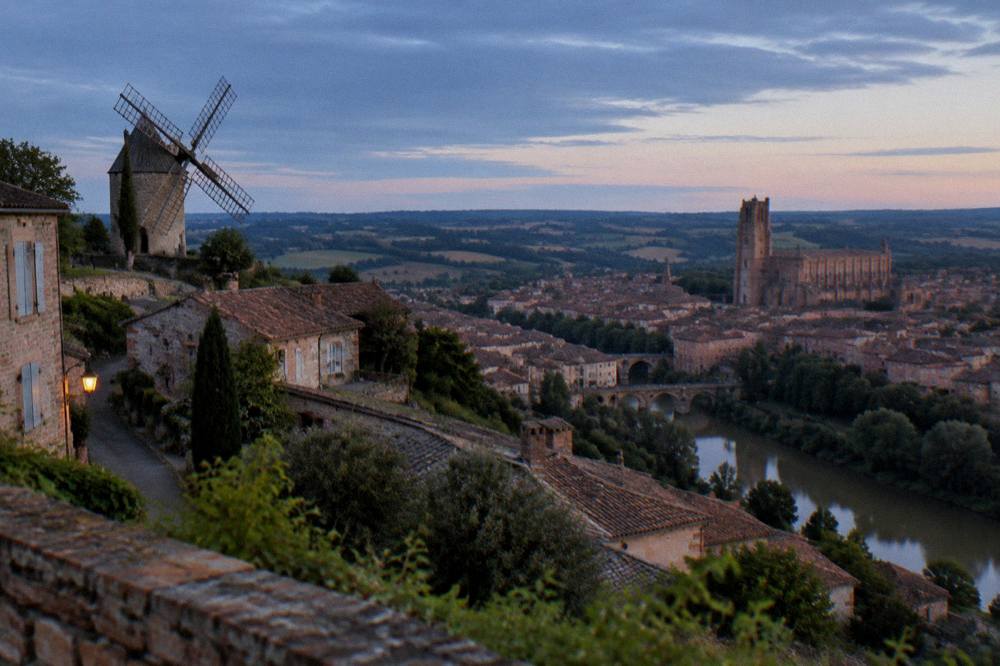
The village's character comes from its setting and its material. The brick that built Lautrec is the same clay-and-fire palette that built Toulouse, but on a hilltop it reads differently: walls step with the slope, roofs stack in terracotta tiers, and the evening light turns whole streets amber. Photographers tend to time their visit for late afternoon for exactly this reason.
Lautrec also carries a name that travelers to the region already half know. The painter Henri de Toulouse-Lautrec drew his family name from this corner of the Tarn, and the artist's story is told in full at the museum in Albi, which is covered on our Albi day-trip guide and on the site's page about Toulouse-Lautrec himself. The village, though, is not a museum about the painter; it is a living agricultural village, and that is its appeal.
What Are The Best Things To See In Lautrec?
The essential sights in Lautrec are all within a short walk of one another: the brick lanes and covered market square at the village heart, the hilltop windmill with its panoramic view over the plain, and the church and village walls that frame the skyline. Nothing needs a ticket or a timetable, and the whole circuit can be done at a slow pace in a morning.
Start at the place, the central square, where a medieval covered market hall still anchors village life. Markets and squares like this are the working heart of every Tarn village, and Lautrec's is a good one to linger in: cafés and small shops ring it, and the stone and timber of the hall give the square its shape. If your visit falls on a market day, arrive early, because that is when the village is at its most alive.
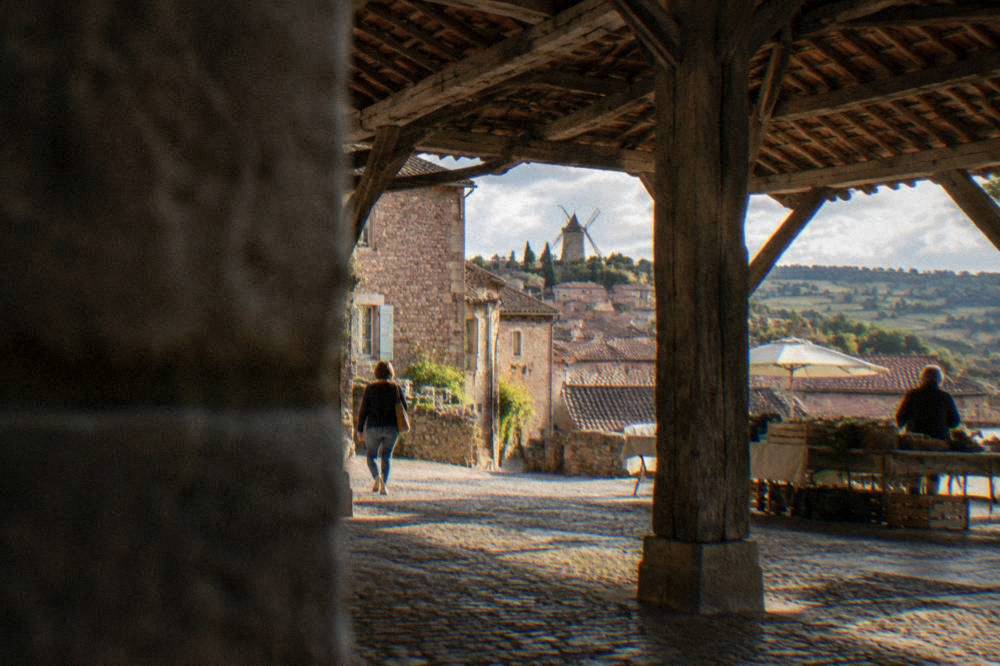
From the square, wander uphill. The lanes narrow and steepen as they climb toward the top of the hill, where the windmill stands. The windmill is Lautrec's signature viewpoint: from the hilltop you look out over the plain, a quilt of fields, hedgerows and, in summer, sunflowers. It is the single best place to understand why the village was built where it was, on a defensible high point above rich farmland.
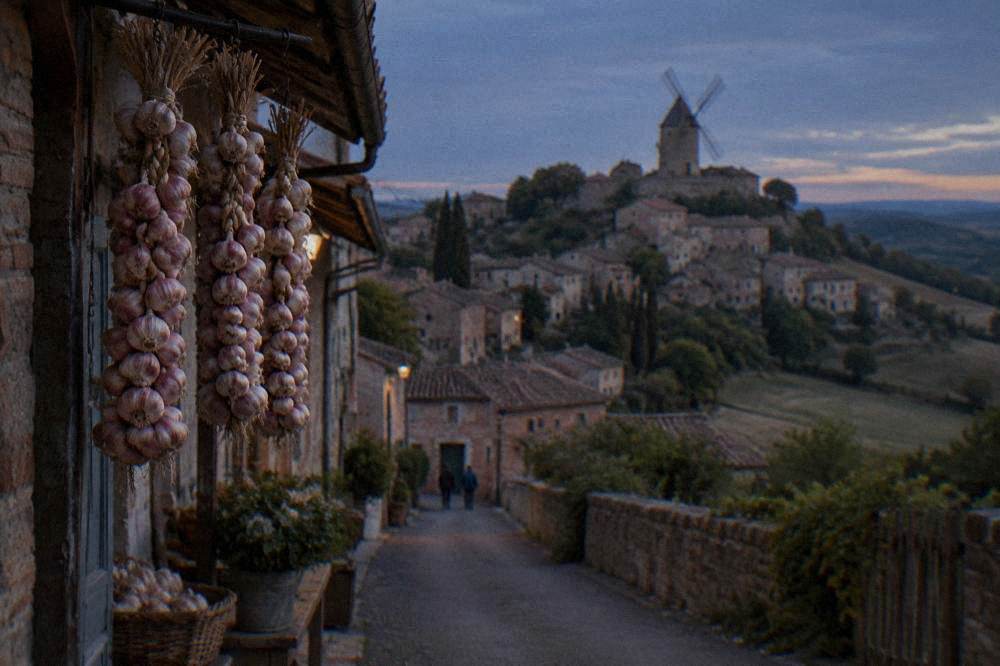
The village's two agricultural claims deserve attention too. Lautrec gives its name to the region's pink garlic, the ail rose, a soft, mild garlic with a rose-tinted skin that is celebrated locally each summer at a garlic festival; the exact date changes year to year, so check with the tourist office before planning around it. The area also has a saffron-growing tradition, and small local producers sell both, alongside other Tarn specialties, in village shops. Neither is a museum piece: both are working crops, and buying a braid of pink garlic is the standard souvenir.
If you want a structured introduction to the wider region instead of self-guiding, an organized excursion covers the driving and the route. The full-day guided trip from Toulouse that includes Albi, Carcassonne and Cordes-sur-Ciel with lunch included is the most complete option on this site's roster:
How Do You Get From Toulouse To Lautrec?
Lautrec is reached from Toulouse by car, with the drive east through the Tarn countryside as part of the pleasure, or as part of an organized day trip that handles the route for you. There is no direct urban transit link: Toulouse's Tisseo network serves the metropole, and Lautrec lies beyond it, so independent travelers drive or join a tour.
Keen to make the village your own destination for the day? Book a rental car here.
For context on the city end of the journey: Toulouse's public transport is run by Tisseo, and its official e-boutique catalogue lists the fares that matter for getting to your starting point in the city. A single trip costs EUR 1.90, or EUR 2.50 if bought last-minute on board. A day pass costs EUR 7.20, a 3-day pass EUR 14.30, and a 10-trip carnet EUR 16.00. There is no 2-day pass in the catalogue.
| Tisseo ticket | Price |
|---|---|
| Single trip | EUR 1.90 |
| Single trip bought on board | EUR 2.50 |
| 10 trips | EUR 16.00 |
| Day pass | EUR 7.20 |
| 3-day pass | EUR 14.30 |
None of that takes you to Lautrec, which is the point: the village is rural, and the freedom of the day trip comes from leaving the transit map behind. If you are not hiring a car, the practical alternative is an organized excursion. Beyond the full-day Albi, Carcassonne and Cordes trip above, the roster also includes a day trip to Albi and Cordes-sur-Ciel with audio guides, which covers the same department:
That audio-guide excursion suits travelers who want the two headline Tarn stops at a steadier pace, while the full-day version pushes on to Carcassonne and adds lunch. Whichever structure you prefer, three well-reviewed ways to fill a day from this site's roster are below, and the full-day Albi, Carcassonne and Cordes trip is the one that passes closest to Lautrec.
For travelers who do drive, the route east from Toulouse crosses open agricultural country, and the drive itself is short enough that Lautrec works as a morning-only destination with an afternoon stop elsewhere. Our Gaillac wine route guide and the Castres day-trip page both sit in the same broad direction and make natural second stops.
One planning note for the city end: if your Toulouse stay includes airport arrival or departure, the tram T2 to Toulouse-Blagnac airport has been closed since 5 June 2023 and stays closed until the end of 2026 because of the metro Line C works. The airport's Navette bus runs one departure every 15 minutes and takes 20 to 40 minutes to the centre. The details are on our Toulouse airport guide.
What And Where Should You Eat In Lautrec?
Eating in Lautrec means village cooking built on Tarn produce: the local pink garlic in nearly everything, duck and goose dishes from the southwest, and simple café or restaurant plates on the central square. The village is small, so the choice is narrow but honest, and the market hall is the place to see the raw ingredients first.
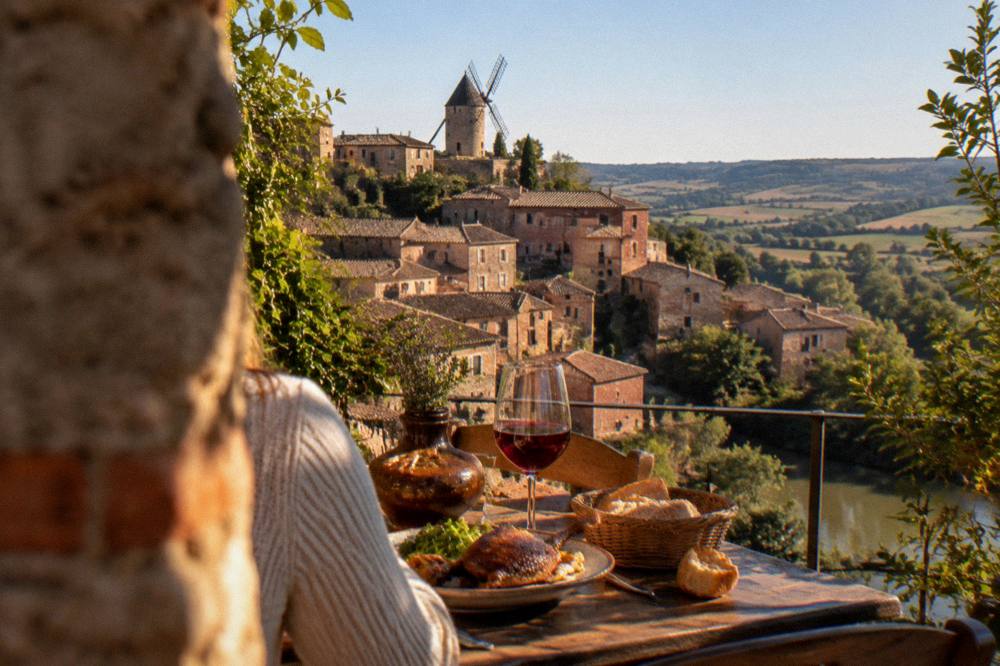
The southwest of France runs on duck and goose: confit, magret, foie gras and cassoulet all travel with you from Toulouse into the Tarn, and village kitchens in Lautrec cook in the same tradition. Pink garlic is the local signature, appearing in everything from roast chicken to the region's simple garlic soups. Saffron, the other local crop, turns up in shops and occasionally on plates. If you want the deep background on the region's food culture before you go, the site's Toulouse food guide and the cassoulet page cover the classics, and the Victor Hugo market guide explains the market culture these villages share.
For travelers who want the region's food explained rather than just served, a guided food experience in Toulouse itself is the strongest preparation, and the chef-led food and history tour in English is the standout on this site's roster:
If a full guided day out of the city is the better fit for your dates, the excursion below is the one to compare it against: same region, same department, but with the driving, the route and the lunch all handled.
A practical rhythm for the day: eat early by French city standards, because village kitchens run shorter service windows than Toulouse restaurants, and the site's page on dinner times in Toulouse explains why the southwest sits down later than visitors expect. In a village like Lautrec, lunch is the meal to plan around, not dinner.
When Is The Best Time Of Year To Visit Lautrec?
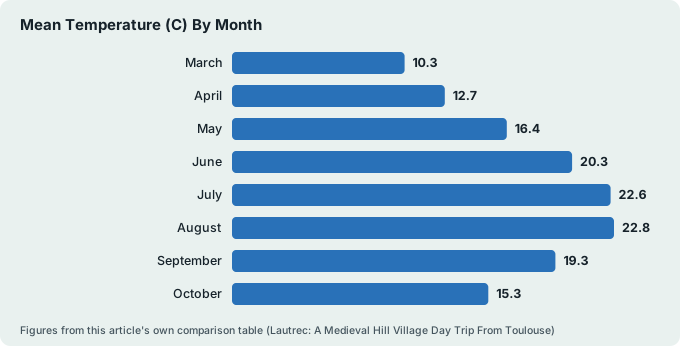
The best time to visit Lautrec is late spring through early autumn, when the hilltop views are clearest, the village shops are fully open and the surrounding fields are green or gold. July is statistically the sunniest month around Toulouse, and May is the wettest, so early summer offers the strongest combination of light and manageable heat.
Meteo-France's 1991-2020 climate normals for the Toulouse-Blagnac station, the closest long-run record for the region, shape the whole calendar. July is the sunniest month at 258.6 hours of sunshine with just 40.1 mm of rain, while May is the wettest month at 73.6 mm, with April at 65.2 mm and June at 64.2 mm close behind. Across the year the station records 627 mm of rain over 95.8 rain days and 2,075.1 hours of sun.
| Month | Mean temperature (C) | Rain (mm) | Sunshine (hours) |
|---|---|---|---|
| March | 10.3 | 45.3 | 175.3 |
| April | 12.7 | 65.2 | 188.5 |
| May | 16.4 | 73.6 | 212.3 |
| June | 20.3 | 64.2 | 231.8 |
| July | 22.6 | 40.1 | 258.6 |
| August | 22.8 | 44.6 | 246.4 |
| September | 19.3 | 45.7 | 210.1 |
| October | 15.3 | 54.3 | 155.2 |
Two cautions from the same record. First, summer heat is real: the station logs 11.5 days a year at or above 30C in July and 11.3 in August, and the all-time record high is 42.4C, set on 23 August 2023. A hilltop village has little shade, so carry water in high summer and walk up to the windmill early. Second, the wettest months are not winter but late spring, so a May visit can be greener and lovelier than July but also wetter. February is actually the driest month in the record at 37.2 mm, though also cold, with a mean of 7.1C and a record low of -19.2C from 15 February 1956.
If you are timing a wider Toulouse stay, the city's verified festival calendar offers anchors: Piano aux Jacobins runs 8 to 30 September 2026, the Toulouse les Orgues festival holds its 31st edition from 7 to 18 October 2026, and the Christmas markets on Place du Capitole, the allees Jean-Jaures and square Charles-de-Gaulle run 26 November to 27 December 2026. The Rio Loco festival returns 9 to 13 June 2027. None of these happens in Lautrec, but a day trip slots neatly around them.
Can You Combine Lautrec With Albi, Cordes-sur-Ciel Or The Gaillac Vineyards?
Yes, and combining is the smart way to do it: Lautrec is small enough for a half day, and the Tarn's headline sights, Albi with its cathedral and Toulouse-Lautrec museum, Cordes-sur-Ciel on its ridge, and the Gaillac vineyards, all sit in the same department, so one loop can carry two or three stops.
Albi is the anchor. The city's cathedral and its museum dedicated to Henri de Toulouse-Lautrec make it the Tarn's biggest draw, and the full-day guided excursion from Toulouse that includes Albi, Carcassonne and Cordes-sur-Ciel with lunch included is built exactly around this logic. For travelers who prefer a shorter structure, the Albi and Cordes day trip with audio guides covers the two closest headline stops. The site's dedicated guides to Albi and Cordes-sur-Ciel go deeper on both.
The Gaillac vineyards complete the triangle. Gaillac is one of France's older wine regions, and the Gaillac wine route guide on this site covers the producers and the driving loop. A realistic independent day: Lautrec in the morning, a vineyard lunch or cellar visit near Gaillac, and Albi in the late afternoon. In the other direction, Castres and the Cathar castles extend the trip for a second day.
Back in Toulouse, if the day trip leaves you wanting more of the city itself, the electric bike tour is the roster's best-rated way to cover Toulouse's panoramas, and it makes a good bookend to a rural day:
What Does A Day Trip To Lautrec Cost?
The village itself costs almost nothing: Lautrec's lanes, square and windmill viewpoint are free to wander, so the real budget lines are transport, food and any paired stops. From the Toulouse side, a day pass on Tisseo costs EUR 7.20 if you need city transit before or after, and the tourist office's Pass Tourisme at EUR 26 covers museums back in the city rather than the village.
The Pass Tourisme, sold by the Toulouse tourist office, costs EUR 26 for stays of one to three days and only pays off from the third activity. It includes a free guided tour from the tourist office, and adding EUR 10 buys 10 public-transport trips. What it covers is city-side: the office's own page lists free entry with the pass at the Fondation Bemberg (normal rate EUR 12), the Museum (EUR 12), Les Abattoirs (EUR 12), the Musee des Augustins (EUR 5) and the Couvent des Jacobins (EUR 5), with a discount rather than free entry at Cite de l'espace, whose normal adult rate is EUR 29.
| Pass Tourisme item | Normal rate | With the pass |
|---|---|---|
| Fondation Bemberg | EUR 12 | Free |
| Museum de Toulouse | EUR 12 | Free |
| Les Abattoirs | EUR 12 | Free |
| Musee des Augustins | EUR 5 | Free |
| Couvent des Jacobins | EUR 5 | Free |
| Cite de l'espace | EUR 29 | Discounted |
Two timing caveats matter for city museums on the same trip. The Musee des Augustins is temporarily closed from 21 September to 2 October 2026 for great-closter works, with its Gothic halls reopening on 3 October 2026 from 10:00. The Couvent des Jacobins is free on the first Sunday of the month except when a temporary exhibition is on. Check the Toulouse museums guide before you build an itinerary.
For lodging, note the Toulouse Metropole tourist tax: non-classified or pending-classification accommodation, which includes most platform rentals, pays 5% of the pre-tax nightly price per person. That applies inside the metropole, not in a Tarn village, but it is the figure to expect if you book a rental in the city at either end of the trip. The site's Toulouse cost guide and where to stay guide break down the rest of the budget.
| Budget line | Typical figure |
|---|---|
| Tisseo day pass (city transit) | EUR 7.20 |
| Tisseo 3-day pass | EUR 14.30 |
| Pass Tourisme (1-3 days) | EUR 26 |
| Transport add-on, 10 trips | +EUR 10 |
| Tourist tax, non-classified rental | 5% of pre-tax nightly price |
Once the city-side budget lines are clear, the remaining decision is how much of the day you want handed to a guide. The three strongest guided options from the roster, led by the full-day Tarn and Carcassonne excursion that this page features, are collected here for a final comparison.
Common Questions About Visiting Lautrec From Toulouse
Quick answers to what planners ask most about a Lautrec day trip.
Is Lautrec worth visiting from Toulouse?
Yes, if you want a quiet, photogenic contrast to the city. Lautrec is a small brick hill village with a covered market square, a windmill viewpoint and local garlic and saffron traditions, and it works best as a half-day stop combined with Albi, Cordes-sur-Ciel or the Gaillac vineyards rather than as a full day on its own.
How far is Lautrec from Toulouse?
Lautrec lies east of Toulouse in the Tarn, close enough for an easy day trip by car or organized excursion. The site does not publish a driving time for this route, and train times on French regional lines are not verified here, so check a mapping service or the tour listing for the current journey.
Can you visit Lautrec without a car?
Independently it is difficult, because Lautrec sits beyond the Tisseo network that serves the Toulouse metropole. The practical car-free option is an organized day trip from Toulouse that covers the Tarn's headline stops, such as the full-day excursion to Albi, Carcassonne and Cordes-sur-Ciel with lunch included.
What is Lautrec famous for?
The village is known for its hilltop brick setting, its medieval covered market hall and windmill, and above all its pink garlic, the ail rose, grown on the surrounding plain and celebrated each summer. The area also has a saffron-growing tradition, and the painter Henri de Toulouse-Lautrec's family name comes from this corner of the Tarn.
What is the best month to visit Lautrec?
June and September are the strongest picks. Meteo-France's 1991-2020 normals for Toulouse-Blagnac show July as the sunniest month at 258.6 hours but with summer heat, while May is the wettest month at 73.6 mm. June offers long light before the peak heat, and September cools back to a 19.3C mean with 210.1 hours of sun.
Can you combine Lautrec and Albi in one day?
Yes, that is the classic pairing. Lautrec needs only a morning, and Albi, with its cathedral and the Toulouse-Lautrec museum, is the Tarn's biggest sight. Travelers who want the combination without driving can take a guided day trip from Toulouse covering Albi and Cordes-sur-Ciel, or the full-day excursion that adds Carcassonne and lunch.
Whether you drive the Tarn lanes yourself or let a guided excursion handle the route, Lautrec delivers exactly what a day out of Toulouse should: brick, a hill, a view and a braid of pink garlic for the drive home.