What Time Do People Eat Dinner In Toulouse?
Dinner in Toulouse runs later than visitors expect. A practical guide to local meal rhythms, early-evening options, and how the pink city eats after dark.
Toulouse, the pink-brick "La Ville Rose" on the Garonne in the Occitanie region of southwestern France, keeps the French southwest's late dinner rhythm, and visitors who plan their evenings around a 6 pm table will find the city eating long before they do. Dinner here is a social event, not a refueling stop, and it anchors an evening that often begins with an aperitif and can drift well past 10 pm. This page lays out the customary rhythm, why it runs late, what to do when you are hungry earlier, and how the seasons shift the whole pattern, with a look at the dishes that tend to appear once the tables fill.
What Time Do People Eat Dinner In Toulouse?
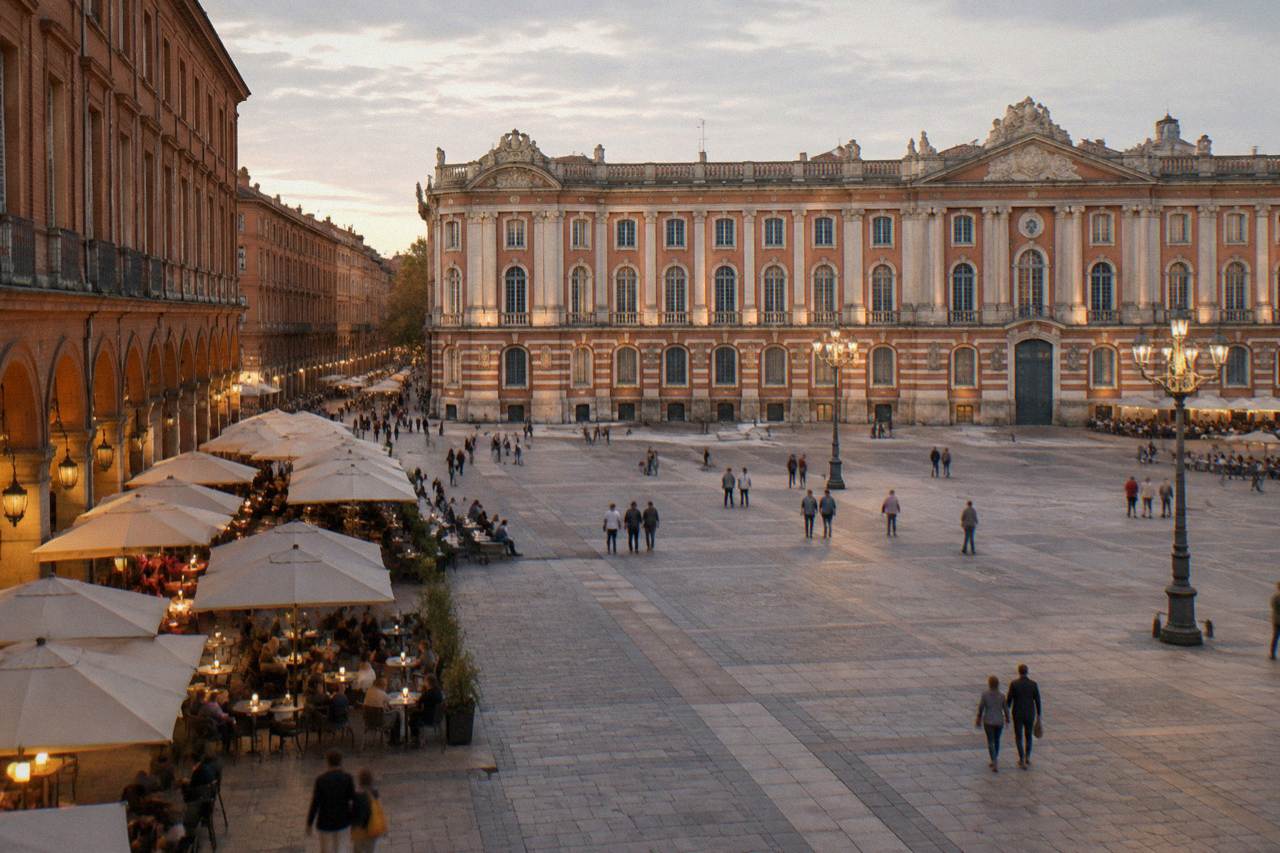
In Toulouse, as across most of France, dinner is typically eaten between about 8 and 9 pm, and restaurant kitchens usually start serving in the early evening and keep going until around 10 pm. Households tend to sit down later than in many northern European countries, and a restaurant table booked for 7:30 pm places you among the earliest diners of the night.
That is the honest, general picture, and it matters because the rhythm shapes everything around it. If you arrive at a restaurant at 6:30 pm, you will likely find it closed or nearly empty, with the staff still setting up. Arrive at 8:30 pm and the same room is full, loud, and unhurried. The evening aperitif, a drink with olives or chips before the meal, fills the gap between the end of the workday and the table, and it is a genuine part of the rhythm rather than a substitute for dinner.
The schedule also runs on a different clock from lunch. Lunch in Toulouse is a real meal, often the larger one of the day, and the afternoon holds on to it: many shops close for a midday break and reopen later, which pushes the whole evening back. A late, proper lunch makes a late dinner feel natural rather than forced.
For visitors, the practical takeaway is simple. Reserve for 8 pm or later if you want the atmosphere, and do not treat a 9:30 pm reservation as an eccentricity. If your group runs hungry early, plan an aperitif stop first, or pick a place that serves continuously, which the next sections cover.
| Meal | Customary window in Toulouse | What it usually looks like |
|---|---|---|
| Breakfast | Early morning, often small | Coffee and bread or a pastry, frequently at home or a cafe standing at the counter |
| Lunch | Around midday to 1:30 pm | A proper sit-down meal, often the main one; many workers take a full break |
| Afternoon snack | Late afternoon | The traditional "gouter", mostly for children, or a coffee pause for adults |
| Aperitif | Early evening onward | A drink and small bites before dinner, with friends or at a cafe terrace |
| Dinner | Typically about 8 to 9 pm | The social meal of the day, unhurried, sometimes stretching past 10 pm |
Why Does Toulouse Eat Dinner So Late?
The late dinner follows the French working day, which typically ends around 6 pm, leaving a natural gap filled by the aperitif hour before the table is set. A long lunch break pushes the evening meal later still, and in a city where social life centers on long meals, there is no pressure to eat early and clear the table.
The rhythm is cultural before it is logistical. In the French southwest, a meal is where the day's conversation happens, and hurrying it would defeat the purpose. Toulouse, a student and aerospace city of 514,819 inhabitants in the commune per INSEE's 2023 figure, has a large population of young people and shift workers, and their evenings start when lectures, labs, and offices let out. The terraces fill first, then the dining rooms.
The aperitif deserves its own explanation because visitors often misread it. It is not a substitute for dinner, and accepting one does not cancel the meal. It is a warm-up: a glass of local wine, perhaps a Fronton red from the vineyards just north of the city, some olives or charcuterie, and conversation that runs until someone declares it is time to eat. Skipping straight from a 1 pm lunch to an 8:30 pm dinner without that bridge is considered a stretch even by locals.
Climate plays a supporting role. Meteo-France's 1991-2020 normals for the Toulouse-Blagnac station show July, the sunniest month at 258.6 hours of sunshine, with a mean daily maximum of 28.2C, and August warmer still at 28.5C. On evenings like that, nobody wants to eat indoors at 6:30 pm. The terrace dinner, eaten slowly as the heat comes off the day, is a summer institution, and it naturally runs late.
If you want to experience the rhythm rather than fight it, an evening built around the city's wine bars is the easiest entry point. The Check availability link covers a small-group wine-bar walk with a local expert, which sits exactly in the aperitif-to-dinner window and doubles as an introduction to the region's bottles. The site's own page on where locals eat in Toulouse picks up the same thread for the meal itself.
What If You Are Hungry Earlier In The Evening?
If your body clock demands food before 8 pm, your best options in Toulouse are brasserie-style places and cafe terraces, which commonly serve continuously through the afternoon and evening, plus the aperitif spread itself, market snacks, and an early sit-down at the few kitchens that open ahead of the local crowd.
The brasserie is the early diner's friend. Unlike a classic restaurant, which often serves lunch, closes mid-afternoon, and reopens for dinner, a brasserie keeps its kitchen running through the gap, so a 6:30 pm bowl of cassoulet or a steak-frites is a normal request rather than a favor. Cafe terraces around the Capitole and along the Garonne work the same way, and a croque-monsieur or a salad at 6 pm draws no attention at all.
The aperitif plate is the other honest answer. A generous one, charcuterie, cheese, and bread, can carry you from 6:30 pm to a proper 8:30 pm reservation without anyone suffering. In a region that produces cassoulet, Toulouse sausage, and ripe sheep's cheese from the nearby hills, the "snack" can be substantial. The site's guide to what to eat in Toulouse lists the dishes worth building an evening around, and the piece on eating out costs in Toulouse helps set expectations before you order.
Families with small children have an easier time than they might fear. Brasseries and pizzerias welcome early tables, and a 6:30 or 7 pm seating with kids is a recognized pattern rather than an imposition. The trick is choosing the right kind of place: a continuous-service brasserie yes, a single-service gastronomic restaurant probably not.
For a bridge into the local rhythm, a guided food walk is the most painless way to arrive at dinner hour already fed and already oriented. The solo pick below is a tasting-based food tour of the city, and it lands you in the evening with a full picture of what the kitchens are about to serve.
What Does A Toulouse Dinner Actually Look Like?
A typical Toulouse dinner follows the classic French structure: an aperitif, then a starter, a main course with cheese or dessert after, eaten over one and a half to two hours, with wine on the table and conversation carrying the pace. The regional staples are cassoulet, Toulouse sausage, and duck in its many forms, with local Fronton and Gaillac wines alongside.
The structure matters because it explains the duration. A three-course meal eaten at a conversational pace simply takes time, and nobody in the room wants it otherwise. The cheese course, served before or instead of dessert, is not an add-on but a fixture, and waiters will not rush a table that is still working through it.
The regional dishes are the reason visitors book dinner in Toulouse at all. Cassoulet, the slow-baked bean and meat casserole that is the city's signature dish, is an evening food by nature, rich enough that it belongs to the end of the day. Toulouse sausage, a coarse-ground pork sausage, appears both inside the cassoulet and grilled on its own. Duck breast, confit, and foie gras all come from the same southwest tradition. The site's pages on what exactly a cassoulet is and what the French eat with cassoulet cover the details, and the story of the signature dish of Toulouse explains why the bean pot carries so much local pride.
Wine is part of the table rather than an optional extra. The vineyards of Fronton sit just north of the city and Gaillac to the northeast, and both appear on local lists by the glass. An evening wine-bar walk led by a local expert, the related tour on this page, is built around exactly this: tasting the region's bottles in the places the city drinks them, in the hours before dinner.
Does The Season Change Dinner Habits In Toulouse?
Yes, and noticeably: summer pushes dinner later and onto the terraces, while winter pulls it indoors and slightly earlier, and the Christmas market season from 26 November to 27 December 2026 adds a whole outdoor layer to the city's evenings.
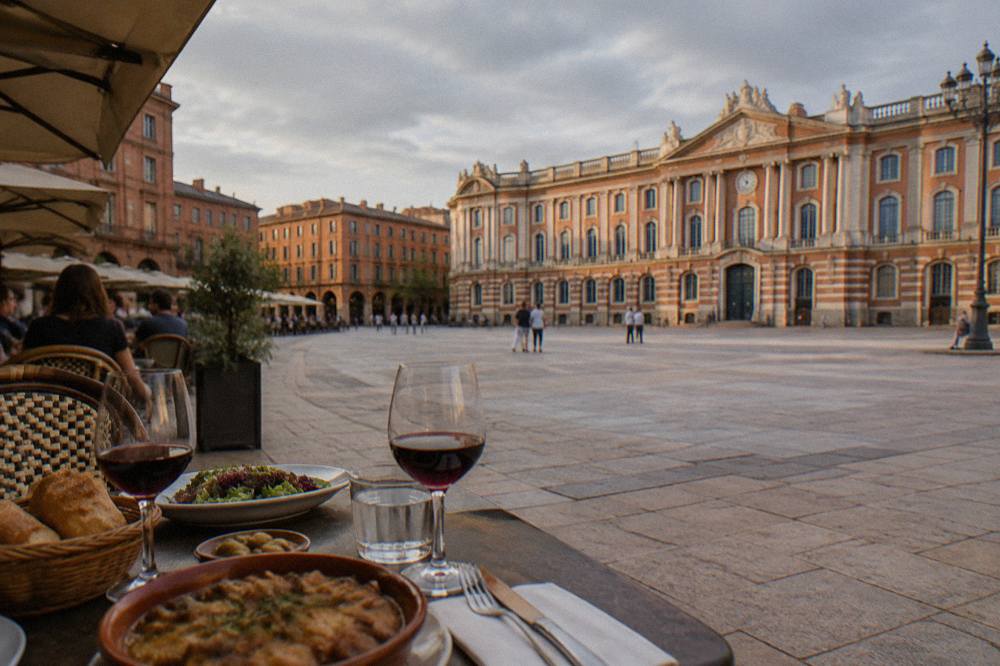
Summer is the terrace season, and the climate data explains it. Meteo-France's 1991-2020 normals for Toulouse-Blagnac show July and August mean daily maxima of 28.2C and 28.5C, with 11.5 and 11.3 days a year respectively reaching 30C or more, and June close behind at 25.7C. Evenings stay warm, daylight lingers, and tables spill onto squares and sidewalks. Dinner drifts later because nobody wants to move.
| Season | Meteo-France figures (1991-2020, Toulouse-Blagnac) | What it means for dinner |
|---|---|---|
| Spring (April-May) | May is the wettest month at 73.6 mm of rain; April 65.2 mm | Terraces open but showers are frequent; indoor tables stay in play |
| Summer (June-August) | July sunniest month at 258.6 hours; 11.5 days at 30C or more | Terrace dinners, latest seatings, slowest pace |
| Autumn (September-October) | September mean maximum 24.8C; October 19.7C | Mild evenings, terraces still busy through October |
| Winter (November-February) | January coldest month, mean 6.3C; February driest at 37.2 mm | Dinners indoors and slightly earlier; Christmas market season adds outdoor stalls |
Winter does the opposite. January, with a mean temperature of 6.3C per the same normals, is not terrace weather, and dinner moves inside to dining rooms and wine bars, often starting a little earlier and ending no earlier. The exception is the festive season: the Christmas markets on Place du Capitole, the allees Jean-Jaures, and square Charles-de-Gaulle run 26 November to 27 December 2026, per Toulouse Metropole's market page, and they turn the early evening into an outdoor event, with food and drink stalls doing brisk trade in the hours before dinner. A warming glass at the market before an 8 pm table is a very Toulouse winter sequence.
The shoulder seasons are arguably the best compromise for visitors. September, at a mean maximum of 24.8C with 210.1 hours of sunshine, still feels like terrace weather, and the city's festival calendar fills the evenings: Toulouse les Orgues runs 7 to 18 October 2026 for its 31st edition, with the opening concert on 7 October at Notre-Dame de la Daurade, so an early dinner followed by an organ concert is a realistic autumn plan. The site's guide to the best time to visit Toulouse works through the full seasonal trade-off.
However you build the evening, the same three experiences keep earning their place in a Toulouse plan: a wine-bar walk with a local expert to learn the aperitif hour properly, a guided highlights walk to get your bearings before the terraces fill, and a private day tour to Albi and Cordes-sur-Ciel when you want to trade the dinner hour for a whole day in the region's medieval hill towns.
Common Questions About Dinner Time In Toulouse
Quick answers to what planners ask most about eating dinner in the pink city.
What time do people eat dinner in Toulouse?
Typically between about 8 and 9 pm, in line with the wider French rhythm. Restaurant kitchens usually open for the dinner service in the early evening and keep serving until around 10 pm, and a reservation for 8 pm or later puts you in step with the room.
Is it rude to eat dinner early in Toulouse?
No. Nobody will judge a visitor for eating at 6:30 pm, but many kitchens will simply not be open yet. Choose a brasserie or a cafe with continuous service and an early table is entirely normal, especially for families.
What is the aperitif hour?
The aperitif is the drink-and-bites pause in the early evening before dinner, and it is a genuine part of the local rhythm rather than a replacement for the meal. A glass of Fronton or Gaillac wine with olives or charcuterie is the classic form.
Do Toulouse restaurants take reservations for 9:30 pm?
Yes. A late table is a normal request, and on busy nights the last seatings can run close to the kitchen's closing time. Booking ahead is wise for popular places, particularly on weekends.
What should I eat for dinner in Toulouse?
The regional classics: cassoulet, Toulouse sausage, and duck breast or confit, with local Fronton or Gaillac wines. The city's page on its signature dish covers the cassoulet story in detail.
Where can I find more on eating like a local in Toulouse?
The site's page on where locals eat in Toulouse covers neighborhood favorites, and the piece on eating out costs sets a budget picture before you book a table.
The short version: plan your Toulouse evening the way the city does, with an aperitif bridge and a table from 8 pm, and let the Toulouse Travel Guide pages on food and neighborhoods handle the rest of the planning.