Conques: A Day Trip From Toulouse
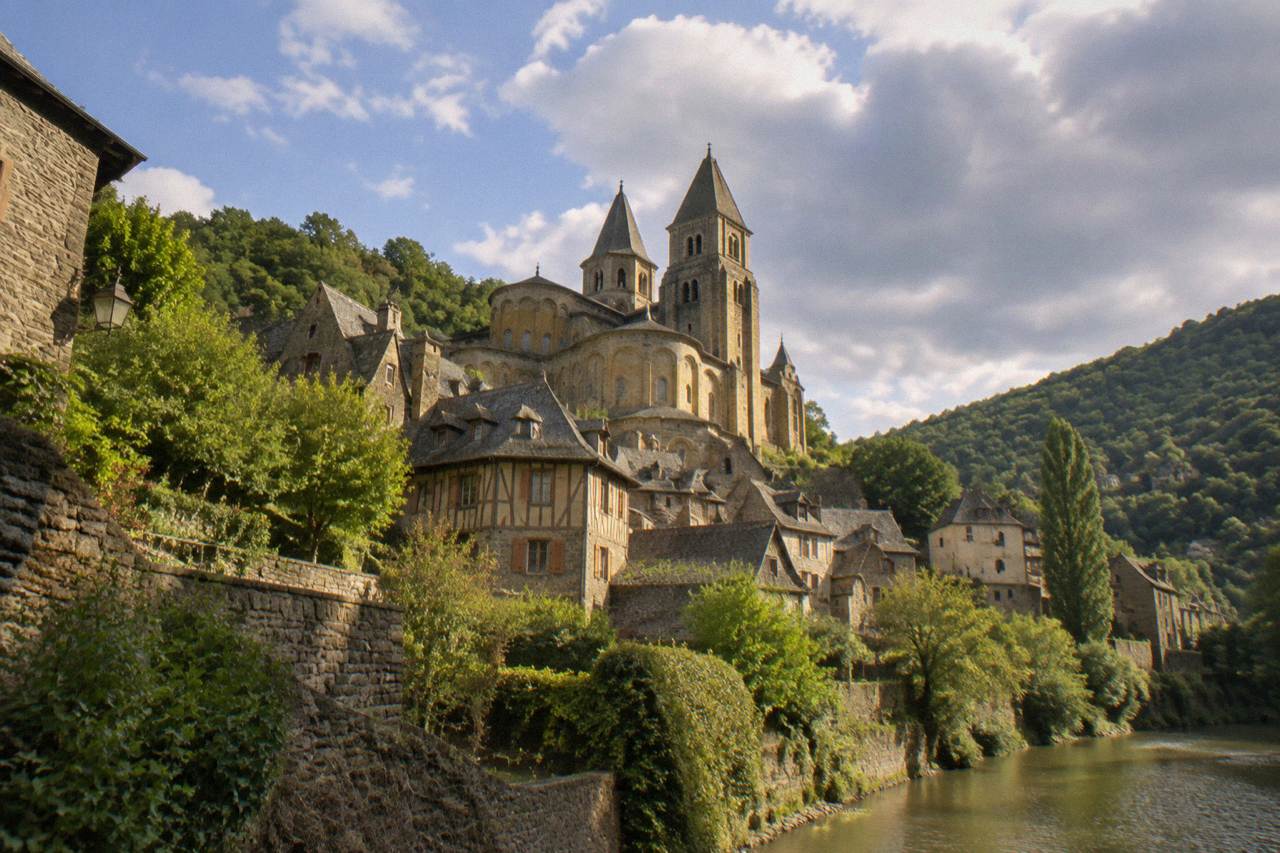
Conques is a small medieval village in the Aveyron, north of Toulouse, clustered around an abbey church on one of the historic French routes to Santiago de Compostela. This guide covers how it fits into a Toulouse trip, what the village offers, and how to plan the day.
Short answer
Conques is a hillside village in the Aveyron region north of Toulouse, reached as a full-day trip by car or organized tour. The village is known for its abbey church, its carved tympanum, and its place on one of the French pilgrimage routes to Santiago de Compostela, inscribed by UNESCO in 1998 as part of the Routes of Santiago de Compostela in France.
Conques sits in the Aveyron, the hilly department north of Toulouse, the pink-brick city on the Garonne in the Occitanie region of southwestern France. The village is small, built of pale stone rather than Toulouse's rose brick, and it wraps itself around a single large monument: an abbey church whose carved west front is one of the celebrated sculptures of medieval France. Pilgrims walking toward Santiago de Compostela have passed through the valley for centuries, and that traffic is the reason the village exists in the shape it does today. For a visitor based in Toulouse, Conques works as a full-day excursion into a quieter, greener landscape than the city, and it pairs naturally with other Aveyron and Midi-Pyrenees stops on a longer loop. This guide from Toulouse Travel Guide covers what the village offers, how to think about the journey, and how to fit Conques into a wider itinerary.
Where Is Conques And Why Do Toulouse Visitors Go?
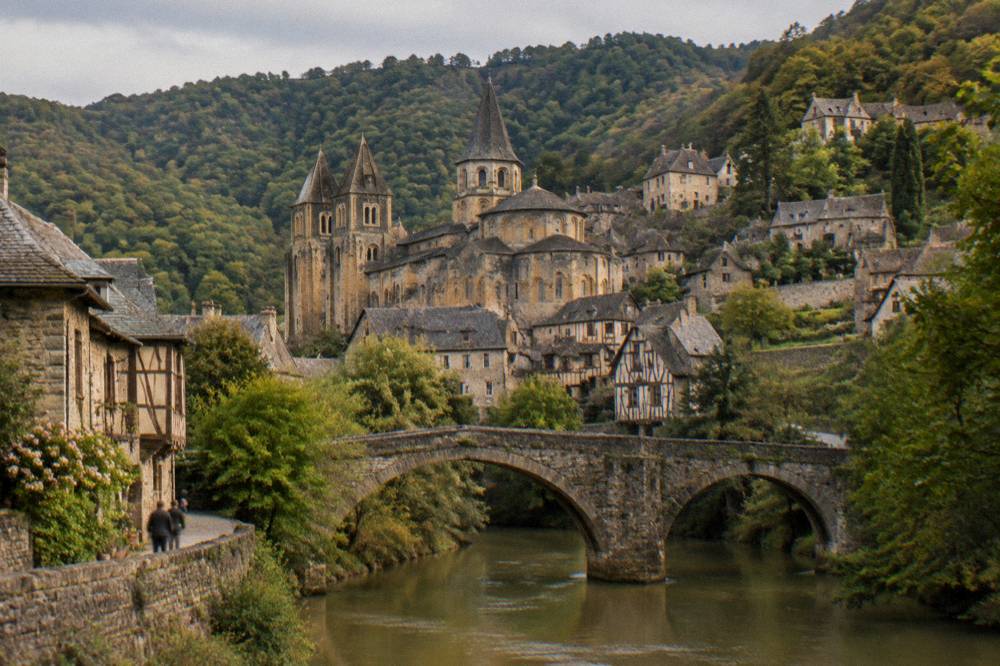
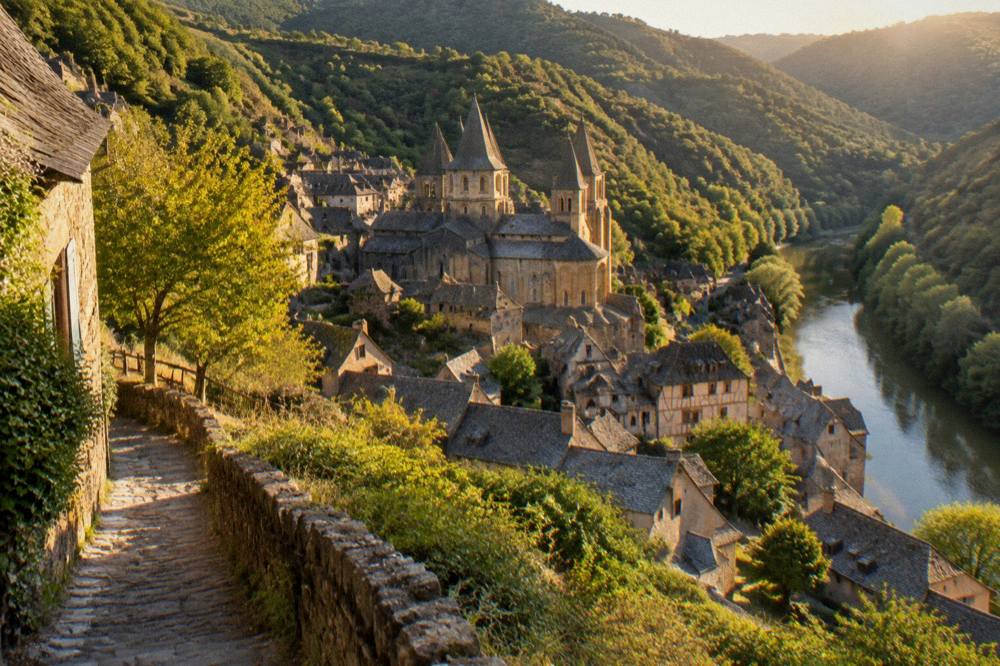
Conques is a village in the Aveyron department, north of Toulouse, set in a wooded valley where a stone bridge crosses the Dourdou river below the abbey church. It is known for that church, for its carved tympanum, and for its position on one of the historic French routes to Santiago de Compostela, a network inscribed by UNESCO in 1998.
The village is compact enough that everything worth seeing sits within a few minutes' walk of the church square. That concentration is the appeal. Day-trippers from Toulouse trade the city's pink brick and plane-lined squares for narrow stone lanes, steep alleys, and a valley view that opens up from the church steps. The setting is inland France at its greenest: the Aveyron is hill country, not mountain country, and the landscape around Conques is a patchwork of woods and small fields rather than the open farmland south of Toulouse.
What draws people is the abbey church of Sainte-Foy, the village's reason for being. The church is a major stop on the Via Podiensis, one of the French branches of the pilgrimage route to Santiago de Compostela, and the UNESCO listing that covers the Routes of Santiago de Compostela in France, inscribed in 1998, recognizes that whole network. Toulouse holds its own piece of the same listing: the Basilique Saint-Sernin is listed as part of the property and is a major stop on the Via Tolosana. A traveler who has already stood inside Saint-Sernin will recognize the family resemblance, a pilgrimage church built on a grand scale for a village that seems far too small to need one.
The village itself is protected heritage, and its population is tiny, a fraction of Toulouse's 514,819 residents in the commune alone. That scale difference is the point of the trip. Conques delivers, in a single steep valley, the medieval France that Toulouse's boulevards and aerospace industry sit on top of.
How Do You Get From Toulouse To Conques?
Conques is a full-day trip from Toulouse, reached by car through the Aveyron countryside or by joining an organized excursion that covers the driving. There is no direct urban transport link: the village is rural, small, and best treated as a destination you drive to or have driven to, with the walking done once you arrive and park.
The honest planning answer is that Conques rewards travelers who treat the journey as part of the day. The route north from Toulouse leaves the city's metro area behind quickly and runs through rolling country; the roads tighten as they approach the valley, and the final descent into the village is one of the memorable approaches in the region. Independent drivers should plan for a full day out of Toulouse, with the village explored on foot once the car is parked, and should check parking and access arrangements with the village's own information before setting out, since a village of this size manages visitor pressure carefully.
Travelers without a car have two realistic paths. One is to rent a vehicle in Toulouse for the day; the city is a normal French rental market and the drive is the standard way locals reach the Aveyron. The other is to book a guided day trip that includes the driving. The roster of tours from Toulouse runs heavily to the classic Midi-Pyrenees and Cathar-country destinations, and the nearest match in style to a Conques day is the Albi and Cordes-sur-Ciel format: a private driver-guide, a UNESCO-listed or heritage town, and time to walk. The Albi and Cordes-sur-Ciel private day tour from Toulouse is the site's featured option in that mold, and our Albi day trip guide and Cordes-sur-Ciel guide cover those two stops in detail.
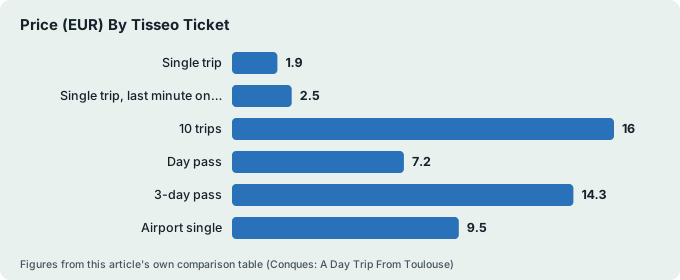
Before leaving Toulouse, it is worth getting the city's own transport sorted, especially if your day trip starts or ends with a metro or bus ride across town. The Tisseo catalogue gives the current fares:
| Tisseo ticket | Price (EUR) | Notes |
|---|---|---|
| Single trip | 1.90 | Bought in advance |
| Single trip, last minute on board | 2.50 | Bought on the vehicle |
| 10 trips | 16.00 | Multi-trip carnet |
| Day pass | 7.20 | Unlimited same-day travel |
| 3-day pass | 14.30 | No 2-day pass is listed |
| Airport single | 9.50 | Tisseo network plus the Navette aeroport |
What Are The Highlights Of Conques?
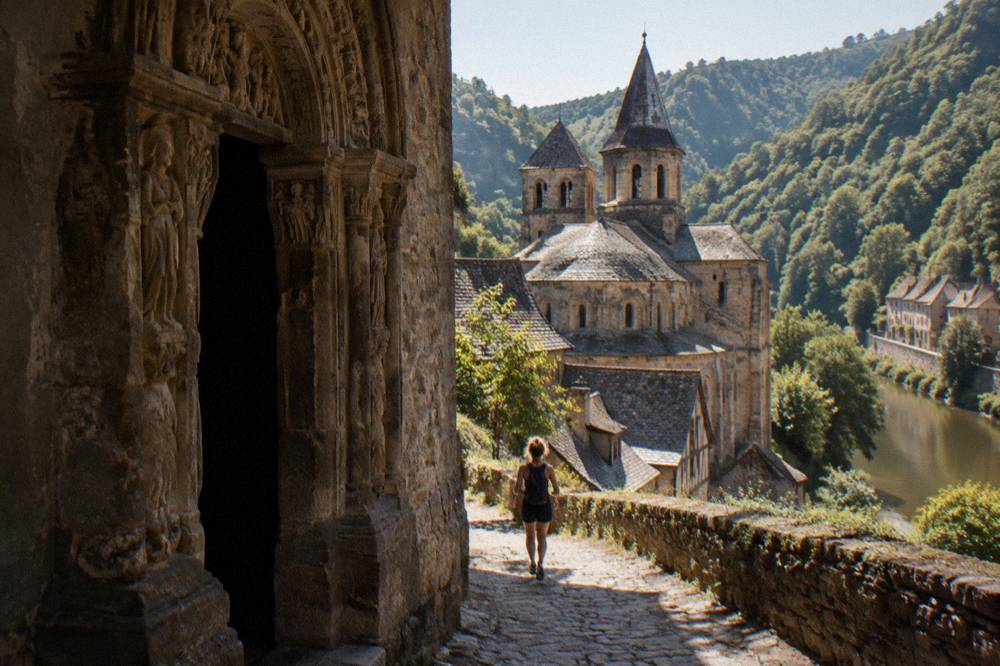
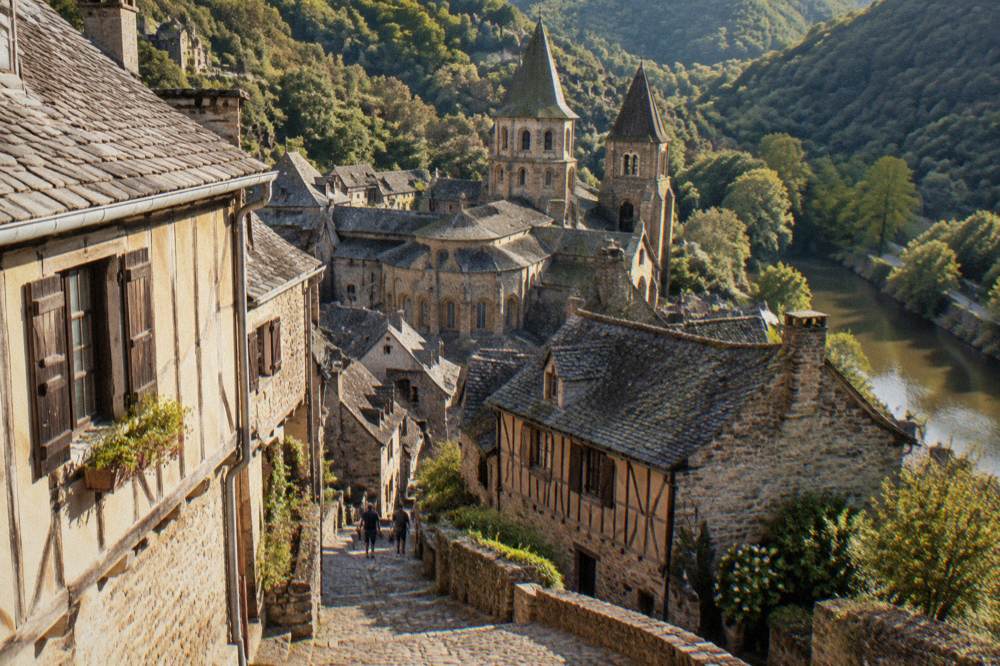
The abbey church of Sainte-Foy is the essential sight, with its carved west tympanum, its treasury of medieval goldwork, and the church interior's stone vaulting, all within a village whose lanes, viewpoints, and river bridge fill out the rest of a half-day. Everything sits within walking distance of the church square.
Start at the church. The west front's carved tympanum is the village's signature: a dense relief of figures arranged around a central image of judgment, considered one of the major Romanesque sculptures still in place in France. Inside, the nave is built for pilgrims, wide and processional, and the light changes through the day as the sun moves around the towers. The treasury holds medieval reliquaries in gold and enamel, including the famous jeweled statue of Sainte-Foy, and it is one of the few medieval church treasuries in the region to survive with its centerpiece intact. Check current opening arrangements on the spot, since a working abbey village adjusts hours around services, restoration work, and the seasons.
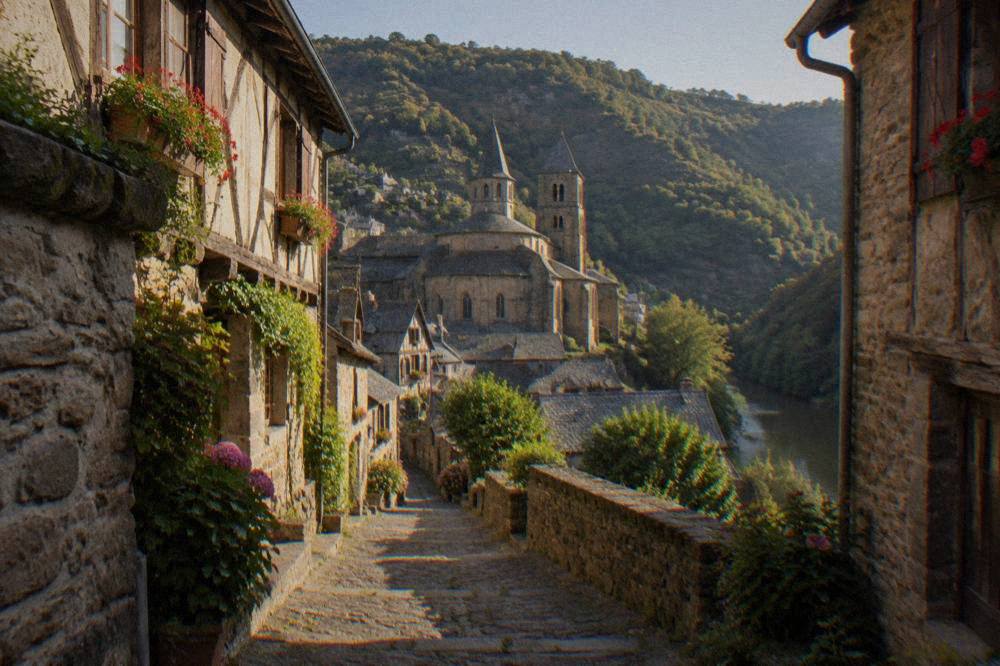
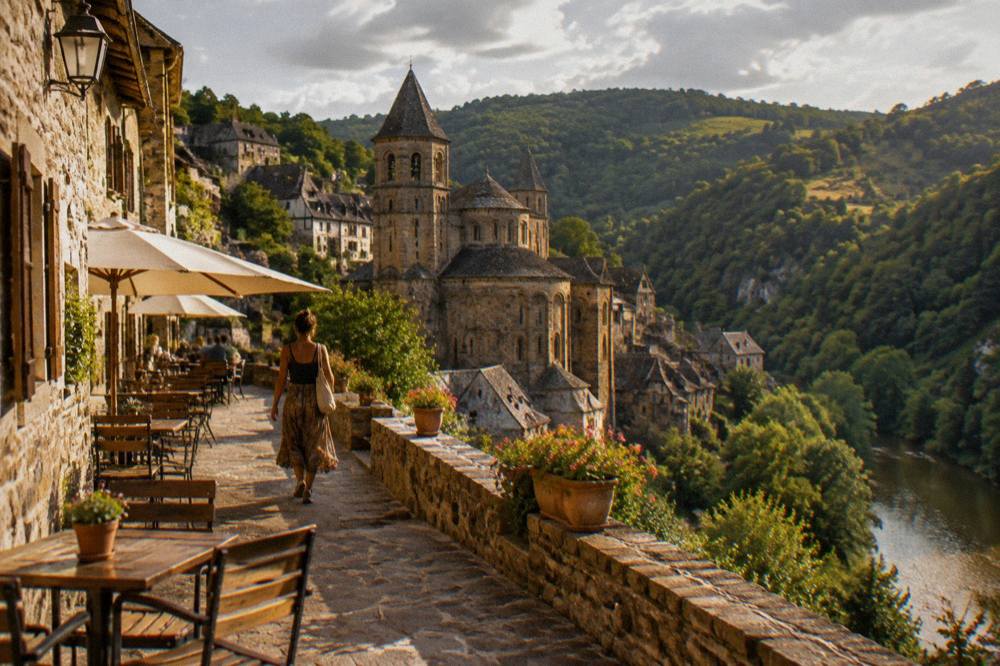
After the church, the village itself is the attraction. The lanes climb from the square in short, steep flights; the rooftops stack below the church; and the viewpoint over the valley, reached on foot in a few minutes, gives the classic postcard angle of the towers above the trees. The old bridge over the Dourdou below the village is the other essential stop: from the bridge, the whole settlement appears at once, church and houses folded into the hillside. Photographers should plan for late afternoon, when the west front is in sun and the valley colors warm up.
Give the village a half-day of actual walking time. That is enough to see the church, the treasury, the bridge, and the lanes at a museum pace, with a long lunch in between. Conques is not a place to rush; the experience is closer to a slow circuit than a checklist, and the absence of anything to hurry toward is precisely what separates it from a city day in Toulouse.
Is Conques On The Santiago De Compostela Pilgrimage Route?
Yes. Conques is a major stop on the Via Podiensis, one of the historic French routes to Santiago de Compostela, and the wider network, the Routes of Santiago de Compostela in France, was inscribed by UNESCO in 1998. Toulouse's own Basilique Saint-Sernin belongs to the same inscription as a stop on the Via Tolosana.
This connection is the single best reason to pair Conques with a Toulouse stay, because the two places are chapters of the same story. Medieval pilgrims converging on the Pyrenees used several French branches: the Via Tolosana through Toulouse, the Via Podiensis through Conques and the Aveyron, and others further west. The UNESCO inscription of 1998 recognized the routes as a set, and the Basilique Saint-Sernin, a Monument Historique since 1840, is listed as part of that property. A traveler who visits Saint-Sernin in the morning and reads about Conques afterward is reading the same pilgrimage infrastructure in a different landscape.
The village's pilgrim identity is still visible. Walkers on the modern long-distance path pass through the valley today, and the village's facilities, from the church to the small hotels and cafes, exist in a form shaped by centuries of through-traffic. For a day visitor, that means the atmosphere is not a museum reconstruction: Conques is a living waypoint, and the mix of hikers with boots and staffs alongside day-trippers is part of the scene in the square.
Pilgrimage heritage also links Conques to other day trips from Toulouse. Rocamadour, the cliff-side sanctuary further north, is another of the great pilgrimage sites of medieval France, and our Rocamadour day trip guide covers it. The same religious history runs through Lourdes, which is a different era of pilgrimage entirely but the same instinct, and through the abbey churches and cloisters scattered across the region, several of which are covered in our Moissac guide.
Curious about the other great pilgrimage site of medieval France? Book a Rocamadour day trip here.
When Is The Best Time Of Year For A Conques Day Trip?
Late spring through early autumn is the practical window, matching Toulouse's own climate: Meteo-France's 1991-2020 normals for Toulouse-Blagnac show July as the sunniest month at 258.6 hours of sunshine with only 40.1 mm of rain, while May is the wettest month at 73.6 mm, so shoulder months trade greenery against showers and midsummer trades heat against reliability.
The village is outdoors: the lanes, the bridge, and the viewpoint are the experience, and the church is the only substantial indoor refuge. That makes the weather matter more than it does for a museum day in Toulouse. The climate data below is measured at Toulouse-Blagnac, the reference station for the region, and the Aveyron valley runs a touch cooler and greener than the city plain, so treat it as the planning baseline rather than a village forecast.
| Month | Mean temperature (C) | Rain (mm) | Sunshine (hours) |
|---|---|---|---|
| February | 7.1 | 37.2 | 118.2 |
| May | 16.4 | 73.6 | 212.3 |
| July | 22.6 | 40.1 | 258.6 |
| October | 15.3 | 54.3 | 155.2 |
Two readings of that table matter for Conques. First, May is the wettest month in the region, at 73.6 mm over the 1991-2020 normals, nearly double February's 37.2 mm, a fact that surprises visitors who assume Mediterranean France is dry in spring. The compensation is that May's rain comes with 212.3 hours of sunshine and the Aveyron at its greenest. Second, July and August are the reliable months: July combines the year's best sunshine with modest rain, and August is the warmest month at a 22.8 C mean. The region's record high, 42.4 C on 23 August 2023, is a reminder that heat spikes happen, and a stone village with steep lanes is hard work in that weather.
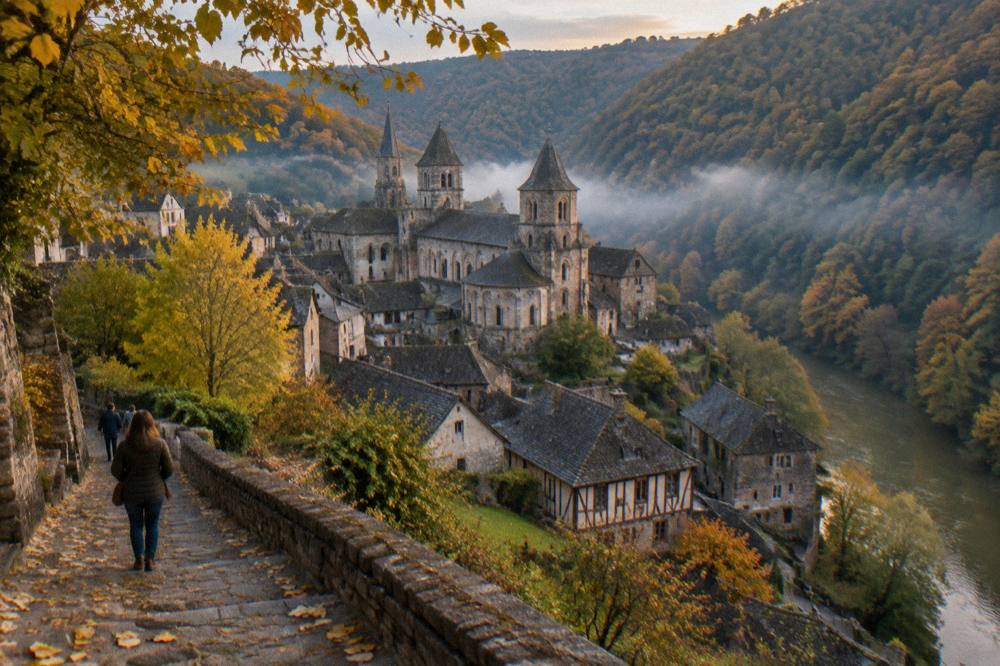
Autumn is the connoisseur's choice. October still carries 155.2 hours of sunshine, the valley colors are at their best, and the summer crowds have thinned. Winter is quiet and atmospheric, and the church is at its most dramatic in low light, but the village's outdoor dimension shrinks and some seasonal facilities close. Whenever you go, check the village's own information for service times and any restoration work before you commit to a date.
How Does Conques Compare With Other Day Trips From Toulouse?
Conques is the region's purest medieval-village experience, more compact and more rural than Albi, less fortified than Carcassonne, and closer in spirit to Cordes-sur-Ciel and Rocamadour; it suits travelers who want one great church and a quiet valley rather than a full day of monuments.
The honest comparison is by travel style. Albi delivers a cathedral city with museums and a riverside old quarter, and it is the easiest big-hitter from Toulouse; our Albi guide covers the practical side. Carcassonne is the maximal option, a complete walled city, and the coach day trip is the classic way to see it; our Carcassonne guide has the details. Cordes-sur-Ciel is the closest stylistic cousin to Conques: a hilltop bastide with a single dramatic silhouette, and it can be combined with Albi on one long day.
Conques differs from all of these in one respect: it has no city around it. There is no cathedral close, no museum quarter, no shopping streets. What there is, is one abbey church of pilgrimage-rank importance, a treasury, and a village that exists because of it. Travelers who want density of sights should pick Albi or Carcassonne. Travelers who want atmosphere, walking, and a single overwhelming monument should pick Conques, ideally on a day when the weather holds.
For combining, the natural pairings are with the Aveyron's other heritage stops or with a loop through the Gaillac vineyards, covered in our Gaillac wine route guide. A private tour format suits this kind of multi-stop day best, since the villages are small and the value is in the pacing rather than the volume of sights.
What Should You Plan Before Leaving Toulouse?
Three things: a realistic full-day schedule, the right ticketing back in Toulouse if your trip starts from the airport or a distant neighborhood, and an awareness of the city events that can crowd your departure day, from Toulouse les Orgues in October to the Christmas markets from 26 November to 27 December 2026.
Timing first. Conques is not a half-day trip: the village deserves a half-day on the ground, and the round journey fills the rest. Build the day around the church's opening hours, which you should confirm locally on the day, and plan lunch in the village rather than back on the road. If you are combining Conques with another stop, accept that the second stop will be brief, or split the region across two days and stay overnight in the Aveyron.
Second, the Toulouse end of the journey. If your Conques day sits at the start or end of your stay, the Pass Tourisme from the tourist office is worth knowing about: it costs EUR 26 for stays of one to three days, pays off from the third activity, and includes a free guided tour from the tourist office, with an optional EUR 10 add-on for ten public-transport trips. It covers the city's museums, not the Aveyron, but it is the standard tool for the Toulouse half of the trip:
| Pass Tourisme detail | Figure |
|---|---|
| Pass price | EUR 26 |
| Validity | 1 to 3 days |
| Transport add-on | +EUR 10 for 10 trips |
| Guided tour from the tourist office | Included |
| Break-even point | From the 3rd activity |
The museums the tourist office lists as free with the pass, at their normal rates, are:
| Museum or monument | Normal rate (EUR) | With the Pass |
|---|---|---|
| Fondation Bemberg | 12 | Free |
| Museum de Toulouse | 12 | Free |
| Les Abattoirs | 12 | Free |
| Musee des Augustins | 5 | Free |
| Couvent des Jacobins | 5 | Free |
Third, check the city's event calendar for your dates. A departure morning during a major festival means fuller trains and buses and a city center that is slower to escape. The verified anchors for the season ahead: Piano aux Jacobins runs 8 to 30 September 2026, Toulouse les Orgues holds its 31st edition from 7 to 18 October 2026 with the opening concert at Notre-Dame de la Daurade, and the Christmas markets on Place du Capitole, the allees Jean-Jaures and square Charles-de-Gaulle run 26 November to 27 December 2026. In 2027, Rio Loco runs 9 to 13 June on the Prairie des Filtres. None of these block a Conques trip, but any of them can change the rhythm of the day you leave.
Common Questions About A Conques Day Trip From Toulouse
Quick answers to what planners ask most about Conques.
Is Conques worth the trip from Toulouse?
For travelers who want medieval atmosphere and one great pilgrimage church, yes. Conques is compact, quiet, and unlike anything in Toulouse itself. If you prefer dense sightseeing, Albi or Carcassonne packs more into a single day.
Can you visit Conques without a car?
It is difficult as an independent day trip by public transport. The practical car-free options are renting a car in Toulouse for the day or booking a guided excursion that includes the driving, in the style of the Albi and Cordes-sur-Ciel private tours.
How long should you spend in Conques?
A half-day on the ground is enough for the abbey church, the treasury, the bridge, and the lanes at a comfortable pace. With travel each way, plan the whole day out of Toulouse.
What is Conques famous for?
The abbey church of Sainte-Foy, its carved Romanesque tympanum, its treasury of medieval goldwork, and its role as a stop on the Via Podiensis, one of the French routes to Santiago de Compostela inscribed by UNESCO in 1998.
What is the best time of year to visit Conques?
May through October, with July the most reliable month in the region: Meteo-France's normals show it as the sunniest month at 258.6 hours of sunshine with 40.1 mm of rain. October is quieter and the valley colors are at their best.
Can you combine Conques with other stops?
Yes, but briefly. The natural pairings are the Aveyron's other heritage villages, or a loop through Albi, Cordes-sur-Ciel and the Gaillac vineyards over a longer day or two.
Conques is the day trip from Toulouse for travelers who want the region's medieval soul without a walled city or a cathedral town around it. Pick a clear day, leave early, give the church the time it deserves, and let the valley do the rest.