What Is The Oldest Building In Toulouse?
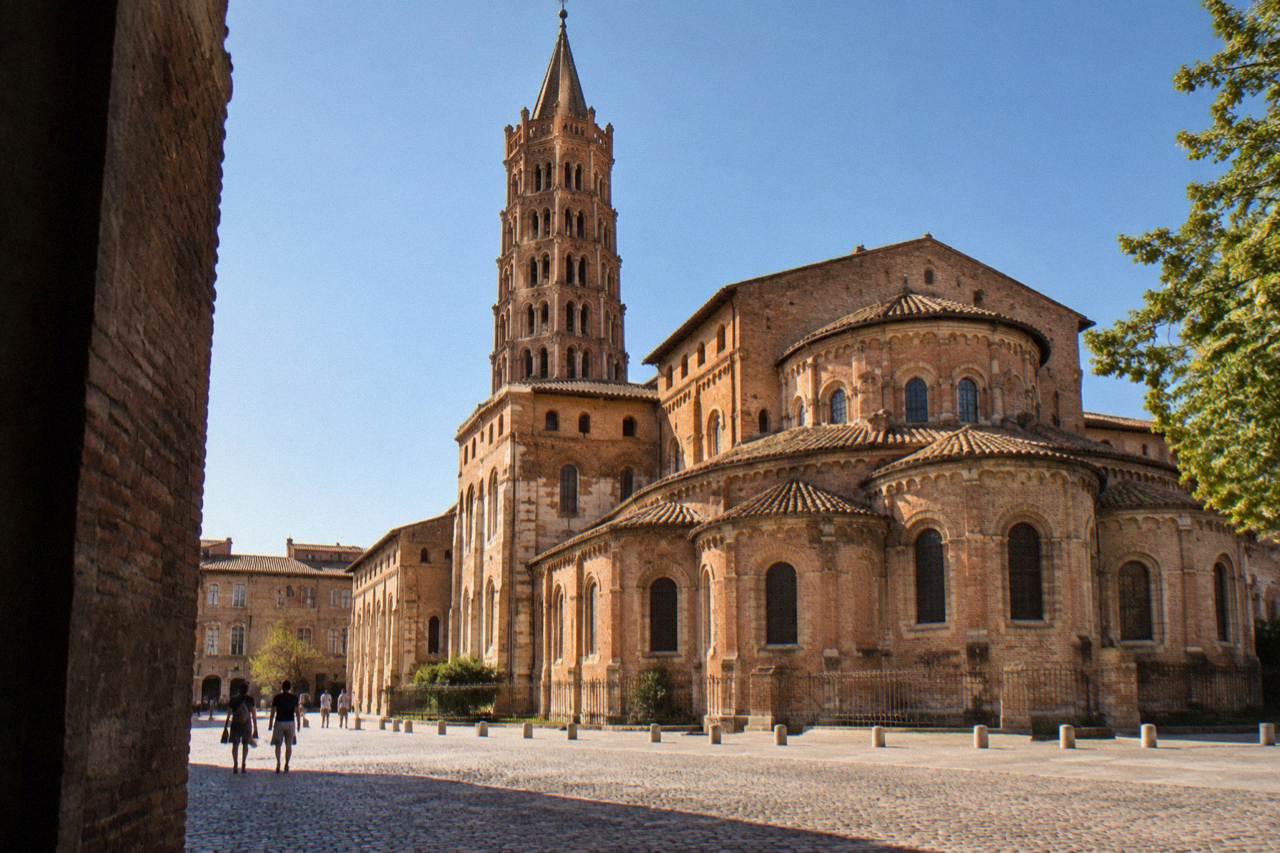
The oldest building in Toulouse is usually named as the Basilique Saint-Sernin, the Romanesque basilica on the Via Tolosana. What is verified, what is legend, and how to visit.
Ask which building in Toulouse, the pink-brick city on the Garonne in the Occitanie region of southwestern France, is the oldest, and one name dominates every answer: the Basilique Saint-Sernin. It is the city's great Romanesque church, a listed monument since 1840 and part of a UNESCO World Heritage property since 1998, and no other building in the center carries an older or better documented claim. The honest answer needs some care, though, because the word "oldest" hides a tangle of rebuilds, surviving fragments and proud local rivalries, and several other churches and town houses in Toulouse have serious claims of their own.
This site holds every claim to the standards of the official record, so this page separates what the city and UNESCO actually state from what local legend adds. The short version: Saint-Sernin is the answer to give at a quiz night, and the surrounding detail is more interesting than the headline. For the wider picture of the city's fame, see why so many travelers end up here in why Toulouse is so famous, and for how long to give the city, how many days is enough for Toulouse covers the planning side.
What Is The Oldest Building In Toulouse?
The oldest building in Toulouse is generally held to be the Basilique Saint-Sernin, the great Romanesque basilica northeast of the Capitole. The city's own monument page records it as a Monument Historique since 1840 and as part of the UNESCO-listed "Routes of Santiago de Compostela in France" since 1998, and it stands as a major stop on the Via Tolosana pilgrimage road.
The basilica's standing is what matters here rather than a precise founding year. The UNESCO listing that covers Saint-Sernin, the "Routes of Santiago de Compostela in France", was inscribed in 1998, and the Canal du Midi, the city's other World Heritage property, was inscribed in 1996 under criteria (i)(ii)(iv)(vi). Saint-Sernin's Monument Historique protection dates from 1840, one of the earliest such classifications in France, which is itself a signal of how early antiquarians singled the building out.
The reason the answer is not a single clean date is that medieval churches are palimpsests. Saint-Sernin was built in stages, with later chapters of masonry wrapped around earlier cores, and the building you walk through today is the sum of those campaigns. Guides will point to this column or that crypt vault as the oldest surviving piece, and the claims are genuinely hard to rank from outside. What no other building in the city disputes is the basilica's overall antiquity and its scale: it is the largest and oldest of Toulouse's surviving churches, and the one whose walls carry the deepest documented history.
Which Other Buildings In Toulouse Have Serious Age Claims?
Behind Saint-Sernin, the strongest age claims in Toulouse belong to the city's other medieval churches and to fragments embedded in later buildings: the Couvent des Jacobins, the cathedral of Saint-Etienne, and the Notre-Dame-du-Taur church near the basilica all carry medieval fabric, while the grand brick merchants' houses of the Renaissance, such as the Hotel de Bernuy, are the oldest of the city's secular town houses.
The Couvent des Jacobins, the Dominican convent whose church roof restoration ran through summer 2026 while the site stayed open to visitors, is the most obvious runner-up. The tourist office lists admission at EUR 5, free with the Pass Tourisme, and the city's page records that the convent is free on the first Sunday of the month except when a temporary exhibition is on. Its brick vaults rank among the most photographed interiors in the city, and the complex sits within easy walking distance of Saint-Sernin, so the two make a natural pairing for anyone tracing Toulouse's oldest stones.
The cathedral of Saint-Etienne deserves its mention for a different reason: it is famously asymmetrical, the result of building campaigns that changed course, and its mixture of styles makes it a lesson in how "oldest" gets complicated. The Notre-Dame-du-Taur church, standing on the street of the same name between the Capitole and Saint-Sernin, is tied to the same pilgrimage story as the basilica and belongs in any conversation about the city's early Christian buildings. On the secular side, the Renaissance hotel particulier, the tall brick merchants' houses of the old quarter, represent the oldest grand domestic architecture in the city, and several now serve as museums or event spaces.
The table below gathers the figures for the buildings most often named in the "oldest in Toulouse" conversation. Every figure comes from the city's own pages or the tourist office's price table.
| Building | Verified status or figure | Source basis |
|---|---|---|
| Basilique Saint-Sernin | Monument Historique since 1840; UNESCO-listed since 1998 as part of the Routes of Santiago de Compostela in France | Toulouse Metropole monument page |
| Couvent des Jacobins | Admission EUR 5, free with the Pass Tourisme; free on the first Sunday of the month except during temporary exhibitions | Tourist office Pass Tourisme page; city page |
| Musee des Augustins | Temporarily closed 21 September to 2 October 2026 for great-cloister works; Gothic halls reopen 3 October 2026 from 10:00 | Museum's own announcements |
| Canal du Midi (city's other UNESCO property) | Inscribed 1996, criteria (i)(ii)(iv)(vi) | UNESCO listing |
| Musee Saint-Raymond | Reopened on 3 April 2026 after renovation works | Musee Saint-Raymond official site |
One caution belongs here: the Musee Saint-Raymond, the archaeology museum that would otherwise be the natural place to see Roman Toulouse, was closed from 3 November 2025 for renovation and modernisation works and reopened on 3 April 2026.
If you want the city's layers explained in situ rather than pieced together from plaques, a guided format does the work for you. The Immerse Yourself In Toulouse In The 18th Century walk, Check availability on the operator's live listing, focuses on the 18th century, a later period than the medieval churches, but it is exactly the era that shaped the streets and facades you walk between them.
How Old Is The Basilique Saint-Sernin Compared With The Rest Of The City?
The Basilique Saint-Sernin belongs to the Romanesque era, the period of the great pilgrimage churches, and it predates essentially everything a visitor recognizes as "old Toulouse": the Capitole's courtyard and facade, the Renaissance merchants' houses, and the 18th-century streetscapes that give the city center its current look. The official record protects it as a monument of the first rank rather than dating it to a single year.
Toulouse as a city is far older than any surviving building, a Roman settlement on the Garonne, but almost nothing of that era stands above ground in the center. What the Middle Ages left is churches, and Saint-Sernin is the summit of that inheritance. The later chapters of the city, the brick merchants' houses of the Renaissance and the elegant 18th-century redesigns, are what most people actually photograph, and they are all younger by centuries. That gap between the basilica and everything around it is why the answer to this question feels so settled: there is simply no rival of comparable age and comparable completeness.
The practical payoff is that a single walk connects the whole timeline. Start at the basilica and the Notre-Dame-du-Taur church, continue down the rue du Taur to the Capitole, and finish in the streets where the 18th-century city lives, and you have walked the city's chronology in about a kilometer of pink brick. The neighborhood context around that route is covered in what is the nicest part of Toulouse, and the food you will pass along the way has its own answer in what is the signature dish of Toulouse.
If medieval France is what pulled you to Toulouse in the first place, going deeper pays off. The region around the city holds some of the best-preserved medieval sites in France, and one of them, the cliff village of St-Cirq-Lapopie paired with the painted Paleolithic cavern of Pech Merle, is reachable on a dedicated day tour from Toulouse. It is a full day out of the city rather than a city visit, but for a traveler chasing the oldest things in the region, a decorated cave and a village frozen in the Middle Ages is a hard pairing to beat.
Can You See Roman Toulouse Above Ground?
Almost nothing of Roman Toulouse survives as a standing building in the city center, which is why the Basilique Saint-Sernin holds the "oldest building" title so firmly. The city's Roman past is documented and archaeologically rich, but it lives in museum collections and excavation finds rather than in walls you can walk into, and the archaeology museum that displays it spent much of 2025-2026 closed for renovation works.
The distinction matters because visitors sometimes arrive expecting a Roman amphitheater or temple like those of southern neighbors. Toulouse's Roman story is real, the settlement stood on the Garonne and the region's roads converged on it, but the standing inheritance is medieval. The Musee Saint-Raymond is the place where that earlier layer is displayed, and its closure for renovation and modernisation works from 3 November 2025 until its reopening on 3 April 2026 meant the medieval churches carried even more of the visitor's weight.
For the oldest things in the wider region, the answer moves beyond buildings entirely. The Pech Merle cavern, reachable on the St-Cirq-Lapopie day tour from Toulouse, holds Paleolithic wall paintings, art far older than any structure in any city, and the medieval villages of the Lot and Aveyron hold architecture that survived untouched. Within Toulouse itself, though, the ranking is stable: Saint-Sernin first, the other medieval churches behind it, and the Renaissance and 18th-century city forming the beautiful younger envelope.
What Should You Plan Around When Visiting The Oldest Buildings?
Plan around opening status and the Pass Tourisme: the Couvent des Jacobins costs EUR 5 and is free on the first Sunday of the month except during temporary exhibitions, the Musee des Augustins is closed 21 September to 2 October 2026 for cloister works with its Gothic halls reopening 3 October 2026, and the Pass Tourisme at EUR 26 covers municipal museums and monuments plus a free guided tour from the tourist office.
The Pass Tourisme is the efficient tool here. The tourist office's own page lists it at EUR 26 for stays of one to three days, says it pays off from the third activity, and includes a free guided tour from the office; adding EUR 10 buys ten public-transport trips on the Tisseo network. The office's rate table shows what the pass saves you at the buildings in this article's orbit: the Musee des Augustins at EUR 5 and the Couvent des Jacobins at EUR 5 are free with the pass, alongside Les Abattoirs at EUR 12 and the Collection Bemberg at EUR 12.
| Item | Figure | Where it applies |
|---|---|---|
| Pass Tourisme | EUR 26, stays of 1 to 3 days | Tourist office, includes a free guided tour |
| Pass transport add-on | +EUR 10 for 10 trips | Tisseo metro, bus and tram |
| Couvent des Jacobins | EUR 5, free with the pass; free first Sunday except during temporary exhibitions | Convent admission |
| Musee des Augustins | EUR 5, free with the pass; closed 21 Sep to 2 Oct 2026 | Museum admission |
| Tisseo single trip | EUR 1.90 | Any journey planning between the sites |
Timing the walk matters less than timing the museums. The churches of the old center keep long hours and the walk between them is short, but the museums have their own calendars, as the Augustins closure in the autumn of 2026 shows. Check each site's own page for the day you travel, and if your visit falls in October, note that the Toulouse les Orgues festival runs 7 to 18 October 2026 with its opening concert at Notre-Dame de la Daurade on 7 October, which adds organ music to some of the very churches this article discusses.
Common Questions About The Oldest Buildings In Toulouse
Quick answers to what planners ask most about the city's oldest architecture.
What is the oldest building in Toulouse?
The Basilique Saint-Sernin is the answer given by the city's own record: a Monument Historique since 1840, part of the UNESCO-listed Routes of Santiago de Compostela in France since 1998, and a major stop on the Via Tolosana. No other building in the center carries an older documented claim.
Is the Basilique Saint-Sernin a UNESCO World Heritage site?
Yes, since 1998. It is listed as a component of the "Routes of Santiago de Compostela in France", the UNESCO property inscribed that year. The Canal du Midi, inscribed in 1996, is Toulouse's other World Heritage property.
What other old buildings should I see near the basilica?
The Notre-Dame-du-Taur church on the street of the same name, the Couvent des Jacobins with its EUR 5 admission, and the cathedral of Saint-Etienne all carry medieval fabric within a short walk. The Musee des Augustins, in a former convent, displays the city's art inside another of its old religious buildings, though it is closed 21 September to 2 October 2026 for cloister works.
Can you see Roman buildings in Toulouse?
Almost nothing Roman stands as a building in the center. The city's Roman past is displayed mainly in the Musee Saint-Raymond, which was closed from 3 November 2025 for renovation and modernisation works and reopened on 3 April 2026.
Does the Pass Tourisme cover the old buildings?
Yes. The tourist office lists the pass at EUR 26 for one to three days, free with it at the Musee des Augustins (normally EUR 5), the Couvent des Jacobins (EUR 5), Les Abattoirs (EUR 12) and the Collection Bemberg (EUR 12), plus a free guided tour from the tourist office itself.
The oldest walls in Toulouse are not a ruin behind a rope but a working basilica at the heart of a living city, and the walk from its bell tower down to the Garonne passes every younger century on the way. That is the real answer to the question: one Romanesque giant, a supporting cast of medieval churches, and a city that kept building in pink brick around all of it, which you can read more about at Toulouse Travel Guide.