What Does The French Word Toulouse Mean?
The name Toulouse is not French in origin: it descends from Tolosa, a pre-Roman name the city already carried before Latin writers recorded it. Here is what the word means, where it comes from, and how it shaped La Ville Rose.
Toulouse looks and sounds like a French word, but the name of the pink-brick city on the Garonne in the Occitanie region of southwestern France is older than the French language itself. The city was already called something close to Tolosa long before Roman writers put the name into Latin, and the word they recorded was not theirs either. That single name, carried through two thousand years of conquests, language shifts and pilgrim roads, is the reason the city is called Toulouse today, and its meaning is still argued over by linguists.
What Does The French Word Toulouse Mean?
The word Toulouse has no meaning in French: it is a proper name that descends from Tolosa, the pre-Roman name of the city, which Latin writers adopted unchanged. Linguists trace Tolosa to a pre-Indo-European or Aquitanian root, and the most common readings link it to words for a raised ground or to water, but no meaning is settled. The name is a survival, not a translation.
That answer surprises people because the name looks so French. It ends the way French place names often do, and it sits comfortably in a sentence of French. But the sequence of sounds was fixed before any Romance language existed in the region. When Roman authors wrote about the city, they wrote Tolosa, and they were writing down a name that the local population already used. The Romans did not rename the settlement after a general or an emperor, which is what happened to many Gallic towns. Tolosa stayed Tolosa.
The modern French form, Toulouse, is the result of the name being worn down by ordinary sound change over centuries of everyday speech in the langue d'oc and then in French. Nothing about that process added meaning. It is the same phenomenon that turned Burdigala into Bordeaux: the word kept its identity as a name while its shape followed the pronunciation habits of whoever was saying it.
This is why asking what Toulouse means in French is a slightly sideways question. A French speaker hears a name and nothing more, the same way an English speaker hears Manchester without thinking of a Roman camp. The interesting question is what Tolosa meant to the people who coined it, and that is where the debate lives.
Where Does The Name Tolosa Come From?
Tolosa is a pre-Roman name, and its most widely discussed origin is Aquitanian, the old language of the region between the Garonne and the Pyrenees, which was related to Basque. Proposals for its meaning include a root denoting a hill or raised site and a root connected with water, and the city's riverside position on the Garonne keeps the water reading alive. None of the readings is proven.
The Aquitanian connection matters because it puts Toulouse's name in a different family from most of France. The Gaulish names that cover much of the country, the ones built on roots like briva for bridge or magos for market, belong to the Celtic branch. Aquitanian, by contrast, was closer to what survives today as Basque, and its names behave differently. Linguists who study the old names of southwestern France repeatedly find Tolosa sitting in that Aquitanian layer rather than the Celtic one.
The readings themselves fall into a few camps. One camp reads the first syllable as a word for a height or a mound, the kind of name given to a settlement on raised ground above a river plain. Another reads it as connected to water or to a spring, which suits a city that grew at a crossing point of the Garonne. A third group holds that the name is simply too old to interpret, that the root it came from died with the language that spoke it, and that any modern translation is guesswork dressed up as etymology.
What is not disputed is the path the name took. Tolosa was the city's name in Latin records, it survived the fall of Rome, it was used through the Middle Ages in both Latin and the local Occitan tongue, and it passed into French as the kingdom's language spread south. The table below shows the main forms the name has taken.
| Language or context | Form of the name | What it tells you |
|---|---|---|
| Pre-Roman (Aquitanian layer) | Tolosa | The original form, recorded by Latin writers |
| Latin | Tolosa | Adopted unchanged into Roman administration |
| Occitan | Tolosa | The local Romance form, still pronounced that way in the south |
| Modern French | Toulouse | The form after centuries of French sound change |
| English | Toulouse | Borrowed from French, spelling unchanged |
The Occitan form deserves a pause. In the region's own language, spoken across Occitanie for centuries before French became dominant, the city is still called Tolosa, and the final syllable is voiced. A visitor who asks what the French word means is really asking about a name that French borrowed from its southern neighbor, not one it created. The city's Occitan heritage runs deeper than visitors expect, and the name is the clearest surviving piece of it.
Is Toulouse Even A French Word, Or An Occitan One?
Strictly speaking, Toulouse is a French spelling of an Occitan name: the city is Tolosa in Occitan, and the French form is what the name became when French became the administrative language of the south. The word carries no independent meaning in French, only the identity of the city. So the honest answer is that Toulouse is a borrowed name, not a French word with a definition.
This distinction is more than pedantry, because it explains why the city's name behaves differently from names coined in French. French place names that were assembled from French words usually betray their parts: Neuilly contains a word for a newly cleared field, Fontainebleau announces a spring and a beech. Toulouse announces nothing. It is a single indivisible block of sound, and that block was imported whole from an older language of the region.
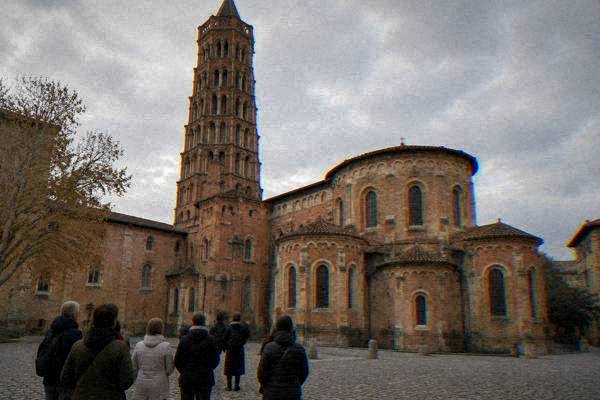
The Occitan language itself, the langue d'oc of the medieval south, gave the city several of its most famous associations. The pilgrim road that runs through Toulouse toward Santiago de Compostela is the Via Tolosana, the Tolosan way, named with the Occitan form, and the Basilique Saint-Sernin, a major stop on that road, is listed by UNESCO as part of the Routes of Santiago de Compostela in France, inscribed in 1998. The name of the city and the name of the road are the same word in the same old language.
Visitors sometimes notice the gap between the written name and the way locals say it, and the Occitan layer is the reason. The city's day-to-day language today is French, like everywhere else in the country, but the name remains a fossil of the south's own tongue. If the question is whether English speakers struggle with this, the honest answer is that the pronunciation of Toulouse trips up plenty of visitors, and whether English is widely spoken in Toulouse is a separate and more practical question.
| Name carried by the city | Where it comes from | Status today |
|---|---|---|
| Tolosa | The pre-Roman and Occitan name | Used in Occitan and in historical names like the Via Tolosana |
| Toulouse | The French form of the same name | The official and everyday name |
| La Ville Rose | A nickname from the city's pink brick | A widespread nickname, not a translation of the name |
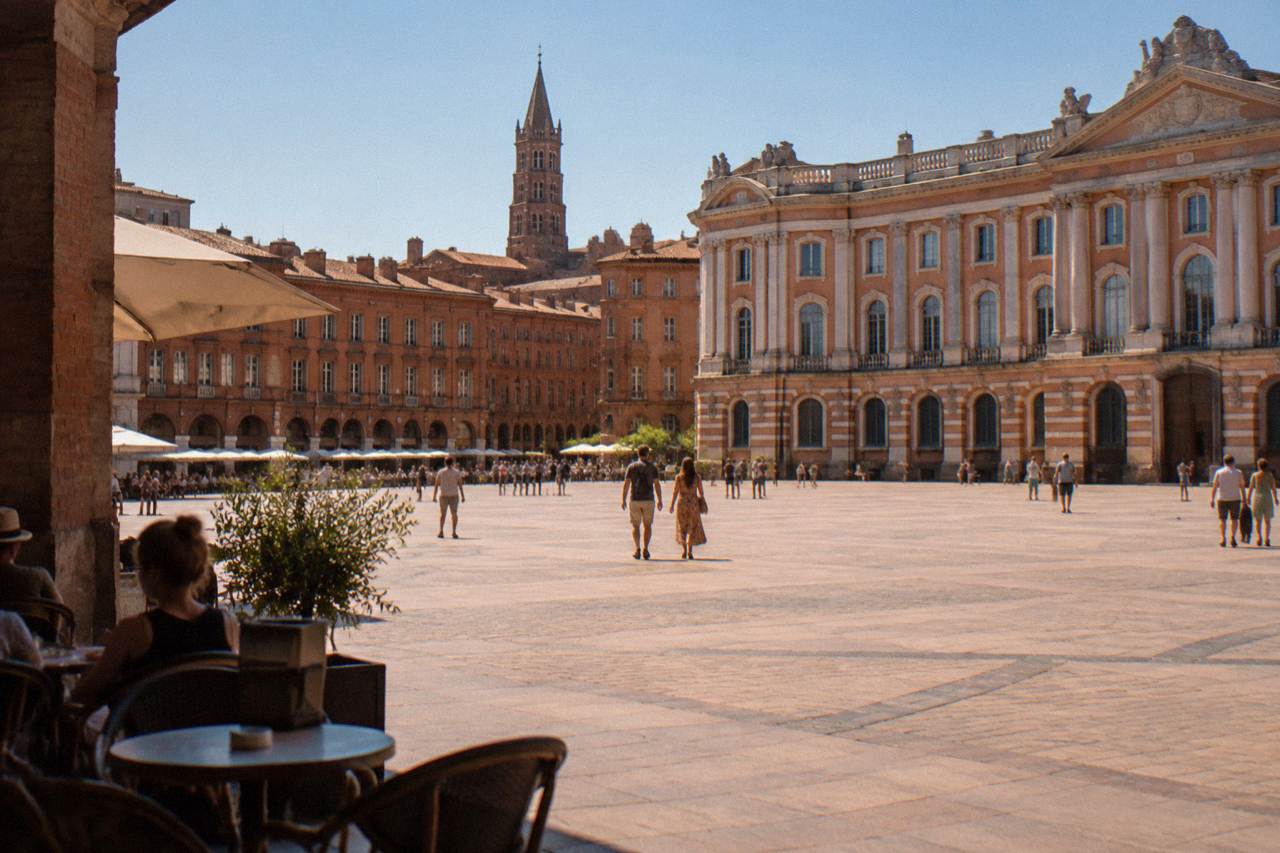
The nickname in that last row is the one piece of the city's naming that does have a visible meaning. La Ville Rose, the pink city, describes the terracotta brick that gives the historic center its color, and the name Toulouse itself has nothing to do with it. The brick nickname is a much later addition, and the two names answer different questions: one says where the city is, the other says what it looks like.
How The Name Of Toulouse Shaped What The City Is Called Today?
The name Tolosa left traces far beyond the city limits: the Via Tolosana pilgrimage route carries it toward Spain, and the modern French form Toulouse now labels the airport, the metro, the rugby club and the aerospace industry that made the name known worldwide. The commune of 514,819 inhabitants is the name's home, but the word has traveled with the city's fame.
The modern reach of the name is mostly the reach of the city's modern identity. Toulouse-Blagnac airport handled 7,621,409 commercial passengers in 2025, and every one of those travelers heard the city's old Aquitanian name announced over a terminal PA. The aerospace sector around the airport, with the Aeroscopia museum and the Airbus assembly plants, carried the name onto the side of aircraft and into the itineraries of aviation enthusiasts from every continent.
The name also anchors the city's cultural exports. The rugby club, the food, the canal and the pilgrim church all travel under the same word, and a visitor planning a trip quickly finds that the name points in several directions at once. Someone drawn by the cassoulet, someone following the pilgrim road and someone flying in for the aerospace museums all arrive in the same place, and how many days is enough for Toulouse depends on which of those versions of the name pulled them there.
For a literal overview of what the name covers, a private sightseeing flight above Toulouse and the Great Pyrenees shows the city and the mountains in a single trip, with the operator's live listing carrying the current price and availability: Check availability.
The name's geography is worth one more note, because the word Tolosa has a near twin in Spain. The Basque town of Tolosa, in the province of Gipuzkoa, carries a name from the same old language family, and some linguists treat the two names as cousins from the same Aquitanian-Basque root rather than as coincidence. Whether or not the two towns share a meaning, they share a linguistic neighborhood, and that pairing is one of the stronger arguments that Toulouse's name belongs to the pre-Indo-European layer of southwestern Europe rather than to Celtic Gaul.
Why Do So Many People Believe Toulouse Means Something In French?
People assume the name must mean something in French because most French place names do decode into older French or Latin words, and Toulouse sits in a country where etymology usually pays off. The name resists decoding because it is older than the languages being used to decode it, and folk explanations rush in to fill the gap, which is exactly what has happened here.
The folk explanations are worth naming, because a visitor will meet them. One story ties the name to a supposed word for a hill, another to water, a third to a personal name of some forgotten chief. None of these can be checked against a living speaker of the language that coined the word, so they circulate freely. The responsible position, and the one this site holds, is that the name's origin is pre-Roman, that its most serious candidates point to the Aquitanian language family, and that a confident translation of Tolosa into any modern language is not supported.
The pattern is common in Europe's oldest names. Rivers and cities that were already named when writing arrived tend to keep names whose meanings evaporated with the languages that made them. The Thames and the Danube resist clean translation in English and German for the same reason. Toulouse belongs to that class of names: it is a word that survived its own explanation.
| Question people ask about the name | Honest answer |
|---|---|
| Does Toulouse mean anything in French? | No, it functions only as the city's name |
| What did Tolosa mean originally? | Debated: a raised site and a water root are the main candidates |
| What language family does the name come from? | Pre-Roman, most likely the Aquitanian layer related to Basque |
| Is the Occitan form different? | Yes, Tolosa, and it survives in names like the Via Tolosana |
| Why is the city called La Ville Rose? | A nickname from its pink brick, unrelated to the name's origin |
The name also does one quiet job for the visitor: it signals that the city belongs to the south. Toulouse's identity, its brick, its food, its language history and its position on the Garonne and the Canal du Midi, all sit closer to the Mediterranean and Pyrenean world than to Paris, and the name is the first hint of that. The Canal du Midi itself, which reaches the city and was inscribed by UNESCO in 1996, is part of the same southern geography.
For travelers who want to see the region the name comes from, the country between the Garonne and the Pyrenees holds towns whose names share the same old layer, and a day trip toward Albi or the mountains shows how different the south's naming is from the north's. The private Albi and Cordes sur Ciel day tour from Toulouse covers two of the region's most distinctive towns, and the operator's live listing has the current details.
Common Questions About The Name Toulouse
Quick answers to what people ask most about the word Toulouse, its origin, its meaning and the languages behind it.
What does the French word Toulouse mean?
It has no meaning in French. The name descends from Tolosa, a pre-Roman name of debated origin, most likely from the Aquitanian language layer of southwestern France. French inherited the name as a proper noun only.
Is Toulouse an Occitan name?
The Occitan form of the city's name is Tolosa, and it survives in historical names such as the Via Tolosana, the pilgrim road toward Santiago de Compostela. The French form Toulouse is the same name adapted to French spelling and pronunciation.
Does Toulouse mean pink city?
No. La Ville Rose, the pink city, is a nickname drawn from the terracotta brick of the historic center. It has no connection to the etymology of the name Tolosa.
Is Toulouse related to the Spanish town of Tolosa?
Many linguists treat the two names as related, both belonging to the old Aquitanian-Basque naming layer of the region between the Garonne and the Pyrenees. A shared meaning, if there was one, has not been established.
Why can nobody translate the name?
The language that coined Tolosa disappeared before it could be documented in writing, so the name outlived its own meaning. Candidate readings exist, but none can be confirmed, which is why responsible sources hedge.
The name of the city, in the end, is the oldest thing a visitor touches in Toulouse. The brick is old, the bridges are old and the church towers are old, but the word on the street signs was already ancient when the Romans wrote it down, and it is still the same word, worn into French, doing the same job it has done since before anyone could explain it. For more on what the city built under that name, see why is Toulouse so famous or start with the basics on Toulouse Travel Guide.
Seeing the name from above is also the best way to see how far it stretches: the pink-brick center on the Garonne, the canal that carries the city's UNESCO listing, and on a clear day the line of the Pyrenees to the south, the same mountains that shaped the old Aquitanian world the name came from. The picks below round out the ways to spend that time well.