Is Toulouse A Walkable City?
Is Toulouse a walkable city? A direct answer based on the city's own transport and museum data, with fare tables, weather numbers and honest notes on where walking stops being enough.
Toulouse, the pink-brick "La Ville Rose" on the Garonne in the Occitanie region of southwestern France, is a city whose core was laid out long before the car, and it shows. The commune counted 514,819 inhabitants at the last INSEE figure, but the part a visitor actually walks, the streets between the Capitole, Saint-Sernin and the river, is a tight grid of narrow fronts and small squares. This page answers the question directly, using the city's own transport and museum data rather than impressions, and it flags the places where walking alone stops being the practical answer.
Is Toulouse A Walkable City?
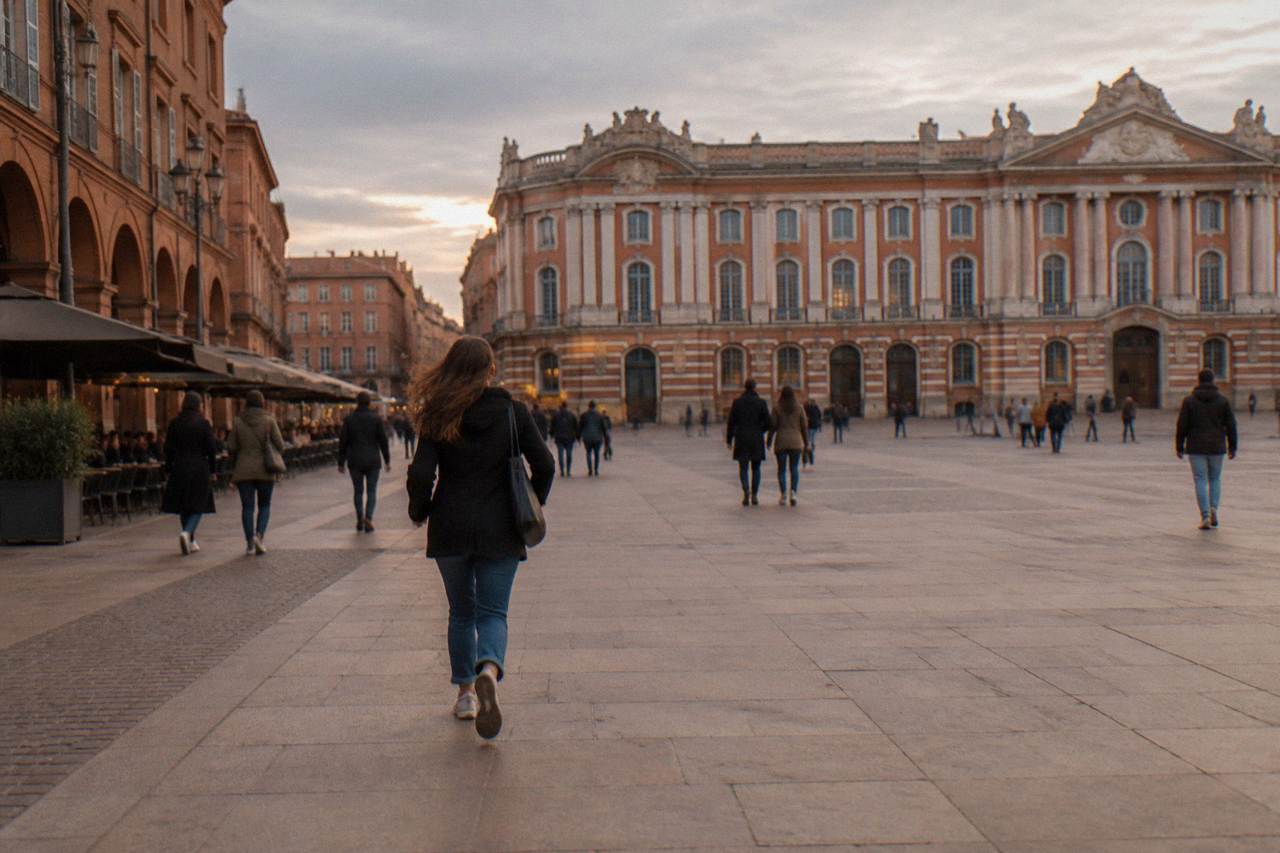
Yes. Toulouse is a walkable city for the classic visitor itinerary: the Capitole, the Basilique Saint-Sernin, the Couvent des Jacobins, the Garonne banks and the cathedral quarter sit close enough together that a fit adult covers them on foot in a single day. Walking stops being the practical answer only for the aerospace sites, which sit outside the center and need public transport or a tour transfer.
That is the honest shape of it. The historic core is where the pink brick, the squares and the markets concentrate, and it is precisely the part that rewards being walked. The tourist office's Pass Tourisme page is built around that assumption: its EUR 26 pass for stays of one to three days includes a free guided tour that starts from the tourist office itself, on foot, in the center.
What the center does not cover is the aerospace cluster. Aeroscopia, the Airbus factory tours and Cite de l'espace are separate destinations, each reachable by public transport or by a booked transfer, and pretending otherwise sets a visitor up for a bad afternoon. The rest of this page breaks down which parts reward walking, what the transport costs when your feet give out, and what the weather does to a walking plan.
Which Parts Of Toulouse Are Best Explored On Foot?
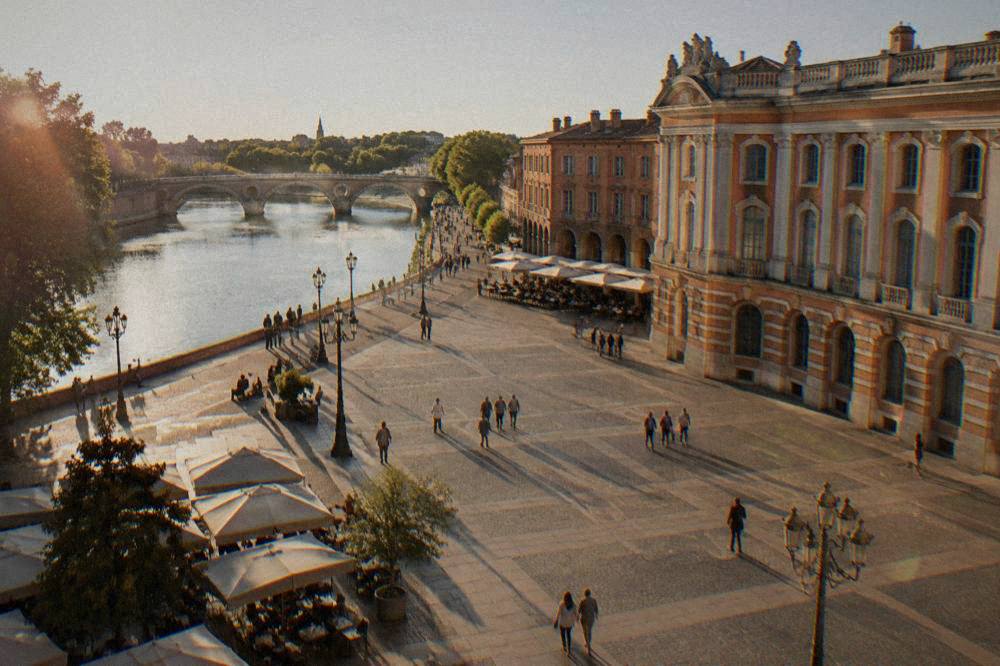
The streets between the Capitole and the Basilique Saint-Sernin form the walkable heart of Toulouse, and the riverside between the Pont Neuf and the Jacobins is the other obvious foot route. Saint-Etienne cathedral, the Carmes and Saint-Aubin quarters and the Victor Hugo market area all sit inside the same comfortable walking web. Only the aerospace attractions and the airport lie outside it.
To cover the walkable heart with commentary along the way, book a self-guided audio tour here.
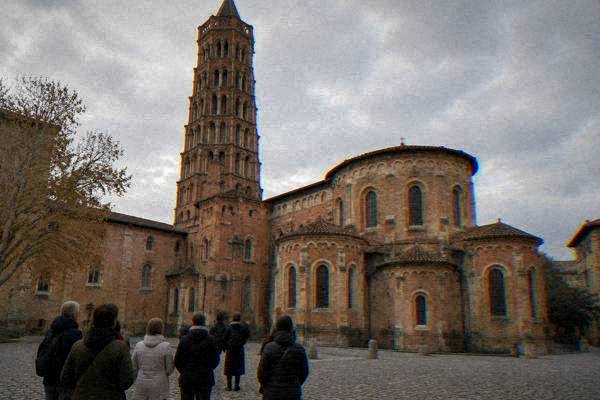
Start with the Capitole and work outward. The basilica of Saint-Sernin is a major stop on the Via Tolosana and has been listed since 1998 as part of the UNESCO "Routes of Santiago de Compostela in France" property, which makes it one of the few sights in the city with a global citation attached. The Couvent des Jacobins sits a few streets from the Garonne, and the city's own page notes its church roof is under restoration with the site still open to visitors, so the walk there stays worthwhile.
The river is the second spine of a walking day. The Garonne banks are the city's open-air counterpart to its museums, and the bridges connect the center to the Saint-Cyprian side, where the dome de la Grave and the Abattoirs museum sit. If you are planning the shape of a whole visit rather than a single day, how many days are enough for Toulouse is the companion question, and the answer there leans the same way: the center on foot, the aerospace sites by transport.
For visitors who want the center explained rather than merely crossed, a guided walk is the natural fit. The private must-see walking tour covers the central sights with a live guide, and you can Check availability alongside it. Free options exist too: Harry's Free Tour on GuruWalk is a tip-based walk, and naming the platform and the guide is the honest way to present it, since it is not our product.
How Walkable Is Toulouse Without A Car?
Toulouse works well without a car for a city-based trip: the metro, tram and bus network sells a day pass at EUR 7.20 and a three-day pass at EUR 14.30, and a single trip costs EUR 1.90. A car only earns its keep for rural day trips into the surrounding towns and wine areas, where coach tours and trains are the simpler alternatives.
The Tisseo e-boutique catalogue gives the full fare ladder, and it is short enough to plan around with confidence. There is no two-day pass, which surprises people who expect one: the jump is from the day pass straight to the three-day. A ten-trip carnet at EUR 16.00 suits a stay split between walking days and museum days better than a pass bought out of habit.
| Tisseo ticket | Price |
|---|---|
| Single trip | EUR 1.90 |
| Single trip bought last-minute on board | EUR 2.50 |
| 10 trips | EUR 16.00 |
| Day pass | EUR 7.20 |
| 3-day pass | EUR 14.30 |
| Airport single (network plus Navette aeroport) | EUR 9.50 |
Two caveats matter for anyone building a no-car plan. Tram T2 to the airport has been closed since 5 June 2023 and stays closed until the end of 2026 because of the Line C metro works, so the airport link is the Navette bus, one departure every 15 minutes, taking 20 to 40 minutes to the center. And the new metro Line C, 27 km with 21 stations from Colomiers to Labege, opens at the end of 2028, not before; anyone who read about it as a done thing should plan around what runs today.
For museum-heavy days, the Pass Tourisme overlaps with the transport question. The tourist office's page lists it at EUR 26 for stays of one to three days, free entry at the Fondation Bemberg, the Museum, Les Abattoirs, the Musee des Augustins and the Couvent des Jacobins, a discount rather than free entry at Cite de l'espace, and an optional EUR 10 add-on for ten transport trips. The office itself says it pays off from the third activity onward.
Does Toulouse Weather Cooperate With A Walking Plan?
Mostly yes. Meteo-France's 1991-2020 normals for Toulouse-Blagnac give the city 2,075.1 hours of sun a year and its sunniest month, July, 258.6 hours, but May is the wettest month at 73.6 mm, ahead of April and June. Winter walking is viable, with January means of 9.7C maximum and 2.9C minimum, so the rain calendar matters more than the cold.
The counterintuitive fact is where the rain falls. Most people assume a southern French city is wettest in winter, and the normals say otherwise: May leads at 73.6 mm, February is the driest month at 37.2 mm, and the tap turns off into summer, with July recording just 40.1 mm. Anyone planning a walking-heavy May visit should pack for showers, not heat, and anyone walking in July should plan for heat, not rain: July averages 11.5 days a year above 30C. More of these guides are collected on Toulouse Travel Guide.
| Month | Mean max C | Mean min C | Rain mm | Sun hours |
|---|---|---|---|---|
| Jan | 9.7 | 2.9 | 52.5 | 89.1 |
| Feb | 11.2 | 3.1 | 37.2 | 118.2 |
| Mar | 15.0 | 5.5 | 45.3 | 175.3 |
| Apr | 17.6 | 7.9 | 65.2 | 188.5 |
| May | 21.4 | 11.4 | 73.6 | 212.3 |
| Jun | 25.7 | 15.0 | 64.2 | 231.8 |
| Jul | 28.2 | 17.0 | 40.1 | 258.6 |
| Aug | 28.5 | 17.1 | 44.6 | 246.4 |
| Sep | 24.8 | 13.9 | 45.7 | 210.1 |
| Oct | 19.7 | 10.9 | 54.3 | 155.2 |
| Nov | 13.5 | 6.3 | 55.0 | 99.9 |
| Dec | 10.4 | 3.6 | 49.3 | 89.7 |
The records frame the extremes: 42.4C on 23 August 2023 and -19.2C on 15 February 1956, both from the same Meteo-France fiche. Neither is a walking day, but neither recurs in a normal year either. For a deeper look at the rain question, does it rain a lot in Toulouse covers the same normals in detail.
Where Should You Stay In Toulouse To Stay On Foot?
Stay inside the ring of boulevards around the Capitole, Saint-Etienne, the Carmes or Saint-Aubin, and the whole walkable core stays within reach without a single transit ticket. The tourist tax rule matters here too: non-classified lodging, which includes most platform rentals, pays 5% of the pre-tax nightly price per person in Toulouse Metropole, so a central rental is not always the cheap option it looks like.
Neighborhood choice is what converts a walkable city into a walkable trip. The quarters named above put the basilica, the Jacobins, the cathedral and the market within a short stroll of your door. If you are weighing character against convenience, what is the nicest part of Toulouse goes deeper, and the honest counterweight is where not to stay in Toulouse, which exists precisely because a couple of areas undercut the on-foot promise.
One museum note belongs in any central-walking plan. The Musee des Augustins is temporarily closed from 21 September to 2 October 2026 for great-cloister works, and its Gothic halls reopen on 3 October 2026 from 10:00, so a walk past it in that window meets a shuttered door. The Musee Saint-Raymond closed on 3 November 2025 for renovation and modernisation works and reopened on 3 April 2026, so it can be included in a museum circuit. The Couvent des Jacobins is free on the first Sunday of the month except when a temporary exhibition is on, a rule stated for the Jacobins, not a blanket municipal policy.
What About Day Trips If You Have No Car?
The walkable part of a Toulouse trip ends at the city edge, but the region's headline destinations, Carcassonne, Albi and Cordes-sur-Ciel, are covered by coach day trips that collect you in the center, so a no-car visitor does not lose them. The Canal du Midi, the region's UNESCO-listed waterway since 1996, is also reachable on foot or by short cruise from the city.
Carcassonne and Albi are the two names that pull visitors out of the city, and both sit outside walking range by any measure. A coach day trip solves the logistics entirely, and the full-day option that bundles Albi, Carcassonne and Cordes-sur-Ciel with lunch included is the one that covers the most ground without a rental car. For the canal itself, what is the best canal trip in France and why is the Canal du Midi famous cover the water side, and the canal towpaths add a flat, car-free walking lane to a Toulouse stay that the city streets alone do not offer.
The guided-walk option deserves its own mention here, because it is the one product category that matches the page's question exactly. A private guided walk through the central must-sees anchors a first day on foot and doubles as an orientation for every self-guided stroll after it, which is why it is the featured tour on this page.
Between the free GuruWalk options, the private guided walks and the coach day trips, a no-car visitor covers the city and its region without ever holding a set of keys. The trio below pulls together the walking tour, the Halle de la Machine entry and the full-day Albi, Carcassonne and Cordes trip, three products that between them cover the on-foot center and the beyond-the-center excursions.
Common Questions About Walking In Toulouse
Is Toulouse A Walkable City?
Yes. The Capitole, Saint-Sernin, the Jacobins, the cathedral and the Garonne banks all sit within a walkable core, and the tourist office's own Pass Tourisme assumes as much by including a free guided walking tour from its central office. Only the aerospace sites and the airport need transport.
Can You Visit Toulouse Entirely On Foot?
You can visit the whole historic center on foot, but not the whole city. Aeroscopia and Cite de l'espace lie outside the center, and the airport is served by the Navette bus, one departure every 15 minutes, since tram T2 to the airport has been closed since 5 June 2023 until the end of 2026.
What Is The Best Month For Walking In Toulouse?
July is the sunniest month at 258.6 hours of sunshine with only 40.1 mm of rain, per Meteo-France's 1991-2020 normals, but it also averages 11.5 days a year above 30C. May is the wettest month at 73.6 mm, so June and September, at 64.2 mm and 45.7 mm with 231.8 and 210.1 hours of sun, are the balanced picks.
Do You Need A Car In Toulouse?
No, not for a city-based trip. A Tisseo day pass costs EUR 7.20 and a three-day pass EUR 14.30, with no two-day pass available, and a single trip is EUR 1.90. A car earns its keep only for rural day trips, and coach tours cover Carcassonne, Albi and Cordes-sur-Ciel without one.
Is The Center Of Toulouse Flat Enough For Easy Walking?
The historic core is a compact grid of streets and small squares between the Capitole, Saint-Sernin and the river, laid out long before the car, and the Garonne riverside adds a level walking spine. No gradient data is available, so anyone with mobility concerns should check their specific route rather than rely on a general flatness claim.
Are Toulouse Museums Within Walking Distance Of Each Other?
The central ones are: the Musee des Augustins, the Couvent des Jacobins, the Fondation Bemberg and Les Abattoirs all sit inside or on the edge of the walkable core. The Augustins is closed 21 September to 2 October 2026 and its Gothic halls reopen 3 October 2026, and the Musee Saint-Raymond reopened on 3 April 2026 after its November 2025 closure.
The short version: Toulouse is a walkable city in the way that matters, its center belongs to pedestrians in practice, and the transport fares, museum closures and rain calendar above are the verified details that turn that claim into a plan.