What Cities Fly Direct To Toulouse?
What cities fly direct to Toulouse? A plain answer for Toulouse-Blagnac airport in southwestern France, plus how to check live routes, reach the city center, and plan the rest of your trip.
Toulouse sits on the Garonne in the Occitanie region of southwestern France, and its airport, Toulouse-Blagnac, is the city's main aerial gateway. In 2025 the airport handled 7,621,409 commercial passengers, a figure the airport's own press release puts 2.8% below 2024. Which specific cities you can reach without a stopover changes with every airline schedule update, so the honest answer to the question below is less a fixed list and more a reliable way to find the current one. This page gives that method, the airport's verified numbers, and the practical steps from the terminal to the center.
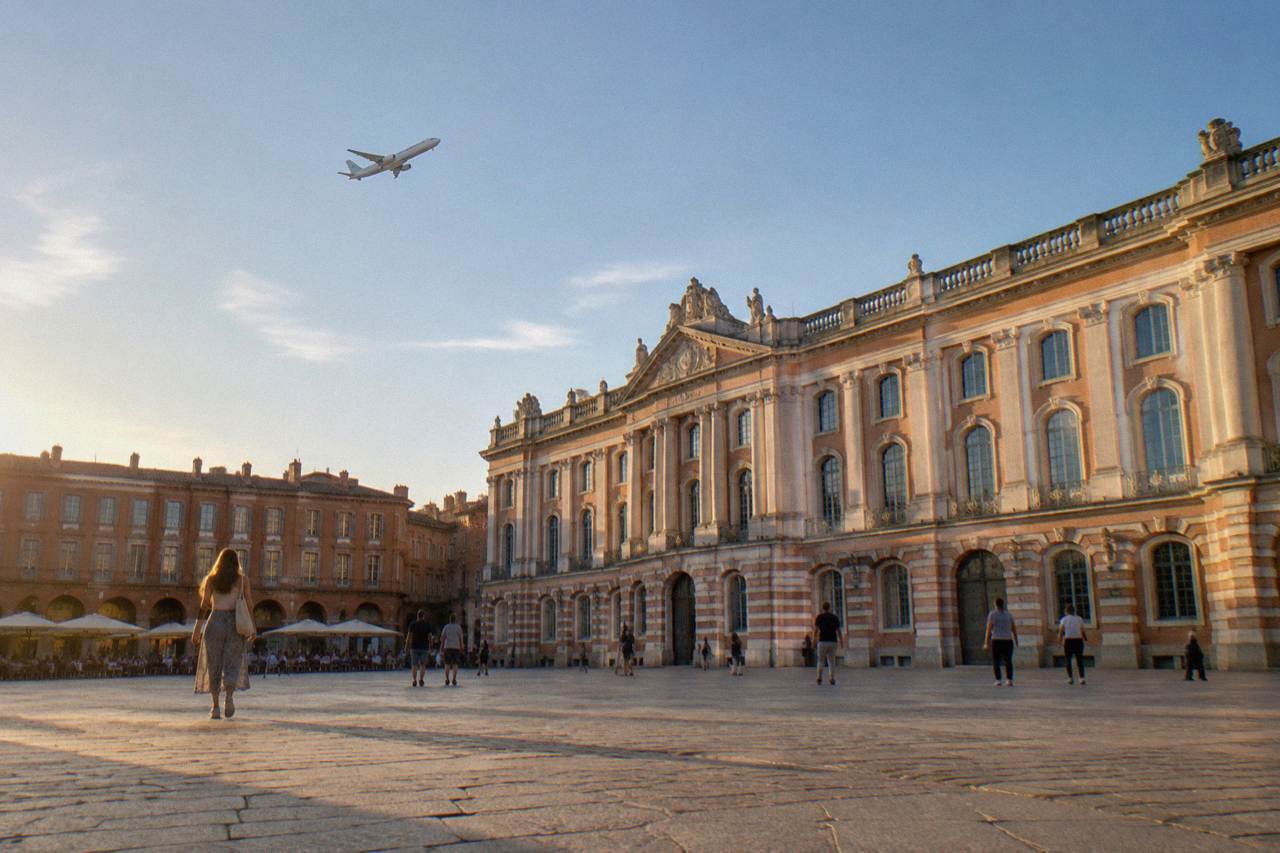
What Cities Fly Direct To Toulouse?
Toulouse-Blagnac airport serves direct flights to cities across France, the wider European continent and some long-haul destinations, but the exact city list changes with each airline's seasonal schedule, so no fixed list printed on a travel page stays true for long. The dependable way to know is to check the airport's own destinations page or a route-search tool for your travel dates. Schedules shift most at the summer and winter season changes.
The airport publishes its live route map on its own website, and that page reflects what airlines are actually operating this season, not what they operated last year. That distinction matters more than it sounds. A city that had a direct flight in summer may lose it in the winter schedule, and new seasonal routes often appear without much announcement outside the aviation press.
For planning purposes, think in three layers. Domestic routes connect Toulouse to other French cities and are the backbone of the schedule. European routes cover the continent, including the UK, Iberia, Italy, Germany, the Low Countries, and Central and Northern Europe. Beyond that sits a smaller set of long-haul and North African links. Which cities sit in each layer on your dates is exactly what the airport's destinations page answers.
If you are weighing Toulouse against another destination, our guide to why Toulouse is so famous explains what the city itself offers once you step off the plane, and how many days are enough for Toulouse helps you size the stay before you book the flight.
How Do You Check The Current Direct Routes Yourself?
Open the Toulouse-Blagnac airport website's destinations section, or use any flight-route search tool that filters on "direct only", and enter Toulouse as your arrival city with your intended dates. Both sources show only what is bookable on those dates, which is the only list that means anything. Checking two sources against each other catches seasonal gaps.
This two-source habit is worth the extra minute. An airport page can lag by a few days when an airline files a schedule change, and a booking tool can show codeshares that look direct but involve a change of aircraft. If a route appears in both places for your dates, you can plan around it with confidence.
Timing matters too. Airlines file their schedules by season, with the big reshuffles at the start of the summer and winter seasons. A route search done in March for a July trip may miss routes that get announced in April. If your dates are flexible, search a week either side: on thin routes, direct flights sometimes run only a few days a week rather than daily.
One more planning note that belongs here rather than further down: the city you start from shapes the whole trip. Readers arriving from the UK have their own set of considerations, covered in our page on how to get to Toulouse from the UK, and budget-airline questions are handled in which airport in Toulouse Ryanair flies to.
How Big Is Toulouse-Blagnac Airport?
Toulouse-Blagnac handled 7,621,409 commercial passengers in 2025, a 2.8% drop from 2024, according to the airport's own press release. That traffic level makes it a mid-sized European city airport: big enough for a full domestic and short-haul network, small enough that connections inside the terminal stay short. It is a single-terminal operation with no satellite shuttling.
The 2025 figure is the airport's published number, released in March 2026, and it describes a year in which traffic varied by destination rather than moving uniformly. The airport described the 2025 evolution as contrasted depending on the destination, which is the normal pattern at a city airport: business-heavy domestic routes and leisure routes do not move together.
For a traveler, the practical meaning of the airport's size is simple. Walking from security to a gate is a matter of minutes, not a trek. Baggage claim is compact. And the transfer into the city, covered in the next section, is short enough that a landing at Toulouse-Blagnac does not eat half a day of your itinerary.
Once you land, the ride into the city is short, book an airport transfer here.
The airport also sits inside the European Union and Schengen area, so for flights from within Schengen there is no passport control on arrival, and the currency at every till in the city is the euro. Readers who want the full picture of the city's aviation industry, which is a large part of why Toulouse has the air connections it does, can read why Airbus is based in Toulouse.

How Do You Get From The Airport To The City Center?
The Navette aeroport bus is the main public-transport link: it runs one departure every 15 minutes and takes 20 to 40 minutes to the center, and the Navette to the Matabiau bus station takes about 25 minutes. Buses 30 and 31 take about 45 minutes to the Capitole with changes. Do not plan around the tram: tram T2 to the airport has been closed since 5 June 2023 and stays closed until the end of 2026.
That tram closure catches out travelers who read older guides, so it deserves its own emphasis. The airport's own access page states the closure plainly, along with the reinforced Navette frequency that replaced it. A single airport ticket covering the Tisseo network plus the Navette costs EUR 9.50 in the official Tisseo catalogue, and the airport's own page still quotes an older figure of EUR 9 for the Navette, so treat the Tisseo catalogue as the current price. Other pages covering the same trip are gathered on Toulouse Travel Guide.
| Option | What the official pages say | Notes |
|---|---|---|
| Navette aeroport to the center | One departure every 15 minutes; 20 to 40 minutes | Reinforced service while tram T2 is closed |
| Navette to Matabiau bus station | About 25 minutes | Connects to the main train station area |
| Buses 30 and 31 | About 45 minutes to the Capitole, with changes | Slower, but on the standard network |
| Tram T2 to the airport | Closed since 5 June 2023, until the end of 2026 | Do not plan around it |
| Airport single ticket | EUR 9.50 (Tisseo catalogue) | Airport's own page still says EUR 9 |
The wider Tisseo network is cheap once you are in the city: the official e-boutique lists a single trip at EUR 1.90, a day pass at EUR 7.20 and a 3-day pass at EUR 14.30, with no 2-day pass on the catalogue. There is no need to buy any of that at the airport unless you are heading straight into town on local buses.
Once you have landed and dropped your bags, the city rewards walking. The Capitole, the Basilique Saint-Sernin and the Garonne riverside sit close together, and our answer on whether Toulouse is a walkable city covers how much you can see on foot.
When Is The Best Time To Book A Direct Flight?
Book a summer-season direct flight two to four months out, and a winter or shoulder-season flight four to eight weeks out, because Toulouse's demand peaks follow the city's festival calendar and the school holidays rather than a beach season. The city is inland, on the Garonne, so there is no coastal summer rush to compete with. Meteo-France's normals show July is the sunniest month at 258.6 hours.
Those booking windows are planning ranges, not promises: fares move with demand, and the only reliable way to know a price is to look at the live listing for your dates. What the climate data does tell you is when the city itself is at its best. Meteo-France's 1991-2020 normals for Toulouse-Blagnac put the annual mean maximum at 18.8C with 2,075.1 hours of sun, and a surprise for many first-time planners: May, not a winter month, is the wettest, at 73.6 mm of rain.
| Month | Mean temperature | Rainfall | What it means for a visit |
|---|---|---|---|
| May | 16.4C | 73.6 mm | Wettest month of the year, pack for showers |
| July | 22.6C | 40.1 mm | Sunniest month, 258.6 hours of sun |
| August | 22.8C | 44.6 mm | Warmest month on the annual table |
| October | 15.3C | 54.3 mm | Mild, with the organ festival in 2026 |
If you are timing a trip around events rather than weather, the city's calendar has verified anchors: Toulouse les Orgues runs 7 to 18 October 2026, the Christmas markets run 26 November to 27 December 2026, and Rio Loco runs 9 to 13 June 2027. A flight booked around one of those fills the evenings as well as the days.
What Can You Do Once You Are In Toulouse?
Toulouse rewards a landing with pink-brick architecture, the Basilique Saint-Sernin, the Capitole, Garonne riverside walks and the aerospace attractions around the city, including Aeroscopia and the Cite de l'espace. Day trips by coach reach Carcassonne and Albi. The city's nickname, La Ville Rose, comes from its brick, and the UNESCO-listed Canal du Midi runs through it.
The Canal du Midi was inscribed by UNESCO in 1996, and Saint-Sernin is listed as part of the Routes of Santiago de Compostela in France, inscribed in 1998. Those two listings anchor the heritage side of a visit, while the aerospace side is genuinely unlike anywhere else: this is the city where Airbus builds its aircraft, and the museums and tours around that industry are a major draw.
For the airborne theme, the natural companion to a flight into Toulouse is a flight above it. The private sightseeing flight above Toulouse and the Great Pyrenees puts you back in the air with the city below, and the operator's live listing carries the current price and availability: Check availability.
Beyond the city, the region is rich in day-trip destinations, and our page on beautiful towns to visit near Toulouse lists the standouts, with Carcassonne the classic first choice, covered in whether Carcassonne is worth visiting.
Common Questions About Flying Direct To Toulouse
Quick answers to what planners ask most about direct flights into Toulouse-Blagnac.
What Cities Fly Direct To Toulouse?
The direct-route list changes with every airline season, so check the airport's own destinations page or a direct-only route search for your dates. The network covers French cities, European destinations and a smaller set of long-haul links.
Does Toulouse Have One Airport?
Yes for commercial flights: Toulouse-Blagnac is the city's airport, and it handled 7,621,409 commercial passengers in 2025. Our page on whether Toulouse has two airports covers the small-airfield question in detail.
Can You Take The Tram From Toulouse Airport?
No. Tram T2 to the airport has been closed since 5 June 2023 and stays closed until the end of 2026 because of the Line C metro works. The Navette aeroport bus runs every 15 minutes and takes 20 to 40 minutes to the center.
How Early Should You Get To Toulouse Airport For An International Flight?
Follow your airline's check-in guidance for your specific route, and read our dedicated page on how early to get to Toulouse airport for an international flight for the full breakdown.
Which Airlines Fly Out Of Toulouse?
The airline mix changes by season, so our dedicated answer on which airlines fly out of Toulouse is the right place to look, alongside the airport's own carrier list.
Is Toulouse Airport Close To The City Center?
Yes. The Navette to the center takes 20 to 40 minutes, and the Navette to the Matabiau bus station takes about 25 minutes, so the transfer is short by big-city standards.