Is Toulouse A Big Airport?
How big is Toulouse-Blagnac airport? Passenger numbers, transport links into the pink city, and what the airport's size means for your trip to Toulouse in southwestern France.
Toulouse, the pink-brick city on the Garonne in southwestern France, is served by a single commercial airport: Toulouse-Blagnac. It is the city's only gateway for air travelers, and in 2025 it processed 7,621,409 commercial passengers, a figure the airport's own press release published in March 2026. That number answers the size question directly, but the practical meaning of "big" for a visitor is really about connections, transfer times and how smoothly the airport feeds into the city it serves.
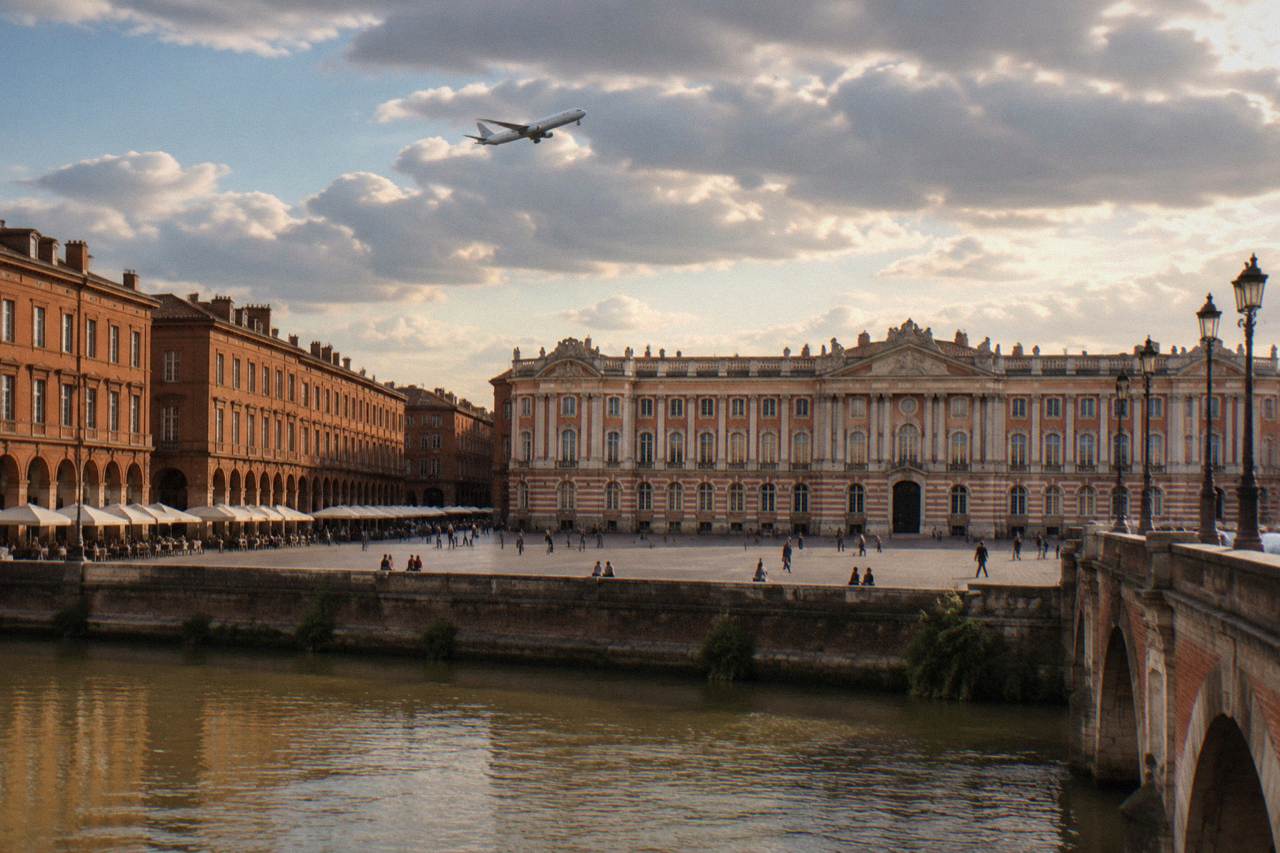
Is Toulouse A Big Airport?
Yes, Toulouse-Blagnac is a big airport by regional French standards, though not a mega-hub: the airport's press release records 7,621,409 commercial passengers in 2025, down 2.8% on 2024, a throughput that puts it among France's significant provincial airports. It is large enough to sustain a full schedule of domestic and short-haul international routes while staying compact enough that a landing rarely turns into the long-haul ordeal of a major capital hub. For a city of 514,819 inhabitants, it is a substantial piece of infrastructure.
The airport sits at Blagnac, on the northwestern edge of the city. For a destination of 514,819 inhabitants in the commune itself, an airport of this size is a substantial piece of infrastructure, and it reflects Toulouse's role as the capital of the Occitanie region and as the home of the French aerospace industry. Airbus assembles aircraft in the Toulouse area, and a large share of the airport's traffic exists because of that industry, its business travelers and its freight.
What the size does not mean is congestion on the scale of Paris. The terminal complex is a manageable set of halls rather than an endless sprawl, and the airport's layout keeps the distance between check-in, security and the gates short. Travelers connecting through Toulouse, or arriving for a weekend in La Ville Rose, generally move through the building faster than the raw passenger number might suggest.
How Many Passengers Does Toulouse-Blagnac Handle Each Year?
Toulouse-Blagnac handled 7,621,409 commercial passengers in 2025, a drop of 2.8% compared with 2024, according to the airport's published traffic figures. The airport describes 2025 as a year of contrasted evolution across its destinations, meaning some routes grew while others contracted, and the headline total landed slightly below the previous year's mark. A single year is a snapshot, so the honest way to read the figure is as part of a longer growth pattern around the aerospace economy.
The airport has grown around the aerospace economy of the city and the tourism pull of Occitanie, and a year of mild contraction does not change the underlying picture: this is a busy, working airport with a broad route network, not a small regional airfield with a handful of weekly flights.
For a visitor, the practical consequences of that scale show up in three places. First, the range of destinations is wide enough that many travelers can fly in without connecting through Paris. Second, ground transport is built to absorb a steady flow of arrivals, with a dedicated airport shuttle rather than an improvised bus stop. Third, facilities inside the terminal, from car hire desks to food outlets, match what a seven-figure annual passenger count supports.
| Measure | Figure | Source basis |
|---|---|---|
| Commercial passengers, 2025 | 7,621,409 | Airport press release, published March 2026 |
| Change on 2024 | Down 2.8% | Airport press release |
| Airport shuttle frequency | One departure every 15 minutes | Airport transport page |
| Shuttle time to the center | 20 to 40 minutes | Airport transport page |
| Shuttle time to Matabiau bus station | About 25 minutes | Airport transport page |
| Buses 30 and 31 to Capitole | About 45 minutes, with changes | Airport transport page |
The table's message is consistent: an airport of this size invests in dedicated ground links. The Navette aeroport, the shuttle that replaced tram service during the metro works, runs to a fixed 15-minute rhythm, which is the kind of frequency you expect at an airport handling millions of passengers a year rather than a few hundred thousand.
How Do You Get From Toulouse Airport To The City Center?
The fastest public link is the Navette aeroport shuttle, which leaves every 15 minutes and takes 20 to 40 minutes to the center, or about 25 minutes to the Matabiau bus station; a single airport ticket costs EUR 9.50 in the Tisseo catalogue. Buses 30 and 31 also serve the city, taking about 45 minutes to Capitole with changes, at the standard network fare.
One warning matters more than any other detail on this route: do not plan around the tram. Tram T2 to the airport has been closed since 5 June 2023 and stays closed until the end of 2026 because of the metro Line C works. Any itinerary, app suggestion or blog post that tells you to take the tram to the airport is out of date. The shuttle is the replacement, and the airport states plainly that it has been reinforced to one departure every 15 minutes.
The fare structure comes from the Tisseo e-boutique catalogue, the transport network's own price list. The airport single, which covers the Tisseo network plus the Navette, is EUR 9.50. The airport's own access page still quotes EUR 9 for the Navette, but the Tisseo catalogue is the seller's current price, so treat EUR 9.50 as the number to budget. Regular city tickets are far cheaper: a single trip is EUR 1.90, or EUR 2.50 bought last-minute on board.
| Ticket | Price | Notes |
|---|---|---|
| Airport single (Tisseo network + Navette) | EUR 9.50 | Tisseo e-boutique catalogue |
| Single trip, city network | EUR 1.90 | Tisseo e-boutique catalogue |
| Single trip bought on board | EUR 2.50 | Tisseo e-boutique catalogue |
| 10 trips | EUR 16.00 | Tisseo e-boutique catalogue |
| Day pass | EUR 7.20 | Tisseo e-boutique catalogue |
| 3-day pass | EUR 14.30 | Tisseo e-boutique catalogue |
For everything else about the transfer, including taxi costs and the step-by-step options, the site's dedicated guide to getting from the airport to the city center walks through each route, and the answer on how much a taxi costs from the airport covers the private-transfer side. If you are flying out rather than in, the answer on how early to arrive for an international flight applies the same logic to departures.
Once you are on the ground, the airport's size works in your favor in one more way. Because the shuttle runs on a fixed 15-minute rhythm, you do not need to build a long buffer into your landing plan. Collect your bags, walk to the shuttle stop, and the wait is measured in minutes, not hours.
Does The Airport's Size Change How You Should Plan Your Arrival?
Yes, but modestly: because Toulouse-Blagnac is a mid-size airport with a 15-minute shuttle rhythm rather than a mega-hub, arrival formalities are usually quick, and the main planning variable is the shuttle's 20 to 40 minute run into the center, not long queues or inter-terminal transfers. Sizing your transfer window around that journey time is enough.
The airport's scale also shapes what happens around your flight. A seven-figure annual passenger count supports car hire desks, a range of food outlets and staffed services through the day, which is why the site's car hire guide for Toulouse treats picking up a vehicle at the airport as a routine option rather than an adventure. At a genuinely small airfield, those services thin out or close early.
There is a second, less obvious effect worth knowing. Because the airport is the region's main gateway, a large share of your fellow arrivals are heading for the same handful of city-center drop-off points, and the shuttle's schedule absorbs that flow in waves tied to the flight schedule. Landing at a busy hour means a fuller shuttle, not a slower one, since departures keep to the 15-minute rhythm regardless.
If your trip extends beyond the city, the airport's position as the region's gateway makes multi-stop itineraries efficient. The full-day trip to Albi, Carcassonne and Cordes-sur-Ciel, with lunch included, is run from Toulouse, so a morning landing can still feed into a full day of sightseeing the next day without repositioning. You can Check availability on the operator's live listing.
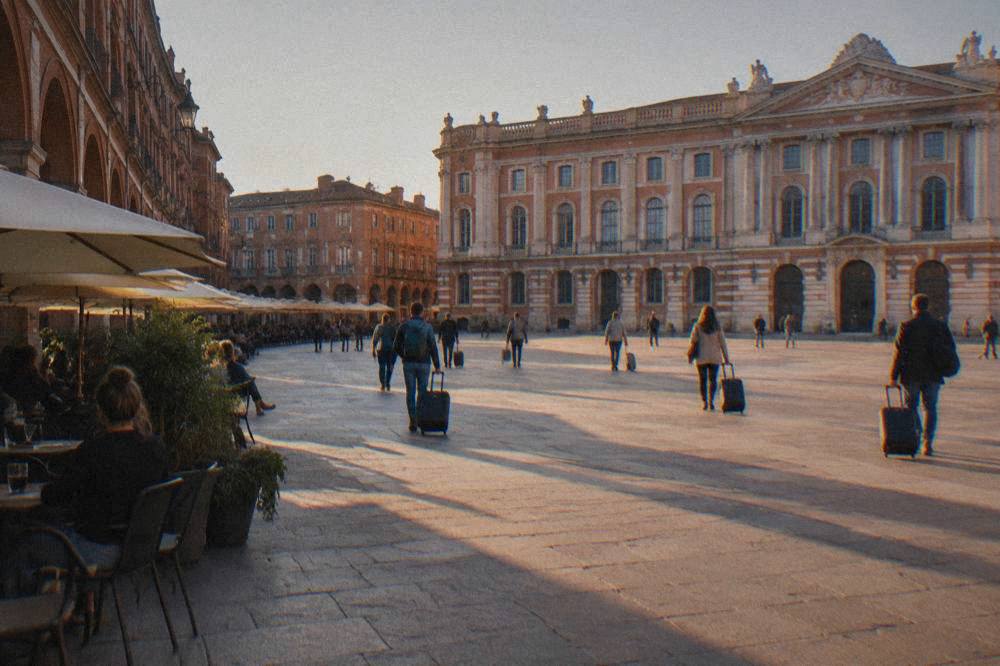
Is Toulouse Airport Getting Bigger?
Yes, in two senses: the tram link to the airport is due to reopen when the current works end in late 2026, and the city's new metro Line C, a 27 km line with 21 stations running from Colomiers to Labege, is scheduled to open at the end of 2028, reshaping the transport map around the airport corridor. Neither change alters the terminal's size, but both change how the airport connects.
The tram story is the one that matters most to visitors in the near term. T2 has been closed since 5 June 2023, and the closure runs until the end of 2026 because of the Line C works. The airport's transport page frames the reinforced Navette as the standing replacement, one departure every 15 minutes, and that is the arrangement to plan around for any trip booked before the reopening.
Line C itself is a bigger statement about the city than about the airport. The metropole's project page gives the line's parameters as 27 km and 21 stations, linking Colomiers, Blagnac, Toulouse and Labege, with service at the end of 2028. Blagnac is on that list, which is why the airport corridor is at the center of the works. A Line B extension toward Labege is planned, but no verified date for it should be printed.
For trip planning, the honest summary is that the airport's ground links are in a transition period, and the shuttle is the reliable constant through it. Anyone booking travel for late 2026 or beyond can reasonably expect the picture to improve, but a plan built on the shuttle today will not be wrong.
And once the transfer is behind you, the city rewards the effort. The Toulouse Travel Guide homepage lays out the full range of things to do, from the Capitole to the Canal du Midi, and the answer on why Toulouse is so famous explains what all those new arrivals are coming for.
Common Questions About Toulouse Airport
Quick answers to what travelers ask most about the airport that serves Toulouse.
Is Toulouse a big airport?
By regional French standards, yes. Toulouse-Blagnac handled 7,621,409 commercial passengers in 2025, and its facilities, route network and 15-minute shuttle rhythm match a mid-size, full-service airport rather than a small regional airfield.
Does Toulouse airport have a train station?
No rail line serves the terminal. The public transport link is the Navette aeroport shuttle, which runs every 15 minutes and reaches the Matabiau bus station in about 25 minutes, where the mainline train station sits. The site's answer on whether the airport has a train station covers the details.
Can you take the tram to Toulouse airport?
Not at present. Tram T2 to the airport has been closed since 5 June 2023 and remains closed until the end of 2026 because of the metro Line C works. The Navette shuttle replaces it, with one departure every 15 minutes.
How long does the transfer from the airport take?
The Navette takes 20 to 40 minutes to the center, depending on traffic, and about 25 minutes to the Matabiau bus station. Buses 30 and 31 take about 45 minutes to Capitole with changes.
Which airport does Toulouse have?
One. Toulouse-Blagnac is the city's single commercial airport, located at Blagnac on the northwestern side of the city. The site's Toulouse airport guide gives the full practical picture.
Is the airport far from the city center?
No. The shuttle covers the distance in 20 to 40 minutes, which keeps the airport well inside a normal transfer window for a city of 514,819 inhabitants in the commune itself.